What's inside
As an Amazon Associate I earn from qualifying purchases. This post may contain affiliate links at no extra cost to you.
Our Top Picks

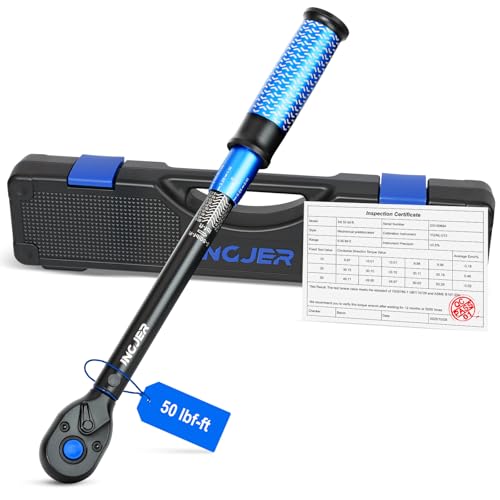


Best Torque Wrenches for Cars: Picks for Common Automotive Jobs
The best torque wrench for cars is usually a 1/2-inch click wrench for wheel lugs, paired with a 3/8-inch wrench for engine and suspension fasteners; choose a digital model if you need an easy-to-read measurement or a beam wrench if low cost and simple construction matter most.
One wrench rarely covers every job well. Lug nuts often need roughly 80–150 lb-ft, while engine and interior fasteners can call for a small fraction of that. A wrench used near the bottom of its range may be harder to set and less useful for accurate repeat work. Match the tool to the fasteners you actually service, then check the vehicle’s manual for the required torque and tightening sequence.
As an Amazon Associate we earn from qualifying purchases at no extra cost to you.


Quick picks by job
- Wheel lugs and general garage work: A 1/2-inch click wrench with a range around 20–150 lb-ft. The Tekton 1/2-Inch Drive Click Torque Wrench is a practical example of this format.
- Engine and smaller suspension fasteners: A 3/8-inch click wrench covering about 10–80 lb-ft. The Tekton 3/8-Inch Drive Click Torque Wrench is one example.
- Frequent work or easier readings: A digital 3/8- or 1/2-inch wrench, such as a model in the GearWrench 120XP electronic torque-wrench line. Check the specific model’s range and units before buying.
- Low-cost, low-fuss use: A beam-style wrench in the drive size and range that fit the job. It does not click or need spring-tension storage, but you must read the scale while applying force.
These are tool-format recommendations, not substitutes for vehicle specifications. Product ranges and features vary by model and generation, so confirm the exact wrench’s published specifications before purchase.
Compare the sizes and readouts
| Wrench type | Useful automotive range | Typical drive | Best fit | Main trade-off |
|---|---|---|---|---|
| Click, small-range | About 10–80 lb-ft (14–108 N·m) | 3/8 inch | Engine, brake, and many suspension fasteners | Not suited to most wheel-lug torque values |
| Click, general-purpose | About 20–150 lb-ft (27–203 N·m) | 1/2 inch | Wheel lugs and larger chassis fasteners | May be too coarse or oversized for small fasteners |
| Digital | Commonly about 10–150 lb-ft (model-dependent) | 3/8 or 1/2 inch | Frequent use, unit conversion, and visible readouts | Costs more; batteries and electronics add upkeep |
| Beam | Ranges vary; select to match the job | 3/8 or 1/2 inch | Occasional work and simple storage | Scale takes attention to read, especially in tight spaces |
The ranges above describe useful buying categories, not universal specifications. Accuracy is also model-specific: compare the manufacturer’s stated tolerance and the portion of the range where it applies. A wrench rated to ±4% does not make every fastener accurate to ±4% if the wrench is used outside its specified range, damaged, or operated incorrectly.
Choose by your garage and workload
| Situation | Good starting choice | Why |
|---|---|---|
| One car, occasional tire changes, modest budget | 1/2-inch click wrench, roughly 20–150 lb-ft | Covers many common lug specifications without paying for electronics. |
| DIY engine work or smaller fasteners | 3/8-inch click wrench, roughly 10–80 lb-ft | Offers a more appropriate range and a handier size for many engine-bay jobs. |
| Several vehicles, regular maintenance, difficult-to-read locations | Digital wrench in the needed drive size | The display and audible or visual alerts can make target readings easier to follow. |
| Tight storage budget or occasional use | Beam wrench with a readable scale | Simple construction avoids batteries and click-mechanism storage concerns. |
| Work spans small engine fasteners and wheel lugs | Two wrenches: 3/8-inch low-range and 1/2-inch higher-range | Better range matching is more useful than forcing one oversized wrench to do everything. |
What matters for each automotive job
Wheel lug nuts
For most passenger-car lug nuts, start with a 1/2-inch drive wrench whose range comfortably includes the vehicle’s specified value. Use a socket that fits the lug nut fully. Tighten in the pattern and sequence specified by the vehicle maker, usually in stages on a wheel with multiple lugs. Do not use the torque wrench as a breaker bar or impact it with a powered tool.
Thread condition matters. Dry, clean threads and lubricated threads can produce different clamping force at the same torque. Do not add oil or anti-seize unless the vehicle or wheel manufacturer specifically calls for it. If the wheel or studs have just been serviced, follow the maker’s guidance on rechecking torque.
Engine and brake work
Many engine fasteners need a lower torque than wheel lugs, making a 3/8-inch wrench the more suitable everyday choice. Some small fasteners require inch-pounds rather than foot-pounds; check the specified units before setting the wrench. For fasteners tightened by angle after an initial torque, a torque wrench alone does not complete the procedure—use the specified angle method and sequence.
Suspension fasteners
Suspension work may involve both moderate and high torque values, plus procedures that depend on vehicle loading or bushing position. Use the service instructions for the exact vehicle, not a generic chart. A larger drive and range may be necessary for some joints, while a compact 3/8-inch tool is more manageable for smaller hardware.
Accuracy, range, and drive size: the practical checks
- Buy for the target value, not the maximum printed on the box. If a fastener calls for 30 lb-ft, a wrench that starts at 50 lb-ft cannot do the job. A target near the bottom of a wrench’s scale is also a reason to consider a smaller-range tool.
- Read the tolerance carefully. Compare stated accuracy, calibration information, and whether the claim applies in clockwise operation only or in both directions.
- Do not confuse drive size with torque accuracy. A 1/2-inch square drive is stronger and common for lug work, but size alone does not establish precision.
- Consider reach and access. A longer handle gives leverage but can be awkward in a crowded engine bay. A universal joint or extension can affect technique and may limit access; follow the wrench maker’s instructions.
- Check the readout in your working position. A digital display is convenient only if it remains visible, and a beam scale needs enough space and light to read while pulling steadily.
Use and store a click wrench correctly
- Confirm the specification and units. Look up the value, sequence, and any angle-tightening steps for the exact vehicle and fastener.
- Inspect the tool and socket. Check for damage, a slipping ratchet, or a cracked socket. Set the wrench within its marked range.
- Pull steadily at the handle. Keep the socket square on the fastener and apply force smoothly. Stop at the click; repeated clicks or extra tightening can overshoot the target.
- Use it only for tightening. Loosen stubborn fasteners with a breaker bar, not the torque wrench. Avoid dropping the tool or using it as a hammer.
- Return the setting to the maker’s storage position. For many adjustable click wrenches, that means winding the setting down to the lowest marked value—not below it—after use. Follow the specific manual, and store the tool clean, dry, and protected.
In regular use, the ratchet head, selector, adjustment lock, and scale are common wear or failure points. Keep dirt and moisture off the mechanism, avoid unapproved disassembly, and arrange calibration or replacement if the wrench has been dropped, overloaded, or no longer behaves consistently. Calibration intervals depend on use and the manufacturer’s guidance; a busy repair setup may need checks more often than a home tool used a few times a year.
Bottom line
For a first automotive torque wrench, choose a 1/2-inch click model covering roughly 20–150 lb-ft if wheel work is the priority. Add a 3/8-inch wrench around 10–80 lb-ft for engine and smaller suspension fasteners. Choose digital for frequent work and clear feedback, or beam for simple occasional use. In every case, the vehicle’s service specification—and correct tool handling—matters more than the wrench’s maximum capacity.