What's inside
- Best Torque Wrench for Motorcycles: Accurate Picks for Every Job
- Quick picks by job
- Compare drive size, range, and fit
- Choose by your actual maintenance
- Accuracy and features worth paying for
- A simple setup check before tightening
- Ownership: calibration, cleaning, and common mistakes
- Bottom line
- Related Guides
As an Amazon Associate I earn from qualifying purchases. This post may contain affiliate links at no extra cost to you.
Our Top Picks

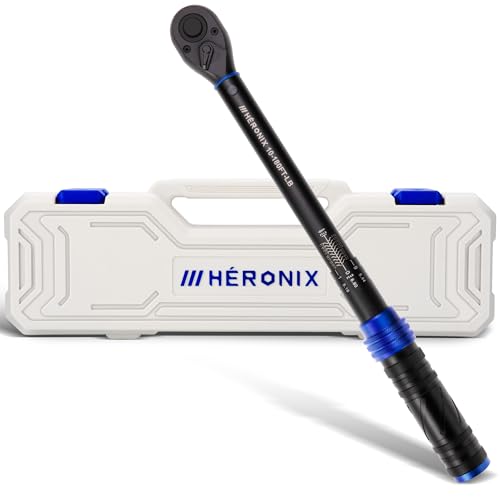
Best Torque Wrench for Motorcycles: Accurate Picks for Every Job
The best torque wrench for motorcycles for most owners is a 3/8-inch-drive click wrench with a range around 10–80 ft-lb (about 14–108 Nm), paired with a small 1/4-inch wrench for low-torque engine and brake fasteners. If you want one tool only, choose a quality 3/8-inch model whose range covers the specific fasteners you service—not simply the widest range on the shelf.
Quick picks by job
- One-wrench garage setup: A 3/8-inch click wrench covering roughly 10–80 ft-lb. It suits many axle, suspension, and larger engine fasteners, though it may not measure small fasteners reliably.
- Frequent low-torque work: A 1/4-inch wrench around 20–200 in-lb (about 2.3–22.6 Nm) for covers, clamps, and smaller brake or engine fasteners. Check the service manual before using it on safety-critical parts.
- Two-wrench coverage: A 1/4-inch low-range wrench plus a 3/8-inch mid-range wrench. This is the most useful arrangement for routine motorcycle maintenance.
- Limited clearance: A compact-head model or a suitable crowfoot attachment. Verify the wrench’s calibration point and account for any change in effective lever length.
Compare drive size, range, and fit
Torque ranges below are practical target bands, not universal motorcycle specifications. Actual requirements vary by model and fastener; use the manufacturer’s service manual for every torque value. Models from established tool makers such as CDI, GearWrench, Norbar, and Tekton are available in relevant manual-wrench formats, but confirm the exact range, head dimensions, and calibration details before buying.
As an Amazon Associate we earn from qualifying purchases at no extra cost to you.

| Wrench type | Useful working range | Typical motorcycle jobs | Trade-off |
|---|---|---|---|
| 1/4-inch drive, click | 20–200 in-lb (2.3–22.6 Nm) | Small covers, clamps, and other low-torque fasteners within the tool’s rated range | Compact, but too small for many axle and suspension fasteners |
| 3/8-inch drive, click | 10–80 ft-lb (13.6–108.5 Nm) | Many medium and larger engine, brake, and chassis fasteners | Best all-round size, but its low end may not suit delicate fasteners |
| 1/2-inch drive, click | 30–250 ft-lb (40.7–339 Nm) | High-torque axles and other large fasteners when specifications fall in range | More leverage and bulk; can be awkward in confined motorcycle spaces |
| Digital, commonly 3/8-inch | Varies by model; select to match the target torque | Users who want a display, unit conversion, or audible/visual target alerts | Costs more and depends on batteries and electronics |
Choose by your actual maintenance
For a first motorcycle tool kit
Start with a 3/8-inch wrench if your service work centers on routine maintenance and you have checked that its range includes the fasteners you plan to tighten. Don’t assume a wrench rated down to 10 ft-lb is accurate enough for a 7 ft-lb bolt. The target should sit comfortably inside the tool’s stated range, rather than below its minimum or right at an endpoint.
For brakes, engine covers, and small hardware
Add a 1/4-inch wrench when the manual lists low values in inch-pounds or single-digit Nm. A larger wrench may physically fit an adapter, but that does not make its low range suitable. On brake components and other critical assemblies, follow the specified tightening sequence and replace fasteners if the manufacturer requires it.
For axles and suspension
Check the service manual before reaching for a 1/2-inch wrench. Some motorcycle axles call for substantial torque; others fall within a 3/8-inch wrench’s capacity. A 1/2-inch tool is useful when the required value is beyond the smaller wrench’s range, but its longer handle can make it easier to overshoot in cramped or awkward positions.
For tight spaces
Compare head width and length, not just drive size. A slim ratchet head can reach between a frame tube and engine case where a bulky digital head cannot. A crowfoot can help when a straight socket will not fit, but it changes the effective wrench length if positioned in line with the handle. Follow the wrench maker’s instructions for calculating the adjustment; placing the crowfoot at 90 degrees to the handle often avoids a meaningful length change, though clearance and manufacturer guidance still matter.
Accuracy and features worth paying for
Look for a stated accuracy—often expressed as a percentage of the reading or full scale—and read how the maker defines it. A stated ±4% accuracy does not mean every target is equally suitable across an enormous range. A wrench that is well matched to a 40 ft-lb job is a better choice than one operating at the very bottom of its capacity.
- Calibration documentation: Useful for professional or frequent work. Check whether a certificate is included and what interval the manufacturer recommends.
- Locking adjustment: Helps prevent an accidental setting change while moving around the bike.
- Scale readability: Dual ft-lb/Nm markings reduce conversion errors; a digital display can help, but it is not a substitute for selecting the correct range.
- Head design: A low-profile ratchet head improves access. A flex head can add reach, but use it only as directed and keep the handle aligned with the intended pull.
- Direction of use: Many click wrenches measure torque in one direction only. Confirm this before using one on a left-hand-thread fastener.
A simple setup check before tightening
- Find the exact specification. Confirm the value, units, thread condition, lubrication instructions, and tightening sequence in the motorcycle’s service manual. A dry-thread figure may not apply to lubricated threads.
- Choose the right wrench. Match the target to the wrench’s rated range and use the smallest suitable drive that safely handles the job.
- Set the value carefully. For a click wrench, unlock the handle if needed, align the scale precisely, and relock it. Avoid estimating between markings unless the instructions allow it.
- Use a steady pull. Fit the socket fully, keep it square to the fastener, and pull smoothly on the handle. Stop at the first click; repeated clicks can continue tightening the fastener.
- Reset and store it correctly. After use, return an adjustable click wrench to its manufacturer-recommended storage setting—often the lowest marked value, not necessarily zero. This helps reduce prolonged spring loading.
Ownership: calibration, cleaning, and common mistakes
Manual torque wrenches need care. Keep them clean and dry, avoid using them as breaker bars, and don’t drop or overload them. Dirt or corrosion on threads, a damaged socket, and poor tool alignment can all undermine a careful torque setting. If a wrench has been dropped, overloaded, stored incorrectly, or used heavily, have it checked or calibrated according to the manufacturer’s guidance. Calibration is a recurring ownership cost, so a home mechanic who uses a wrench a few times a year may reasonably prioritize a dependable, appropriately ranged tool over advanced electronics.
Never use a torque wrench to loosen a fastener. Don’t add a pipe or extension to the handle for extra leverage. Ordinary socket extensions generally do not change torque when kept straight, but offset adapters can. Finally, torque is not a substitute for inspection: stop if threads feel rough, a bolt bottoms out unexpectedly, or parts do not seat evenly.
Bottom line
For most motorcycle owners, a 3/8-inch click wrench is the best starting point because it balances access and capacity. Add a 1/4-inch low-range tool if your work includes small engine or brake fasteners, and choose a 1/2-inch wrench only when your manual calls for values outside your smaller tool’s range. Range fit, readable settings, a compact head, and careful storage matter more than buying the largest or most feature-packed wrench.