What's inside
As an Amazon Associate I earn from qualifying purchases. This post may contain affiliate links at no extra cost to you.
For a beginner who wants to learn electronics by building something, the DSO138-style solder-it-yourself kit is the most discussed option, but its 200 kHz bandwidth and 1 Msps sampling make it a learning tool rather than a bench instrument. A ready-built single-channel scope such as the DSO150 is simpler to use with no soldering, and a buyer who can afford more should look at a two- or four-channel 100 MHz scope, which reviewers and roundups say covers most hobby work. Whichever you choose, keep mains voltage away from any scope that is not designed for it.
As an Amazon Associate we earn from qualifying purchases at no extra cost to you.

What a beginner scope needs to do
Three numbers matter most at the start: bandwidth, sample rate, and memory depth. Bandwidth sets the highest frequency the scope can show accurately. One beginner guide suggests the scope’s bandwidth should be about five times the highest frequency you plan to measure. Sample rate sets how finely the signal is captured in time, and memory depth sets how long a capture can run at that rate. A low sample rate can distort fast edges, and shallow memory limits how much of a slow signal you can see at once.
At a glance
| Model | Best for | Stated specs | Build | Limits reported |
|---|---|---|---|---|
| DSO138 kit (JYE Tech design) | Learning assembly and basic signals | One channel; 0 to 200 kHz analog bandwidth; 1 Msps real-time; 12-bit; 1,024-point record; 10 mV/div to 5 V/div; 1 MΩ input | Solder-it-yourself; 2.4-inch TFT; the manual calls for a 20 W iron and a multimeter | Limited bandwidth and sample rate; small screen; clone units vary in component values |
| DSO150 (assembled) | Beginners who want a ready-to-use single-channel scope | One channel; 200 kHz bandwidth; 12-bit; includes a 1 kHz square-wave output for testing | Assembled | Same class of accuracy as the kit; reviews are from an older period |
| Hantek 2000 series | Budget buyers who want a function generator built in | Bandwidth between 40 and 70 MHz per a comparison; built-in function generator | Not stated in the sources reviewed | Entry models reported to have grainy resolution and narrower viewing angles |
| Owon HDS2102 | Buyers who want 100 MHz on a budget | 100 MHz bandwidth; 500 MSa/s sample rate per a roundup | Not stated in the sources reviewed | Memory reported as shallow at about 8 Kpts |
| Siglent SDS1104X-E | Hobbyists who want four channels and deeper memory | 100 MHz bandwidth; four channels; 1 GSa/s on a single active channel; 500 MSa/s per channel with all channels on; 7 Mpts per channel non-interleaved and 14 Mpts interleaved | Bench instrument with a full display | Full sample rate and full memory come together only with one channel per pair active |
DSO138 kit: the build-and-learn option
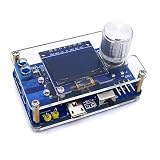
The DSO138 kit is a one-channel scope that arrives as a bare board with a 2.4-inch TFT display, a bag of components, test leads, and an assembly guide. The published specifications are 0 to 200 kHz analog bandwidth, a maximum real-time sampling rate of 1 Msps, 12-bit resolution, and a 1,024-point record. Vertical sensitivity runs from 10 mV per division to 5 V per division, and the input impedance is 1 MΩ. The listed maximum input is 50 Vpp on a 1:1 probe and 400 Vpp on a 10:1 probe. Those limits matter because the kit is not a mains instrument.
Reviewers describe the kit as an entry-level training tool. Its build teaches through-hole soldering and some surface-mount work, and reviewers say the assembly is fairly straightforward for a first project. The main criticisms are the limited bandwidth, a sample rate that gives only about five points per cycle at 200 kHz, and a small screen that can be hard to read. Several sellers offer the board with the surface-mount parts already soldered, and one offers only the microcontroller pre-soldered as a training option. Choose the version that matches your soldering skill.
Clone units are common. One review notes that the design originates with JYE Tech, but copies from different sellers can differ in build quality and component values. Compare the component values in the manual against your board before you power it on. The manual calls for a 20 W iron and a multimeter to check resistor values before soldering, and it asks builders to fill pads fully and avoid bridges between neighboring pads.
DSO150 and the kit alternatives
The DSO150 is the assembled version of the same class of instrument. It has one channel, a 200 kHz bandwidth, and 12-bit resolution, and it adds a 1 kHz square-wave output that a beginner can use for practice. Reviewers find it easier to use than the kit because nothing has to be soldered, though its measurement limits are the same. Its review material is older, so check the current seller’s model and its manual before buying.
100 MHz and up: the step-up options
A two- or four-channel 100 MHz scope is the step most roundups suggest if the budget allows. The Siglent SDS1104X-E is listed at 100 MHz with four channels, and the maker lists a 1 GSa/s real-time rate on a single active channel. With all four channels on, each channel drops to 500 MSa/s, and the element14 community review notes that memory and sample rate are linked in this design. Those links matter for a beginner who wants to see both fast edges and long captures at the same time.
Hantek’s 2000 series is described in one comparison as a budget choice with bandwidth between 40 and 70 MHz and a built-in function generator. Owon’s HDS2102 is described as a 100 MHz unit with 500 MSa/s, but one roundup cautions that its memory is shallow at about 8 Kpts. Both are cheaper routes into 100 MHz, and both show the trade-off between price and memory.
Pick the right scope if…
| If your situation is | Pick | Why |
|---|---|---|
| You want to learn assembly and basic signals | DSO138 kit | Build-and-learn project with a small display and modest bandwidth |
| You want a ready-to-use single-channel scope | DSO150 (assembled) | Same class of limits with no soldering and a 1 kHz output |
| You need 100 MHz on a budget with a function generator | Hantek 2000 series | Built-in generator, with a narrower range of bandwidth options |
| You want four channels and deep memory for hobby projects | Siglent SDS1104X-E | 100 MHz, four channels, and 14 Mpts memory in interleaved mode |
Alternatives worth considering
- A logic analyzer: For digital protocols such as I2C or SPI, a logic analyzer can show more channels than a scope, though it does not show analog shape the same way.
- A digital multimeter: For resistance, voltage, and continuity checks, a meter is the right first tool, and it costs less to learn with than a scope.
- A battery-powered or isolated scope: For work near mains, a battery-powered or isolated instrument reduces the ground-loop risk described in the sources reviewed. This is the safer path when you cannot avoid mains-connected circuits.
Electrical safety notes
Most beginner scopes are not designed for mains voltage. PicoScope’s documentation says its USB scopes are not designed for mains and recommends a differential isolating probe rated for high source voltages when measuring mains. The ground lead on a scope probe connects to the scope’s earth, so clipping it to the wrong point on a live circuit can short it. Do not connect a scope’s ground clip to a switching-supply rail or any mains-connected point unless you know it is safe, and check the probe’s voltage and CAT rating before any mains test. If you are not sure, leave mains work to a licensed electrician.
Frequently Asked Questions
Is a DSO138 kit a good first oscilloscope?
It is a good first project for learning how a scope works and how to solder carefully, and reviewers describe it as a training tool. Its 200 kHz bandwidth and 1 Msps sampling limit what you can measure accurately, so plan on a better scope once your projects need faster signals. Buy the assembled version if you do not want to solder.
How much bandwidth do I need for hobby work?
One beginner guide suggests the scope’s bandwidth should be about five times the highest frequency you plan to measure. Simple microcontroller signals, PWM, and audio often fit within 200 kHz, while faster digital edges need more. A 100 MHz scope covers most hobby needs, according to roundups.
Why does memory depth matter?
Memory depth sets how long a capture can run at a given sample rate. Shallow memory limits how much of a slow signal you can see at once, which matters when you debug a sequence of events. Comparisons note that deep memory is often more useful than headline bandwidth for real troubleshooting.
Are clone kits reliable?
Clones are common, and build quality and component values vary between sellers. Compare the component values in the manual against your board before you power it on, and check that every part sits in its marked position. A clone with a reliable seller and a clear manual is more likely to work than one with no documentation.
Can I use a beginner scope on mains power?
Most beginner scopes are not designed for mains, and PicoScope’s documentation advises against it. Use an isolated or battery-powered instrument, or a differential probe rated for the voltage, and keep the ground clip away from mains-connected points. Mains work should be left to a licensed electrician.
Do I need a function generator too?
A function generator is useful for testing circuits, and some scopes include one. The Hantek 2000 series includes a built-in generator, and the DSO150 includes a 1 kHz square-wave output for practice. A separate generator is worth adding once your projects need a range of waveforms.