What's inside
- Best airtight food storage containers by situation
- Glass versus plastic: the real trade-off
- Seal types: which lid keeps food freshest?
- Stackability is a measurement problem, not a marketing promise
- A simple cost-per-use comparison
- Maintenance determines how airtight containers perform
- Recommended buying checklist
As an Amazon Associate I earn from qualifying purchases. This post may contain affiliate links at no extra cost to you.
The best airtight food storage containers are glass containers with a replaceable silicone seal for oven-to-table use, or lightweight BPA-free plastic containers with a four-latch gasketed lid when low weight, stacking, and budget matter most.
The right choice depends less on the word “airtight” on the label than on four practical details: how reliably the lid seals, whether the container fits your shelves, how it handles cleaning and temperature changes, and how often you will open it. A container that seals well but wastes cabinet space—or whose gasket is difficult to clean—can be less useful than a simpler model.
As an Amazon Associate we earn from qualifying purchases at no extra cost to you.


Our Top Picks
 Vtopmart Airtight Food Storage Containers with LidsTall, Large, Medium, Small3 poundsCheck on Amazon
 Rubbermaid Brilliance BPA-Free Food Storage Containers with Lids16 Cup (6-Piece)16.13 x 8.25 x 9.88 Inches4.1 poundsCheck on Amazon
 Rubbermaid Brilliance 12-Cup Airtight Food Storage Container12 Cup7.9 x 5.4 x 7.1 inches1 poundsCheck on Amazon

Best airtight food storage containers by situation
| Situation | Best choice | Useful specifications | Why it fits |
|---|---|---|---|
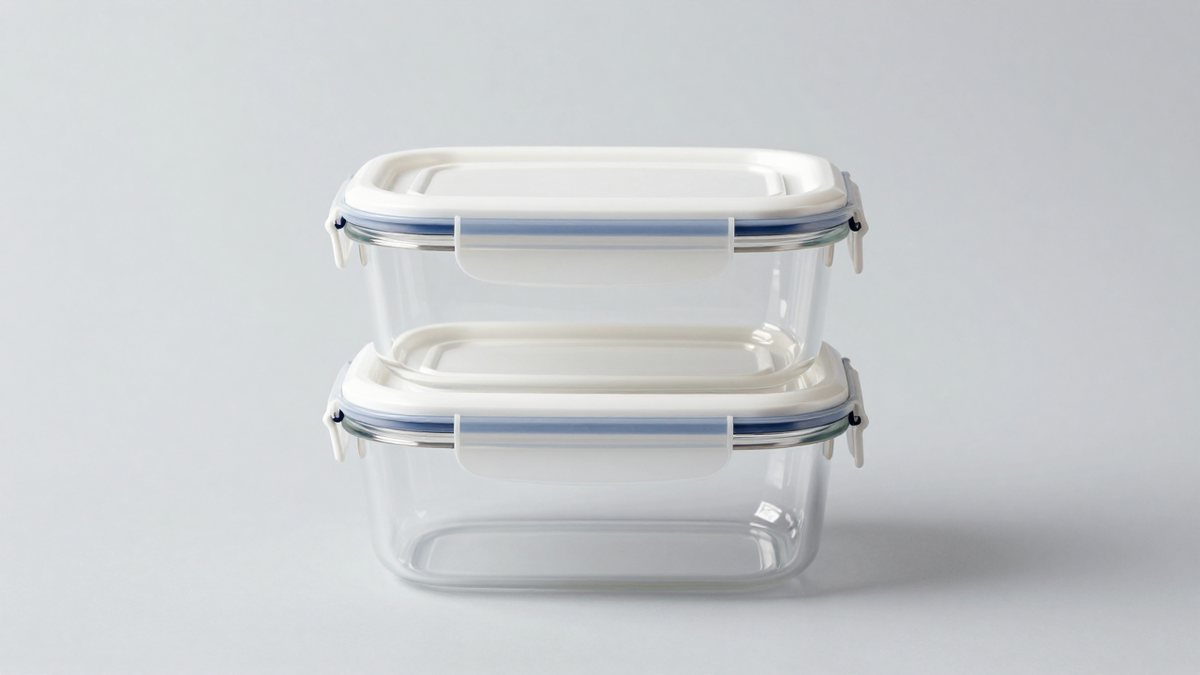
| Daily leftovers and meal prep | Rectangular glass with a removable silicone gasket | 600–1,000 ml; 650–900 g each | Easy to inspect, resists odors and stains, and can often move from refrigerator to oven when the lid is removed |
| Dry pantry staples | Tall plastic canister with a clamp or silicone-gasket lid | 1.5–2.5 L; 100–350 g each | Lightweight, space-efficient, and convenient for flour, sugar, rice, and cereal |
| Small kitchen or deep shelves | Uniform rectangular containers with flat lids | Stackable footprint around 10 × 15 cm; heights of 5–20 cm | Uses vertical space without creating unstable towers |
| Freezer storage | Freezer-rated plastic or borosilicate glass with headspace | 500–1,000 ml; leave 1–2 cm empty at the top | Allows food to expand and reduces cracking or lid distortion |
| Lowest purchase cost | Nested BPA-free plastic sets with snap lids | 300–1,200 ml; typically 100–250 g each | Usually costs less per container and takes little room when stored empty |
Glass versus plastic: the real trade-off
Choose glass for odor control and temperature changes
Glass is the better material when containers will hold tomato sauce, curry, onions, oily foods, or strongly seasoned leftovers. It does not absorb food odors in the way some plastics can, and it is less likely to become permanently stained. Its weight also makes it feel stable when stirring or stacking.
Glass containers are useful for batch cooking because many are designed for refrigerator-to-oven use with the lid removed. Check the manufacturer’s temperature limits rather than assuming all glass is oven-safe. Avoid placing a cold container directly into a hot oven, setting hot glass on a wet or cold surface, or using a damaged dish. Thermal shock can cause even heat-resistant glass to break.
The disadvantages are weight, breakage risk, and higher initial cost. A 900 ml glass container can weigh roughly 650–900 g before food is added, while a similar plastic container may weigh 100–250 g. That difference matters if you carry lunch to work or fill a refrigerator door with several containers.
Choose plastic for portability, stacking, and frequent handling
Good-quality food-storage plastic is lighter, quieter, and less likely to break when dropped. It is often the practical choice for packed lunches, children’s portions, freezer organization, and shelves where a glass tower would be too heavy.
Plastic is not equally durable across all products. Thin tubs may warp in a dishwasher or develop scratches that trap food residue. Some plastics also retain color and odor after repeated use. Look for containers marked for food contact, with clear temperature guidance and lids that remain flat after washing.
“BPA-free” describes one material characteristic, not overall quality. It does not tell you whether the lid seal is reliable, whether the container is freezer-safe, or how well it tolerates heat. Those specifications deserve separate attention.
Seal types: which lid keeps food freshest?
Silicone-gasket snap lids
These lids use a flexible gasket around the rim and one or more locking tabs. Four-sided locking lids generally apply pressure evenly and are a strong all-purpose choice for liquids and leftovers. They are usually easier to stack than clamp jars because the lid remains flat.
The gasket is also the part most likely to wear first. Food grease, detergent residue, and trapped moisture can prevent a complete seal. Choose a design where the gasket can be removed, washed, dried, and replaced. A gasket that is permanently bonded into a complicated lid may be harder to maintain.
Clamp-top glass jars
Clamp jars use a hinged wire mechanism and a rubber or silicone ring. They work well for dry goods, pickles, and refrigerator storage, but the seal depends on the ring sitting evenly against the glass. They are less convenient for stacking and can require more vertical clearance.
Inspect the ring for flattening, cracks, or hardening. A jar may still close mechanically while no longer providing a dependable airtight seal.
Press-on or valve lids
Press-on lids are quick for dry goods but vary widely in sealing performance. Some include a push-button or valve that releases air and indicates whether the lid is engaged. These are convenient, but extra moving parts create more places for crumbs and moisture to collect.
For flour, rice, and cereal, a well-fitting press-on lid can be sufficient. For liquids or food that must remain especially protected from air, prefer a gasketed lid with positive locking points.
Stackability is a measurement problem, not a marketing promise
Before buying a set, measure the shelf’s usable width, depth, and height—not just the outside dimensions of the cabinet. Leave at least 2 cm of clearance above the tallest container so it can be lifted without scraping the shelf.
Uniform footprints are more valuable than having many different capacities. For example, a 10 × 15 cm footprint lets several containers line up predictably, while tapered or irregular tubs may leave unusable gaps. Flat lids allow vertical stacking, but check whether the lid has a stable rim or locating ridge. A smooth lid can let a heavy upper container slide when the shelf is moved.
For pantry staples, a practical arrangement is:
- 1.5–2.5 L containers for flour, sugar, oats, and cereal.
- 1–1.5 L containers for rice, pasta, lentils, and baking ingredients.
- 500–800 ml containers for nuts, seeds, spices, and small portions.
- One scoop or measuring cup stored inside the largest frequently used containers.
Do not fill a container to the rim. Leave enough room to insert a scoop and enough clearance for the lid gasket to sit flat. For a 2 L canister used for flour, filling it to about 1.7–1.8 L is usually more convenient than maximizing capacity.
A simple cost-per-use comparison
Suppose a plastic set costs $25 for 10 containers, while a glass set costs $45 for six. The plastic option costs $2.50 per container; the glass option costs $7.50. If a plastic container lasts three years and a glass container lasts eight years, the approximate container-year cost is:
- Plastic: $2.50 ÷ 3 = about $0.83 per year.
- Glass: $7.50 ÷ 8 = about $0.94 per year.
This does not make plastic automatically cheaper. Replacing two warped plastic containers or several lost gaskets can erase the difference. Conversely, one broken glass dish may cost more than its annualized estimate. The calculation is useful because it separates purchase price from the ownership pattern that matters in your kitchen.
Maintenance determines how airtight containers perform
- Wash the lid and gasket separately. Remove the seal if the design permits it. Crumbs under the gasket are a common cause of leaks.
- Dry every part before closing. Trapped moisture encourages odors and can make pantry staples clump.
- Do not overfill. Food touching the seal can stop the lid from seating evenly.
- Cool hot food before sealing tightly. Closing very hot food can create pressure changes and strain the lid. Follow the container’s temperature instructions.
- Label contents and dates. An airtight container protects against moisture and odors; it does not make food immune to spoilage.
- Replace worn seals. A stretched, cracked, sticky, or permanently flattened gasket is a consumable part, not a problem to solve by forcing the lid.
For dry goods, transfer food only into a clean, completely dry container. Check the original package for insects, moisture, or an unusual odor before transferring it; an airtight container cannot improve compromised ingredients.
Recommended buying checklist
- Choose glass if odor resistance, stain resistance, and reheating matter more than weight.
- Choose plastic if you carry containers, freeze portions, or need inexpensive, lightweight storage.
- Prefer removable silicone gaskets and replacement seals that are actually available.
- Compare the container’s internal capacity, not only its outside dimensions.
- Look for flat, locating lids when stable stacking is important.
- Confirm dishwasher, freezer, microwave, and oven instructions separately; these ratings are not interchangeable.
- Buy a small trial set before committing to a large collection, especially if shelf dimensions are tight.
For most kitchens, the most flexible setup is a mixed collection: glass rectangles for leftovers and strongly flavored foods, plus lightweight gasketed plastic containers for lunches, freezer portions, and pantry staples. That combination costs more than choosing one material exclusively, but it matches each container to the job—and makes freshness, storage space, and everyday handling easier to manage.