What's inside
- Quick comparison: five sideboard classes worth buying
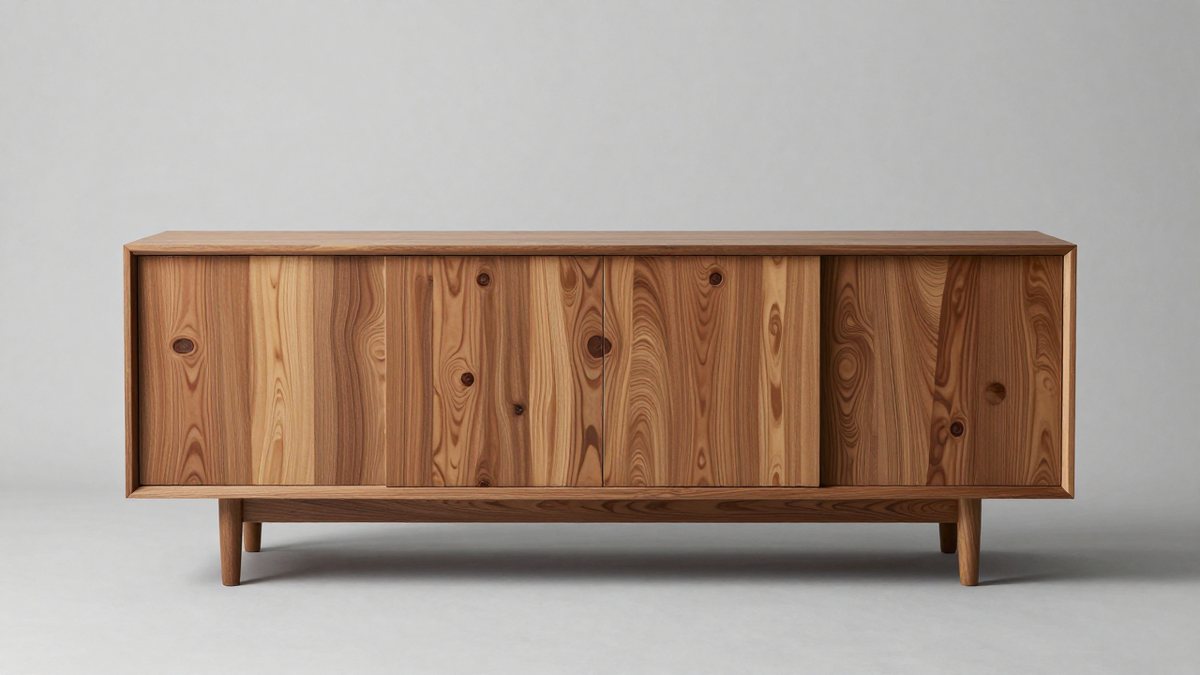
- Best overall: 60-inch solid-wood three-door sideboard
- Best budget: 47-inch engineered two-door with three drawers
- Best for small dining rooms: 36-inch two-door console
- Best for large rooms and open-plan storage: 78-inch four-door buffet
- Best for renters and assembly-averse buyers: pre-assembled 48-inch cabinet
- How to size a sideboard for your dining room
- Solid wood vs engineered wood: the real trade-offs
- What wears out first, and the mistakes that cause it
- Frequently Asked Questions
As an Amazon Associate I earn from qualifying purchases. This post may contain affiliate links at no extra cost to you.
Short answer: For most dining rooms the best sideboard is a 54–66 in wide, 30–34 in tall cabinet about 16–18 in deep, with three doors and two adjustable shelves per bay — roughly 10–11 sq ft of usable shelf surface. Choose solid oak, ash or walnut (about $900–$1,800) if you want a refinishable 20-year piece, or a veneered MDF carcass ($400–$1,000) if you want the same silhouette for less. Size it to the wall first and the table second: 0.6–0.75 × your table length, and never leave less than 36 in of walking clearance between the sideboard front and the table edge.
As an Amazon Associate we earn from qualifying purchases at no extra cost to you.


Our Top Picks
 IFGET 92.63" W Modern Arched Sideboard Buffet Cabinet3 Pieces15.75 x 92.63 x 34 inches40 poundsCheck on Amazon
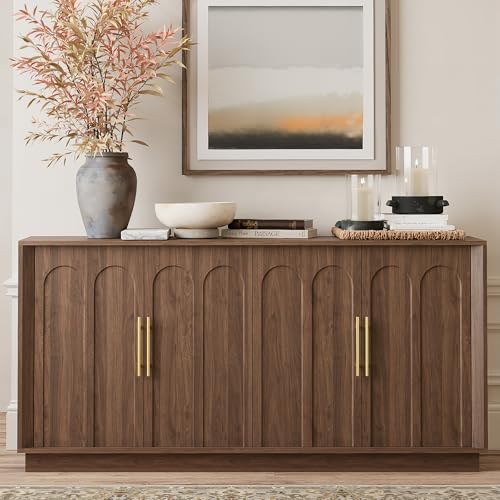 FORTUNETEC 67" Sideboard Buffet Cabinet with StorageX-Large15.7 x 66.9 x 31.5 inches121 poundsCheck on Amazon


Quick comparison: five sideboard classes worth buying
| Pick | Best for | Size (W × D × H) | Material | Storage | Typical price |
|---|---|---|---|---|---|
| Best overall | Most dining rooms, 10+ year ownership | 60 × 17 × 32 in, ~130 lb | Solid oak or ash, dowel/dovetail joinery | 3 doors, 2 adjustable shelves per bay | $900–$1,800 |
| Best budget | First apartment, tight budgets | 47 × 15.75 × 30 in, ~88 lb | Foil/melamine over particleboard | 2 doors, 3 drawers, 1 shelf per bay | $180–$400 |
| Best for small dining rooms | Walls under 8 ft, galley layouts | 36 × 15 × 32 in, ~65 lb | Veneered MDF | 2 doors, 2 shelves | $250–$600 |
| Best for large rooms / open plan | Tables 84 in and up, china and linen storage | 78 × 19 × 33 in, ~190 lb | Solid wood or veneer over plywood core | 4 doors, 2 drawers, 8 shelves | $1,200–$2,600 |
| Best low-assembly | Renters, no-tools households | 48 × 16 × 30 in, ~95 lb | Pre-assembled cabinet or metal frame with solid top | 2 doors, 1 shelf, open lower shelf | $400–$900 |
Best overall: 60-inch solid-wood three-door sideboard
This is the size and spec class that fits the widest range of dining rooms. A 60-inch, three-door cabinet with two adjustable shelves per bay gives you about 10.5 sq ft of shelf surface — enough for 16 dinner plates, 12 bowls, a stack of table linens and two serving platters without stacking anything dangerously high. Per published spec sheets for this class, solid oak and ash units typically ship at 130–160 lb, which is heavy enough to feel planted and light enough for two people to move with a furniture dolly.
Who it suits: anyone pairing it with a table 80 in or longer, or anyone who wants a piece they can sand and re-oil in ten years rather than replace. Main trade-off: cost and weight. You are paying $900–$1,800 and you cannot slide it across a floor alone — dragging a 140 lb cabinet on hardwood leaves marks and can snap a leg tenon.
Best budget: 47-inch engineered two-door with three drawers
Flat-pack sideboards in the $180–$400 band use a particleboard core with a foil or melamine skin. The drawer bank is the reason to pick this class over a plain two-door: three drawers roughly 15 × 13 × 4 in interior each will hold cutlery for twelve, napkins, and the candle-and-placemat clutter that otherwise ends up on the table. Assembly runs 60–90 minutes for two people, with 40–50 cam-lock and screw fasteners.
Who it suits: renters, first homes, and anyone furnishing a dining room that may not be their forever dining room. Main trade-off: edges. Foil and melamine chip at the bottom front corners, and once moisture reaches the exposed particleboard core, the panel swells and never goes flat again. Keep it off wet floors and wipe spills immediately.
Best for small dining rooms: 36-inch two-door console
Under an 8 ft wall, a 60-inch cabinet crowds the chairs. A 36-inch, 15-inch-deep console leaves 12–24 in of wall at each end and still provides six shelves’ worth of narrow storage — best used for glassware, bar items and folded linens rather than dinnerware stacks. Slim depth matters more than width here: going from 18 in to 15 in of depth buys you 3 in of walkway, which is often the difference between a comfortable and a squeezed room.
Who it suits: galley dining areas, apartments, and rooms where the sideboard also serves as a bar. Main trade-off: capacity. A 36-inch unit holds roughly one-third of what the 60-inch class holds, so plan on a second storage spot for platters and serving dishes.
Best for large rooms and open-plan storage: 78-inch four-door buffet
A 78-inch, 19-inch-deep buffet with four doors, two central drawers and eight shelves delivers roughly 18 sq ft of shelf surface. This is the class that actually swallows a full china set plus table linens plus board games, which is why it works in open-plan spaces where the sideboard doubles as the dining-room’s only storage. Expect 170–210 lb and $1,200–$2,600.
Who it suits: tables 84 in and up, and households storing formal dinnerware. Main trade-off: assembly and anchoring. A cabinet this long is usually shipped in two boxes; joining the halves and leveling four to six feet takes two people, and a unit over 30 in tall should be anchored to a stud regardless of how stable it feels.
Best for renters and assembly-averse buyers: pre-assembled 48-inch cabinet
If you would rather not spend an evening with a hex key, buy pre-assembled. A 48-inch cabinet with two doors and one shelf arrives in one piece at roughly 95 lb, or you can go with a metal-frame unit topped with solid wood, which needs no tools beyond a screwdriver for the feet. Both land in the $400–$900 range.
Who it suits: renters who move every couple of years, and anyone without a second pair of hands. Main trade-off: fewer interior options. Pre-assembled cabinets rarely have adjustable shelves, so measure your tallest platter before you buy.
How to size a sideboard for your dining room
| Your table length | Sideboard length (0.6–0.75 × table) | Minimum wall-to-table distance | Practical depth |
|---|---|---|---|
| 48 in | 29–36 in | 52 in (16 in cabinet + 36 in walkway) | 15 in |
| 60–72 in | 36–54 in | 54 in (18 in cabinet + 36 in walkway) | 15–17 in |
| 84–96 in | 50–72 in | 56 in (20 in cabinet + 36 in walkway) | 17–19 in |
| 108 in+ | 65–81 in | 56 in | 18–20 in |
Two worked examples. Proportion: a 72-inch table × 0.6–0.75 = a 43–54 in sideboard, so the 60-inch best-overall pick is actually oversized for that table — drop to the 47-inch class or accept that the sideboard will dominate the wall. Clearance: a 17-inch-deep sideboard plus 36 in of occupied-chair space means the table edge needs to sit 53 in from the wall. Measure that before you buy, because it rules out rooms that look fine on paper.
Also match serving height: dining tables sit at 30 in, so a 30–34 in sideboard top is within comfortable reach for plating and pouring. Anything above 36 in turns buffet service into a reach-over.
Solid wood vs engineered wood: the real trade-offs
| Material | Typical price | Weight (60 in cabinet) | Repairability | Assembly |
|---|---|---|---|---|
| Solid oak / ash / walnut | $900–$2,600 | 130–190 lb | Sand and re-oil every 5–10 years | Often assembled; some ship with legs off |
| Veneer over MDF or plywood | $400–$1,200 | 90–140 lb | Spot-repair veneer; no full refinish | Part-assembled, 30–60 min |
| Melamine / foil over particleboard | $150–$450 | 65–110 lb | Not repairable once the core swells | Flat-pack, 60–90 min |
Cost per year makes the comparison clearer. A $1,500 solid oak sideboard kept 25 years costs $60 per year. A $320 flat-pack replaced every seven years costs about $46 per year, but you buy roughly three of them over 21 years and spend 4–5 hours assembling them. The engineered route wins on cash flow; the solid-wood route wins on the fact that a $150 refinish resets the clock instead of sending you back to a flat-pack box.
What wears out first, and the mistakes that cause it
- Hinges before wood. European cup hinges are adjustable roughly 2–3 mm in three directions; if a door sags, adjust it rather than shimming the cabinet.
- Sagging shelves. A particleboard adjustable shelf on 5 mm pins will bow permanently under sustained loads around 30–40 lb. Solid-wood shelves on cleats handle 60–80 lb. Keep cast-iron cookware and full wine crates low.
- Edge banding lift. The bottom front corners of veneered and foil cabinets take the hit from mops and vacuum bumpers. A bead of wood glue and a clamp fixes it before it peels further.
- Water rings on the top. Lacquered and foil tops ring; oiled solid wood recovers with a light sand and re-oil. Use coasters either way.
- Drawer glides. Entry-level glides are rated around 30–50 lb per pair. Loading a drawer with a full cutlery set and a stack of heavy stoneware is the usual cause of a glide that stops closing flush.
For cleaning: dust with a damp microfiber cloth, and skip silicone-based polishes on veneer — they build a film that traps grit. Oiled solid wood wants a hardwax oil every 12–24 months; lacquered and foil finishes need nothing but a damp wipe.
Frequently Asked Questions
How wide should a sideboard be for a 72-inch dining table?
Use the proportion rule: 0.6–0.75 × 72 in gives 43–54 in. A 47-inch sideboard is the safe middle. If you prefer a longer cabinet for storage reasons, make sure you still have 36 in of clearance from the sideboard front to the table edge, and consider a shallower 15-inch depth to buy back walkway space.
Is solid wood worth the price over engineered wood?
It depends on how long you plan to keep the piece. Solid wood can be sanded and refinished for roughly $150 in materials and will outlast most owners; engineered cabinets are stable and cheaper but are essentially unrepairable once moisture reaches the core. If you expect to move within five years, engineered is the better value.
How much weight can sideboard shelves hold?
As a rule of thumb, an adjustable particleboard shelf on pin supports bows permanently past about 30–40 lb, while a solid-wood shelf on cleats or dadoes handles 60–80 lb. Distribute weight across the shelf rather than loading one corner, and put heavy items on the bottom shelf where the load transfers straight into the base.
Can a sideboard double as a buffet server?
Yes, if the top sits between 30 and 34 in high — dining tables are 30 in, so this keeps serving within easy reach. Allow at least 20 in of depth in front of a drawer so it can open fully without hitting a chair, and leave 12 in of free counter at one end for hot dishes coming out of the kitchen.
Does a sideboard need to be anchored to the wall?
Any cabinet over 30 in tall should be anchored, and anchoring is essential if you have children or pets who might climb or lean on an open drawer. A 78-inch, 190 lb unit is stable until a drawer is fully loaded and pulled out, at which point the center of gravity moves forward fast. One L-bracket into a stud is enough.
How do I care for a veneered sideboard top?
Wipe with a damp microfiber cloth and dry immediately — standing water is the main enemy of veneer and the particleboard beneath it. Avoid silicone polishes and abrasive cleaners, use coasters and felt pads under lamps, and keep the cabinet out of direct sun, which fades veneer unevenly across a large top surface.