What's inside
As an Amazon Associate I earn from qualifying purchases. This post may contain affiliate links at no extra cost to you.
If you need a Makita tool box with wheels for job-site movement, choose MakTrak for rough-terrain capacity and easier access, or a Makpac rolling setup for a slimmer, lower-cost stack that already matches your Makpac cases.
As an Amazon Associate we earn from qualifying purchases at no extra cost to you.


Our Top Picks
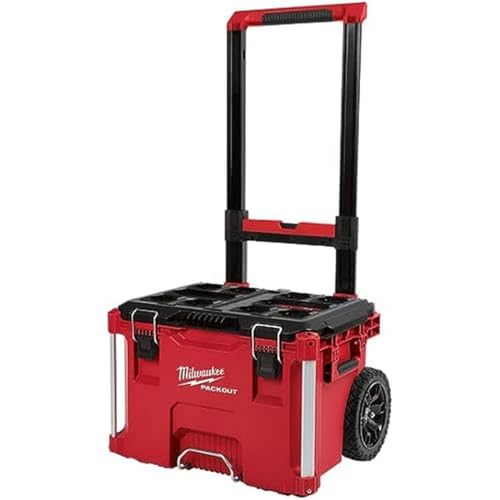 Milwaukee 48-22-8426 Packout22.1" x 18.9" x 25.6"22.1 x 18.9 x 25.6 inches23.4 PoundsCheck on Amazon

MakTrak vs Makpac rolling storage at a glance
These systems solve different problems. MakTrak is a purpose-built rolling tool chest with a wider body, larger wheels and drawer-style access. Makpac is a compact case system that can be transported with a compatible trolley or rolling base. Makpac wins on compatibility with an existing collection; MakTrak wins when the rolling box itself is your main storage unit.
| Feature | Makita MakTrak rolling tool box | Makita Makpac rolling setup |
|---|---|---|
| Typical outside footprint | About 23.2 × 15.7 in (590 × 400 mm), model and market dependent | About 15.6 × 11.6 in (395 × 295 mm) per case |
| Typical overall height | Roughly 17–18 in (430–460 mm) with wheels and handle retracted | Varies with the number of cases; a single trolley case is commonly about 16–18 in tall |
| Wheel size | Approximately 9–10 in all-terrain wheels | Approximately 4–5 in trolley wheels, depending on the rolling carrier |
| Load rating | Roughly 75–100 lb (34–45 kg), depending on the regional model | Usually lower for the complete trolley assembly; follow the rating printed on the specific carrier |
| Interior format | Large open compartment with removable dividers and accessible top storage | Individual removable cases, commonly around 13–14 in wide internally and 3–5 in high per case |
| Locking and latching | Large case latches, integrated stack connection and a folding telescopic handle | Front case latches plus separate interlocking points between Makpac cases |
| Best terrain | Concrete, gravel, compacted soil, thresholds and uneven job-site surfaces | Indoor floors, paved paths, vans and relatively smooth access routes |
Published dimensions and load figures differ between regional MakTrak versions and individual Makpac trolley products. Treat the numbers above as buying guidance, then confirm the label or instruction sheet for the exact product code available in your country.
Interior dimensions: bulk storage versus organised cases
MakTrak provides the more useful interior when you carry a drill, impact driver, charger, hand tools and loose accessories together. Its broad compartment is designed around dividers, so a charger can remain beside a tool rather than occupying a separate case. The large lid area also gives quick access to smaller items without removing the entire stack.
Makpac uses a different logic: each case is a defined container. A Makpac Type 1 is relatively shallow, while taller versions are better for drills, sanders and accessories. The approximate 395 × 295 mm external footprint is efficient in a van, but the internal length is not generous for long tools or bulky dust-extraction accessories. The advantage is predictability. You can assign one case to drilling, one to fasteners and one to batteries.
Measure the tool with its battery attached, not just the bare tool. A case that is 60 mm tall inside may accept a compact drill but reject the same drill with a large high-capacity battery. Dividers also reduce usable width, so allow approximately 10–15 percent more room than the tool’s measured width when planning a compartment.
Wheels and terrain handling
Wheel diameter matters more than the marketing label “rolling.” A 9- or 10-inch MakTrak wheel climbs a cable, door threshold or rough gravel edge with less handle lifting than a 4- or 5-inch trolley wheel. Larger wheels also reduce vibration transmitted to batteries, chargers and delicate accessories.
MakTrak is therefore the better Makita tool box with wheels for moving from a van across a driveway, unfinished floor or compacted site. It is still not a hand truck: deep mud, stairs and loose stone can exceed the balance and traction available from any wheeled tool box.
Makpac’s smaller wheels are easier to store and turn in narrow corridors, but they work best on smooth concrete, shop floors and paved paths. A tall stack can become awkward when crossing a threshold because the load is higher and the wheelbase is narrower. Keep the heaviest case at the bottom and avoid pulling a fully loaded stack sideways.
Latches, stacking and Makpac compatibility
MakTrak has its own locking and stacking interface. Makpac cases do not simply become MakTrak drawers because both systems carry the Makita name. The connection geometry is different, and a Makpac case should not be forced onto a MakTrak lid or latch.
Makpac cases are designed to interlock with other Makpac cases and compatible Makita storage accessories. Some rolling carriers accept Makpac cases directly; others are intended for a particular case size or trolley arrangement. Before buying, check three points:
- Whether the carrier uses the standard Makpac footprint of approximately 395 × 295 mm.
- Whether the number and type of latches match your existing cases.
- Whether the stated load rating applies to the carrier, the individual cases or the complete stack.
If your workshop already contains several Makpac cases, staying within Makpac avoids replacing usable storage. If you are starting from zero and need one rolling box, MakTrak generally offers the more capable platform. Mixing systems may be possible with manufacturer-approved adapters or a separate transport method, but it should not be assumed to be a secure stack.
Which system fits your situation?
| Your situation | Better choice | Reason |
|---|---|---|
| Existing Makpac collection | Makpac trolley or rolling carrier | Preserves interlocking cases and avoids buying a second storage ecosystem |
| Frequent outdoor job-site movement | MakTrak | Larger wheels, broader stance and a higher practical rolling load |
| Small workshop or narrow van | Makpac | Smaller footprint and stackable individual cases |
| Loose hand tools and mixed-size accessories | MakTrak | Open compartment and movable dividers are faster than several shallow cases |
| Occasional transport on smooth floors | Makpac | Lower-cost rolling storage is usually sufficient for short, paved routes |
| Heavy batteries, chargers and power tools | MakTrak, within its stated rating | More usable volume and a stronger rolling platform, provided the load is distributed |
Ownership realities: what wears first
On either system, wheels and latch contact points normally show wear before the molded case body. Gravel can score wheel axles, while overloading accelerates handle flex and makes latches harder to align. Keep the wheels free of cord, tape and compacted dirt; a small obstruction can make a loaded box track poorly.
Do not use the telescopic handle as a lifting handle unless the instructions specifically permit it. Lift from the molded body or designated handholds. Pulling a heavy box up stairs by the extended handle concentrates force in the rails and pivot points.
Clean plastic cases with mild detergent and water, then dry the latch recesses. Avoid petroleum solvents, which can affect some plastics and lubricants. Do not oil latches heavily: oily surfaces attract abrasive dust. Inspect fasteners and wheel hardware periodically, especially after transporting the box in a vehicle.
A simple capacity check before buying
List the equipment you expect to carry and total its weight. For example, a drill at 1.7 kg, impact driver at 1.5 kg, two batteries at 1.4 kg, charger at 1.2 kg and accessories at 6 kg produce a 11.8 kg load. Add the container’s own weight and a realistic growth allowance of 20 percent. In this example, a 14–15 kg contents target is sensible even if the published box rating is much higher.
That allowance matters because the hardest part is not holding the weight; it is rolling it over thresholds without excessive handle force. Keep dense items low and near the wheel axle. A box that is technically within its rating can still tip or steer poorly when heavy batteries and metal tools are placed at the top.
Final verdict
Choose MakTrak when your priority is a genuinely job-site-ready rolling tool box with large wheels, a broad interior and quick access to mixed equipment. Choose Makpac when compact dimensions, modular case-by-case organisation and compatibility with an existing Makpac stack matter more than rough-terrain performance.
The key buying mistake is comparing only the case price. Compare the complete system: wheels, handle, usable interior, stack interface and the route you will actually travel. For smooth indoor transport and an established Makpac collection, Makpac is the efficient choice. For frequent outdoor hauling, MakTrak is the more capable Makita tool box with wheels.