What's inside
As an Amazon Associate I earn from qualifying purchases. This post may contain affiliate links at no extra cost to you.
The best torque wrench for most buyers is the one that covers their working range while delivering repeatable readings—not simply the model with the smallest error in a single test. Project Farm’s comparison is useful for spotting differences in measured accuracy and consistency, but its results are a snapshot of the tested samples, settings, and setup, not a universal ranking of every wrench of the same model.
As an Amazon Associate we earn from qualifying purchases at no extra cost to you.


Our Top Picks
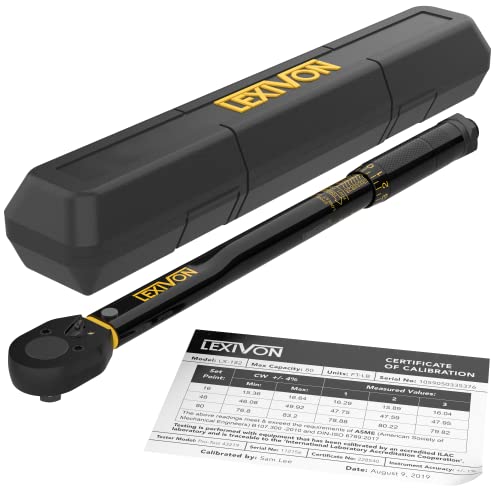 LEXIVON 3/8-Inch Drive Click Torque Wrench 10~80 Ft-Lb/13.6~108.53/8"DR. 10-80 FT-LB2.5 x 3 x 14 inches2.3 PoundsCheck on Amazon


What Project Farm’s torque-wrench test can—and can’t—tell you
Project Farm compared several torque wrenches against a reference setup at selected torque settings. The practical questions are whether a wrench’s readings stay near the target and whether repeated pulls land close together. Those are related but distinct: a wrench can be consistently high or low, or it can average near the target while varying noticeably from pull to pull.
Use the video’s reported results to shortlist candidates, then check the manufacturer’s range, drive size, accuracy specification, and calibration guidance. The test does not establish long-term durability, performance at every point across a wrench’s range, or how every unit from a production run will behave. Nor should results from one test fixture be treated as a calibration certificate.
How to choose by job
| Situation | What to prioritize | Practical choice |
|---|---|---|
| Occasional automotive work on common fasteners | Easy-to-read scale, suitable range, dependable click action | A reputable 3/8-inch or 1/2-inch click wrench whose range covers the specified torque |
| Wheel and suspension work | Range that includes the vehicle’s stated wheel-fastener torque, plus room to work | A 1/2-inch wrench, often with a separate lower-range wrench for smaller fasteners |
| Small fasteners or assemblies requiring low torque | Low minimum setting and fine, legible adjustment | A dedicated 1/4-inch or low-range wrench rather than a large wrench used near its minimum |
| Frequent professional use | Calibration support, clear documentation, serviceability, and repeatability | A documented model from a manufacturer or calibration provider that can support its upkeep |
| Tight budget or limited storage | One wrench that fits the most common jobs without excessive range compromises | Buy for your actual fasteners; add a second wrench only when your work demands it |
Drive size is a useful clue, not a torque specification. A 1/4-inch drive is commonly suited to smaller fasteners, 3/8-inch to general light and medium work, and 1/2-inch to larger automotive fasteners. But overlap is substantial: always follow the fastener or equipment maker’s torque specification and confirm it falls inside the wrench’s stated operating range.
Reading accuracy and repeatability without overclaiming
For each test point shown in Project Farm’s comparison, look at both the size of the error and the spread among repeated pulls. If the target is 100 units of torque and a wrench repeatedly indicates 105, that is a 5% high bias. If its pulls vary from 99 to 106, the spread is a separate concern. A single close reading does not prove the wrench will repeat it.
Also check the direction of the error and the tested setting. A tool may perform well near the middle of its range yet be less convincing near an endpoint. Where the video reports a percentage error, compare like with like: a 3% error at one setting is not a complete description of performance across the range. The manufacturer’s stated accuracy tolerance is a specification under its own conditions; it is not a guarantee that every individual wrench will match a video result.
Value: what you’re paying for
For occasional home use, a basic click-type wrench from an established tool brand may be a sensible value if its range fits the job and the documentation is clear. General market prices vary by size and quality, but entry-level consumer models are often in the tens of dollars, while better-documented or professional options can cost several times more. Treat those as broad market bands, not fixed prices.
Paying more can buy better markings, a more comfortable handle, a broader support network, or easier calibration and repair. It does not automatically mean better results on every fastener. Project Farm’s sampled performance can help distinguish candidates, but the test cannot price in service availability or the cost of replacing a tool that cannot be calibrated locally.
Setup and care that protect your results
- Use the correct range. Avoid choosing a wrench that barely reaches the required torque or using a high-range tool for delicate low-torque work.
- Set the value carefully. Read the scale at eye level, lock the adjustment if the model provides a lock, and confirm the unit—newton-metres, pound-feet, or another unit—matches the specification.
- Pull smoothly. Keep force on the marked grip area and apply steady pressure. Jerking the handle or adding an extension in a way that changes leverage can affect the result.
- Stop at the signal. On a click wrench, stop as soon as it clicks. Continuing to pull can over-torque the fastener and strain the mechanism.
- Store it correctly. For adjustable click-type models, follow the manual’s storage instruction; many specify returning the setting to the lowest marked value, not below it. Keep the tool clean, dry, and protected from drops.
- Check calibration when warranted. A drop, heavy use, suspected damage, or a critical application is reason to seek calibration or verification. Follow the manufacturer’s interval and any workplace requirements.
Common ownership mistakes include leaving a click wrench set at a high value for long-term storage, using it as a breaker bar, and assuming a click means the fastener is correctly torqued despite dirty or damaged threads. The wrench controls applied torque; it does not correct an unsuitable fastener, lubrication condition, or tightening procedure. Follow the equipment maker’s instructions for those details.
Bottom line
Use Project Farm’s results as a comparative screen, not a final authority: favor a wrench that performs consistently at the settings you actually need, then verify its range, specification, and calibration support. For mixed automotive work, two appropriately ranged wrenches can be more useful than one oversized model; for occasional jobs, a single well-chosen wrench is often better value than buying extra range you will not use.