What's inside
As an Amazon Associate I earn from qualifying purchases. This post may contain affiliate links at no extra cost to you.
A feeler gauge and a wire gauge can both help with small gaps, but they measure different things. A feeler gauge checks the width of a clearance by inserting a flat blade into it. A wire gauge identifies the diameter of a wire or rod, or—if you use a round wire as a makeshift probe—offers a rough way to check a gap.
For engine valve lash, spark-plug gaps, and similar slots, buy a feeler gauge. For measuring wire diameter, use a wire gauge. A wire gauge is a reasonable low-cost substitute only when the gap is accessible and approximate results are acceptable.
As an Amazon Associate we earn from qualifying purchases at no extra cost to you.


Our Top Picks

How the two tools measure
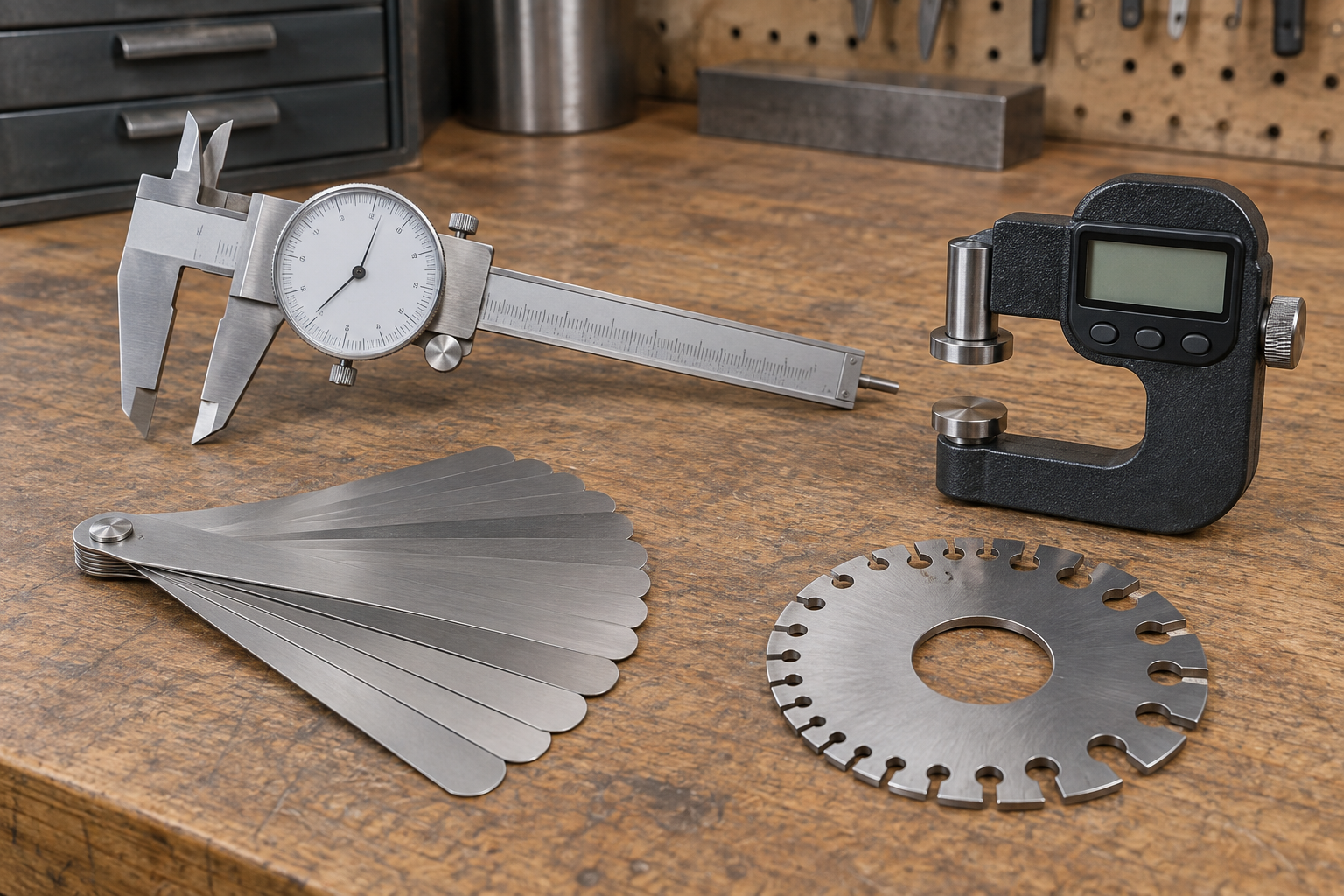
A feeler gauge is a set of thin, flat steel blades, usually marked with their thickness. Common sets cover roughly 0.0015 to 0.035 inches, or about 0.04 to 0.9 millimeters, though the range varies. You slide a blade into the gap; the correct fit has light, even drag without forcing the blade.
A wire gauge has holes, slots, or notches sized to identify wire diameter. Many gauges are designed for specific systems, such as American Wire Gauge (AWG), which assigns numbers to electrical conductor sizes. AWG numbers do not directly state diameter: higher AWG numbers mean thinner wire. A sheet-metal gauge is a different system again, and its numbers cannot be treated as wire diameters.
Round wire can be used as a gap probe because its diameter is known. But it contacts the edges differently from a flat blade, and a stepped wire gauge may only tell you which notch fits. It is not a direct substitute for a feeler set when you need a precise clearance measurement.
Feeler gauge vs. wire gauge at a glance
| Task or feature | Feeler gauge | Wire gauge |
|---|---|---|
| Best use | Checking narrow clearances and gaps | Identifying wire or rod diameter |
| Contact shape | Flat blade | Hole, slot, notch, or round wire |
| Typical reading | Blade thickness marked on the leaf | Diameter or gauge size, depending on scale |
| Fit in a long narrow slot | Usually good | Often awkward or unsuitable |
| Useful for valve lash | Yes | Only as a rough workaround |
| Useful for electrical wire sizing | No | Yes, if the gauge matches the sizing system |
Choose a feeler gauge for clearances
For valve lash, a feeler blade reaches between the valve stem and rocker or cam component, depending on the engine design. The fit gives a practical check at the specified setting. If a manual calls for 0.20 mm, a 0.20 mm blade should move with slight resistance. A blade that slides freely may indicate too much clearance; one that needs force may indicate too little—or a dirty, angled, or damaged blade.
The same principle works for spark-plug gaps and many machine clearances. A spark-plug wire-style gap tool can be quick for a routine check, but a flat feeler blade gives a more direct thickness check. Avoid levering against a fine-wire or precious-metal electrode; bending it can damage the plug.
Look for blades that cover the measurement range in your service manual and have clear markings. Combination metric-and-inch sets are convenient, but confirm which leaf you are using: 0.008 inch is about 0.20 mm, not exactly the same size. For general repair work, a metric-and-inch feeler gauge set is usually a more useful purchase than trying to improvise with round wire.
Choose a wire gauge for wire size
If you need to identify electrical wire, select a gauge marked for the system you are using. An AWG gauge helps identify conductor size; it does not measure insulation thickness or confirm how much current an installation can safely carry. For stranded wire, sizing by the insulated outside diameter will be misleading. Use an appropriate stripped conductor and avoid crushing or spreading strands while checking it.
For other materials, make sure the gauge’s scale matches the job. A sheet-metal gauge, for example, can identify sheet thickness only according to its specified gauge system; thickness varies by material and standard. A wire gauge is not a universal thickness ruler. A wire gauge marked in AWG makes sense for sorting bare electrical conductors, but it will not replace a feeler set for measuring engine gaps.
When wire is an acceptable workaround
A known-diameter piece of smooth, round wire can check a gap when the tolerance is loose and the shape allows it to enter. For instance, if you are checking whether a gap is clearly larger or smaller than 1 mm, a straight 1 mm wire may answer the practical question. It is cheap, easy to find, and may be enough for a noncritical fit check.
The limits matter. Wire can catch on burrs, compress or bend under pressure, and touch the gap at only a small point. A notched gauge may also be hard to keep square. In a tapered or irregular gap, the wire may fit at one location but not represent the clearance elsewhere. Do not use an improvised wire check for a specification that calls for a particular feeler thickness and drag.
Accuracy, care, and common mistakes
Both tools depend on clean contact and correct handling. Wipe oil, grit, and rust from the work and measuring surface. Dirt can make a feeler blade seem too thick; corrosion or a burr can stop either tool from seating. Keep feeler leaves flat. A kinked blade no longer measures reliably, and forcing one into a gap can damage the blade or the part.
Use the lightest pressure that gives a repeatable result. A feeler gauge should not be hammered or pried into place. If two neighboring blade sizes are available, test both: the thinner one should fit, while the next thicker one should be snug or refuse to enter, depending on the specified method. This gives a useful bracket rather than trusting one uncertain fit.
For frequent setup work, or clearances below about 0.1 mm, check that the set includes the required sizes and is not bent or worn. For an occasional loose-fit check, a simple gauge—or even known-diameter wire—may be adequate. Buy for the measurement system and geometry of the job, not just the smallest number printed on the package.