What's inside
As an Amazon Associate I earn from qualifying purchases. This post may contain affiliate links at no extra cost to you.
Our Top Picks


The short version
For curved woodwork, both the Milwaukee M18 FUEL jigsaw and Bosch JS470E can make controlled cuts. The bigger difference is how you want to work: Milwaukee is a cordless platform tool, while the Bosch is a corded saw with a broad, stable shoe and straightforward controls. If you already own M18 batteries and often work away from an outlet, the Milwaukee is the convenient choice. If you want one jigsaw for a workshop and don’t mind a cord, the Bosch is a sensible value.
Neither saw will make a tight curve cleanly with a blade that is too wide, a feed rate that forces the cut, or a pencil line you can’t see. Blade choice and technique matter at least as much as the saw.
As an Amazon Associate we earn from qualifying purchases at no extra cost to you.


What these saws have in common
Both are full-size jigsaws with variable-speed triggers, orbital-action settings, and tool-free blade changes. Both can handle curved cuts in plywood, solid wood, and common sheet materials. Their orbital settings trade finish for speed: more aggressive action clears chips quickly on straight cuts, but tends to leave rougher edges and makes a tight curve harder to steer.
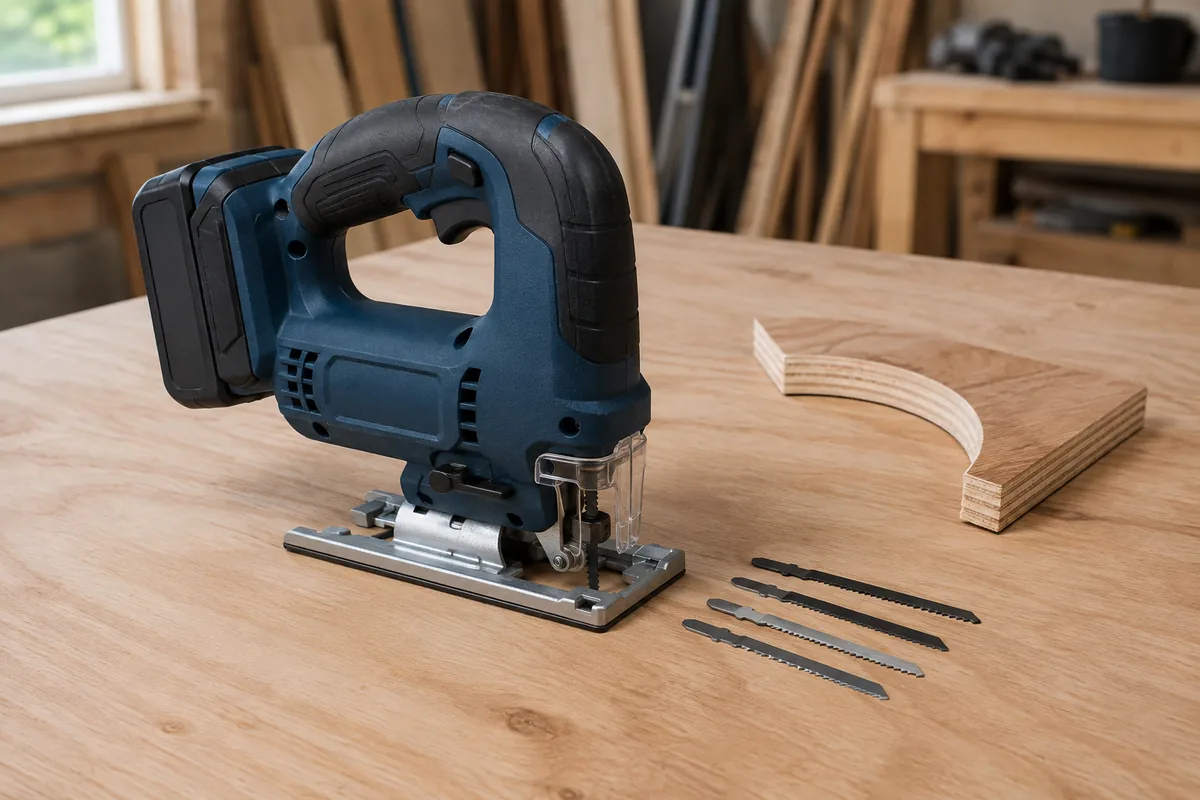
For visible curved edges, start with orbital action off or at its lowest setting. Use a narrow, sharp blade intended for curves, keep the base flat, and let the saw advance without twisting the blade. A blade bent sideways in the cut can leave a bevel even when the shoe looks level.
Side-by-side comparison
| Feature | Milwaukee M18 FUEL jigsaw | Bosch JS470E |
|---|---|---|
| Power source | M18 battery; battery and charger may be sold separately | Corded electric |
| Stroke length | 1 inch | 1 inch |
| Variable speed range | 0–3,500 strokes per minute | 500–3,100 strokes per minute |
| Orbital settings | Four positions, including off | Four positions, including off |
| Best fit | Mobile work and users already invested in M18 | Bench work and buyers who prefer corded power |
| Main trade-off | Battery cost, weight, and runtime depend on the pack | Cord management and access to an outlet |
Specifications can vary by package or product revision, so check the listing for the exact kit contents. The Milwaukee’s top speed is useful for fast cuts, but speed alone does not make it better at curves. The Bosch’s lower minimum speed can be helpful when you want a slower, deliberate start.
Curve control in practice
The Milwaukee’s cordless setup is its clearest advantage on a workpiece that is awkward to reach or too large to bring to a bench. There is no cord to drag around a cabinet panel or catch on a sawhorse. Its 3,500-strokes-per-minute ceiling gives it plenty of speed for ordinary wood cutting. The cost is that the tool needs a charged battery, and a larger battery can make an already substantial saw feel heavier over a long cut.
The Bosch is a practical choice for repeated cuts at a fixed station. You don’t have to plan around battery charge or buy into a battery system. Its cord is a real nuisance on large panels: route it behind you, keep it clear of the blade, and stop if it snags rather than pulling the saw sideways. That sideways pull is a common cause of an ugly, drifting curve.
For either saw, tight curves expose the limits of the blade before the motor. A wide general-purpose blade may bind or bend when you turn sharply. If the curve is small, use a narrower curve-cutting blade, slow down, and make relief cuts from the waste side so chips don’t trap the blade. Don’t try to correct a wandering cut by rotating the saw against a blade already pinched in the kerf.
Which one should you buy?
Choose the Milwaukee if you already own compatible M18 batteries, work on installs or large panels away from a bench, or value freedom from a cord enough to pay for the platform. If this will be your first M18 tool, include the battery and charger in the total price; a bare tool can look cheaper than the real purchase.
Choose the Bosch if most cuts happen in a workshop, you have reliable outlet access, and you would rather avoid battery expense. For occasional curves in furniture parts, trim backing, or plywood templates, the corded saw is not a compromise you need to apologize for. The money saved can go toward good blades, which are consumables and make a noticeable difference in cut quality.
Compare current Milwaukee M18 FUEL jigsaw listings with the Bosch JS470E listings, checking whether a battery, charger, case, or blade set is included. Don’t compare a complete kit’s price with a bare-tool price.
Getting a cleaner curve
Draw the line clearly, clamp the work so it cannot vibrate, and support the offcut if it might sag and pinch the blade. Put the visible face where the blade’s tooth direction is least likely to tear it; most jigsaw blades cut on the upstroke, though reverse-tooth blades behave differently. Test the blade on scrap if the finished face matters.
Start just outside the waste line and leave a little material for sanding. Keep the shoe flat and move at a steady pace. If the motor slows noticeably, the blade gets hot, or the cut begins to veer, ease off and check for a dull blade, excessive feed pressure, or a curve that is too tight for that blade. For a smooth, accurately sized curve, a jigsaw leaves room for cleanup; it is not a substitute for a router and template when the edge must be precise straight off the tool.