What's inside
As an Amazon Associate I earn from qualifying purchases. This post may contain affiliate links at no extra cost to you.
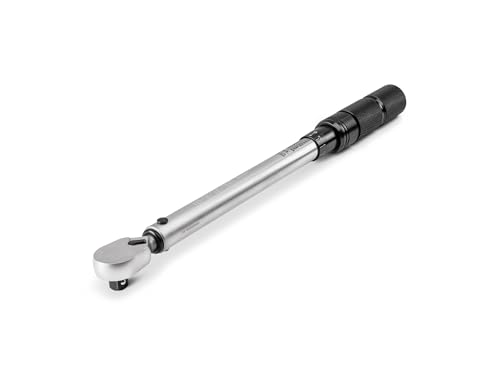
The best torque wrench for automotive use is usually a 3/8-inch click wrench covering roughly 10–100 ft-lb; pair it with a 1/2-inch model for wheel lugs and higher-torque fasteners, and add a 1/4-inch wrench if you regularly work on small engine or interior components. One wrench rarely covers every automotive job accurately, so choose by the torque values you actually need—not by maximum capacity alone.
As an Amazon Associate we earn from qualifying purchases at no extra cost to you.


Our Top Picks


Quick picks by job
- One-wrench DIY setup: A 3/8-inch click wrench around 10–100 ft-lb. It suits many brake, suspension, and engine fasteners, though it may not cover wheel-lug specifications.
- Wheel lugs and larger fasteners: A 1/2-inch click wrench around 30–250 ft-lb. Check that your vehicle’s lug specification falls comfortably within its range.
- Small, low-torque fasteners: A 1/4-inch wrench around 20–200 in-lb. This is useful for delicate engine, sensor, and interior work where a larger wrench may be hard to control.
- Frequent or documented work: Consider a digital wrench with an audible or visual target alert, or a wrench supported by accessible calibration service and documentation.
Compare common automotive torque-wrench sizes
The figures below are representative ranges, not specifications for a particular model. Actual capacity, accuracy, length, and calibration options vary by manufacturer. Confirm those details before buying.
| Drive size | Common range | Typical uses | What to watch for |
|---|---|---|---|
| 1/4 inch | 20–200 in-lb (about 1.7–16.7 ft-lb) | Small engine fasteners, sensors, clamps, and interior hardware | Too low for most wheel lugs; use inch-pounds carefully and avoid confusing them with ft-lb. |
| 3/8 inch | 10–100 ft-lb | Many brake, engine, and general repair fasteners | A strong all-rounder, but its upper limit may not reach some lug specifications. |
| 1/2 inch | 30–250 ft-lb | Wheel lugs, suspension, and larger chassis fasteners | Less suitable for low-torque work; a fastener near the bottom of its range is harder to set precisely. |
Choose by the work you do
For occasional DIY repairs
Start with the drive size and range that cover the manufacturer’s specifications for your most common jobs. For a mix of brake and engine repairs, a 3/8-inch click wrench is often the practical first purchase. If wheel service is also on your list, verify the lug torque in the owner’s or service manual. If it sits above the wrench’s range—or near its maximum—a separate 1/2-inch wrench is a better fit than forcing one tool to do both jobs.
For wheel lugs
Choose a 1/2-inch wrench whose working range comfortably includes the specified lug torque. A 1/2-inch drive describes the square drive size, not the torque accuracy or the socket size; use the correct impact-rated or standard socket for the job, as appropriate. Loosen tight lug nuts with a breaker bar, not the torque wrench. Use a torque wrench only for final tightening, and tighten in the vehicle maker’s specified sequence and stages.
For brake and engine work
These jobs can span very different torque levels. A caliper bracket fastener may call for far more torque than a small engine cover or sensor fastener. Check each specification rather than relying on a general rule of thumb. A 3/8-inch wrench handles many mid-range tasks, while a 1/4-inch inch-pound wrench helps prevent over-tightening smaller fasteners. For critical engine work, follow the service procedure exactly; some joints require a torque-plus-angle method rather than a torque wrench setting alone.
Click, split-beam, or digital?
- Click wrench: A common choice for home mechanics. Set the target on a scale or dial, pull smoothly, and stop at the click. It is straightforward to use, but the scale can be hard to read and an abrupt pull can overshoot the setting.
- Split-beam wrench: Often adjusts with a lever and may not require the same routine of returning the setting to minimum after use. That can simplify storage, but check the maker’s instructions and calibration support.
- Digital wrench: Shows a numeric setting and may provide a buzzer, light, or vibration as you approach the target. It can make unit conversion and repeatability easier, but batteries and electronics add maintenance needs and potential failure points.
For any style, look for a clearly legible scale, a comfortable handle, a dependable lock, and a stated accuracy specification. A wrench with a broad range is not automatically the best option if your usual fasteners fall at the edge of that range.
A simple way to check range fit
Suppose your vehicle’s service information specifies 100 ft-lb for its wheel lugs. A 3/8-inch wrench topping out at 100 ft-lb would be operating at its limit; it is wiser to choose a suitable 1/2-inch wrench whose stated range includes that value with room to spare. If the same vehicle also has small fasteners specified at 80 in-lb, that equals about 6.7 ft-lb—far below the useful range of most 1/2-inch wrenches. The practical solution is two appropriately sized tools, not an adapter intended to make one wrench cover everything.
Calibration, care, and ownership
Torque wrenches can drift after heavy use, impact, corrosion, or years in storage. Before buying, check whether the manufacturer offers calibration, provides a calibration certificate, and specifies a recommended interval or service procedure. Calibration support matters most if you use the tool frequently or need documented accuracy. A certificate records a check at a point in time; it does not prevent later damage or guarantee accuracy forever.
- Read the instruction manual for the wrench’s storage setting. Many click wrenches should be returned to their lowest marked setting—not below it—after use; others have different requirements.
- Keep the wrench clean and dry, and store it in its case. Do not use it as a breaker bar or drop it onto a hard floor.
- Pull smoothly from the handle’s intended grip area. Stop when the wrench signals the target; repeated clicks can keep tightening the fastener.
- Use a compatible extension carefully. A straight extension generally does not change the effective lever length, but a crowfoot used inline can change it; follow a reliable manufacturer method or reposition it at 90 degrees where the geometry permits.
- Replace a wrench with a damaged ratchet, unclear scale, slipping lock, or evidence of impact damage, and arrange a calibration check if accuracy is in doubt.
Bottom line
For a first purchase, a 3/8-inch click wrench around 10–100 ft-lb suits many everyday repairs. Add a 1/2-inch wrench for wheel lugs and higher-torque work; add a 1/4-inch inch-pound wrench for small fasteners. Match every setting to the vehicle’s service information, and prioritize usable range, readable adjustment, and calibration support over a high maximum number.