What's inside
As an Amazon Associate I earn from qualifying purchases. This post may contain affiliate links at no extra cost to you.
The best torque wrench for tires is usually a 1/2-inch drive, 24- to 26-inch click wrench covering roughly 30–150 ft-lb (41–203 N·m), because that range fits most passenger-car, crossover, SUV, and light-truck wheel-lug specifications while providing enough leverage for accurate tightening.
As an Amazon Associate we earn from qualifying purchases at no extra cost to you.

Our Top Picks
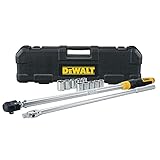
 HORUSDY 1/2-Inch Drive Click Torque Wrench Set10-170 ft-lb17.5 x 3.5 x 2.9 inches4.21 poundsCheck on Amazon

Quick picks by vehicle and working situation
| Situation | Best match | Target specifications | Why it fits |
|---|---|---|---|
| Typical sedan, hatchback, or crossover | 1/2-inch click wrench | 30–150 ft-lb; 18–24 inches long | Covers most lug-nut settings without excessive bulk |
| Large SUV, pickup, or trailer | 1/2-inch heavy-duty click wrench | 30–250 ft-lb; 24–26 inches long | Provides coverage for higher specifications and more leverage |
| Low-clearance wheel work | 3/8-inch wrench, used with the correct socket | 20–100 ft-lb; 12–18 inches long | More compact, but unsuitable if the vehicle requires more than its maximum |
| Frequent professional or fleet use | Certified industrial click or electronic wrench | 1/2-inch; range selected around the required torque | Better calibration support, readability, and serviceability |
What to look for in the best torque wrench for tires
1/2-inch drive is the safest general-purpose choice
A 1/2-inch square drive is the standard size for wheel-lug sockets. It accepts common impact-rated lug sockets, thin-wall wheel sockets, and extensions more readily than smaller drives. A 3/8-inch model can work for compact cars with lower torque settings, but its capacity may be too limited for trucks. A 3/4-inch wrench is normally unnecessary for ordinary passenger-vehicle wheels.
Choose a wrench whose working range places your vehicle’s specification near the middle, not at the extreme end. If the owner’s manual specifies 100 ft-lb, a wrench rated 20–100 ft-lb is a poor match because settings at the maximum limit can be less convenient and may offer less measurement margin. A 30–150 ft-lb wrench is better suited.
Torque range matters more than maximum torque
Wheel-lug specifications commonly fall somewhere around 75–150 ft-lb, but there is no universal value. Some compact vehicles use less, while heavy-duty pickups, vans, and aftermarket wheel systems may require more. Always use the vehicle manufacturer’s specification, which may differ between front and rear axles or between steel and alloy wheels.
For occasional tire changes, a 30–150 ft-lb wrench offers useful coverage. For trucks or mixed household vehicles, a 30–250 ft-lb model provides more flexibility. Do not select a 250 ft-lb wrench solely because its maximum number is larger: a long, heavy wrench can be awkward when accurately setting lower passenger-car values.
Length affects leverage and usability
A longer handle makes higher torque easier to apply, but it also needs more room beside the tire. A 24-inch wrench is a practical compromise for most garages. A 12- to 18-inch wrench fits cramped spaces but may require more physical effort at higher settings. Very short models are convenient for storage but can encourage users to add an uncontrolled pipe for leverage; that can damage the wrench or exceed the intended measurement conditions.
Accuracy and calibration support
Look for a stated accuracy of approximately ±3% clockwise, or better, and a manufacturer that provides calibration documentation or a service procedure. A click wrench is a precision instrument, not a substitute for a breaker bar. Use a separate breaker bar to loosen stuck lug nuts so the torque mechanism is not exposed to excessive shock.
Common, established options include the Tekton 1/2-inch click torque-wrench range, CDI Torque Products’ 1/2-inch adjustable models, and GearWrench’s 1/2-inch click models. Exact ranges, scales, drive lengths, and included accessories vary by model, so verify the current specification before buying. For commercial use, brands such as Norbar and Precision Instruments also offer professional torque tools and calibration services.
Head-to-head: click, beam, and electronic torque wrenches
| Type | Typical wheel-use strengths | Limitations | Best user |
|---|---|---|---|
| Click | Clear release signal, broad availability, easy presetting | Must be reset to its lowest setting for storage; can be misread if used too quickly | Most home mechanics |
| Beam | Simple construction, no spring to unload, generally inexpensive | Requires a line-of-sight reading while pulling; awkward around some wheels | Occasional users who value simplicity |
| Electronic | Digital display, audible and visual alerts, often supports multiple units | Higher cost, batteries, electronics vulnerable to poor storage and impact | Frequent or precision-focused users |
How to match the wrench to your vehicle
- Find the exact lug-nut torque. Check the owner’s manual or the manufacturer’s service information. Do not rely on a generic chart, tire-shop memory, or the number printed on an unrelated wheel listing.
- Convert units if necessary. One ft-lb equals approximately 1.356 N·m. Thus, 100 ft-lb is about 136 N·m, while 140 ft-lb is about 190 N·m.
- Check the wrench range. Put the required value between roughly 20% and 80% of the tool’s range when possible. For a 100 ft-lb requirement, a 30–150 ft-lb wrench is a stronger match than a 20–100 ft-lb model.
- Confirm socket compatibility. Select a correctly sized, undamaged socket. If an extension or adapter is required, use it in a straight line and follow the tool manufacturer’s guidance.
- Decide whether one wrench is enough. If one car requires 85 ft-lb and a truck requires 165 ft-lb, a 30–250 ft-lb 1/2-inch wrench can cover both. If the lower setting is especially important, two appropriately sized wrenches may be easier to read and handle.
Correct wheel-lug procedure
Remove and install lug nuts with a breaker bar or suitable hand tool, then use the torque wrench only for final tightening. Clean dirt and corrosion from the stud and nut threads, but do not lubricate them unless the vehicle or wheel manufacturer specifically calls for it; lubricant changes the friction and can cause excessive clamping force at the same displayed torque.
Thread each nut by hand first. Tighten in a star or crisscross pattern in stages, such as approximately half the final value followed by the full value. Keep the wrench handle at a right angle to the fastener, pull smoothly, and stop immediately at the click. Do not use the wrench to break fasteners loose or as a general-purpose ratchet.
After driving a short distance, recheck the wheel only if the vehicle or wheel manufacturer recommends it. Rechecking should use the same specified torque, not a higher “safety” value.
Ownership, storage, and common failure points
The spring and adjustment mechanism in a click wrench are the parts most affected by long-term storage under tension. Return an adjustable click wrench to its lowest marked setting after use, without forcing it below that setting. Store it dry, protected from drops and extreme heat, and avoid using it in place of a breaker bar.
Keep the scale and locking collar clean enough to read. If the tool is dropped, used to loosen fasteners, exposed to rain, or begins clicking inconsistently, have it checked before trusting it on wheel hardware. Calibration intervals depend on use; annual calibration is a sensible routine for frequent shop work, while occasional home users should at least have the wrench checked after misuse or a significant impact.
Replacement sockets are usually more economical than replacing a complete wrench. Use impact-rated sockets with impact tools, but make the final torque measurement with the torque wrench. Avoid thin-wall sockets that are cracked, rounded, or too loose on the lug nut, since a damaged socket can distort the nut and make accurate tightening impossible.
Bottom line
For most drivers, choose a 1/2-inch click torque wrench rated around 30–150 ft-lb, with a 24-inch handle, a clear dual scale, a positive locking collar, and stated accuracy near ±3%. Move to a 30–250 ft-lb model for higher-torque trucks and mixed vehicle ownership. The right tool is not the one with the largest maximum number; it is the one that places your vehicle’s specified lug torque comfortably inside its range and can be used accurately in the space around your wheels.