What's inside
- How to Choose a Battery Powered Ratchet Wrench: 5 Decision Criteria
- Spec Comparison: Popular Battery Powered Ratchet Wrenches in 2026
- Best Picks by Situation
- Runtime Worked Calculation: Will One Battery Last?
- Decision Matrix: Match Your Situation to the Right Type
- Durability and Ownership Realities
- Final Recommendation
- Related Guides
As an Amazon Associate I earn from qualifying purchases. This post may contain affiliate links at no extra cost to you.
The best battery powered ratchet wrench for everyday repairs is a 12V 3/8-inch model like the Milwaukee M12 FUEL, because it delivers enough torque for automotive and household fasteners while keeping the head small enough for tight engine bays and cabinets.
As an Amazon Associate we earn from qualifying purchases at no extra cost to you.


Our Top Picks
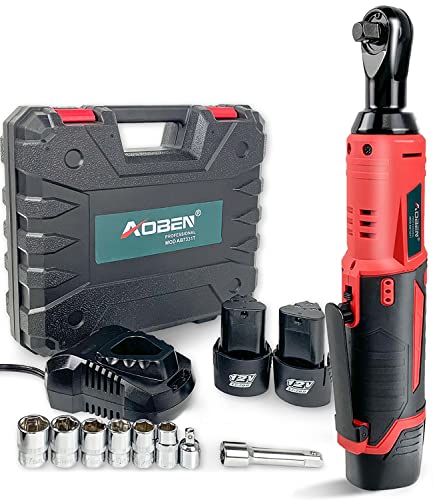 AOBEN Cordless Electric Ratchet Wrench Set3/8" 12V with 2 Batteries12 x 10 x 3.5 inches4.4 poundsCheck on Amazon


How to Choose a Battery Powered Ratchet Wrench: 5 Decision Criteria
Not all ratchets are built for the same job. For daily repairs rather than heavy shop use, balance portability and power using these five factors:
1. Battery Voltage and Platform Compatibility
Voltage determines both power and weight, and platform determines long-term cost:
- 12V systems (Milwaukee M12, Bosch 12V, Makita 12V max CXT): Lightest and most compact, ideal for one-handed overhead work and tight spaces. This is the sweet spot for everyday repairs. Bare tools are widely available and batteries are affordable.
- 18V/20V systems (DeWalt 20V MAX, Ryobi 18V ONE+, Makita 18V LXT, Craftsman V20): More power and longer runtime, but the battery adds length and weight to the handle. Best if you already own that 18V/20V platform for drills and impacts and want to share batteries.
- Platform lock-in: A battery powered ratchet wrench is rarely a standalone purchase. If you already own Milwaukee M12 or Ryobi ONE+ batteries, staying in that system will save you $50-$100 versus buying a new charger and batteries. Check whether the tool is sold as a bare tool or kit.
2. Torque vs. Control
For everyday repairs you need 35-60 ft-lbs (47-81 Nm) of maximum torque. More than 70 ft-lbs is useful for lug nuts and suspension work but increases the risk of snapping small fasteners if you lack variable speed. Look for:
- Variable-speed trigger with 2-stage control or electronic speed reduction
- Maximum RPM of 200-300 for controlled run-down, not just breakaway power
- A manual ratcheting override so you can break loose a tight bolt by hand, then power it off
3. Head Profile and Access
Head length, thickness, and anvil size determine where the tool actually fits:
- 3/8-inch drive: The versatile standard for everyday repairs. Fits 8mm-19mm sockets used on cars, lawn equipment, and furniture assembly.
- 1/4-inch drive: Thinnest head (under 1.1 inches thick) for small engine work, interior trim, and bicycles, but limited to about 30-35 ft-lbs.
- Extended reach: Long-neck models (11-16 inches) reach deep behind engines and water heaters but are harder to store in a home toolbox.
Measure your tightest space. A standard 10.5-inch ratchet often fails to clear exhaust manifolds or inside kitchen cabinets where an extended head succeeds.
4. Runtime and Battery Size
Runtime is quoted in fasteners per charge, not minutes. Most brands rate with a 2.0Ah battery:
- 12V with 2.0Ah: 120-180 fasteners (10mm nuts at 20 ft-lbs)
- 18V/20V with 2.0Ah: 170-250 fasteners, with heavier weight
For intermittent home use, a single 2.0Ah battery is usually enough for a full day of repairs. A 4.0Ah or 6.0Ah battery doubles runtime but adds 0.3-0.5 lbs and shifts balance toward the battery end, which causes fatigue overhead.
5. Weight and Ergonomics
A house-call repair ratchet is held one-handed at awkward angles. Tools under 3.0 lbs with battery are noticeably less fatiguing. Rubber overmold, a recessed trigger, and an LED light near the head matter more than raw power after the first 30 minutes of use.
Spec Comparison: Popular Battery Powered Ratchet Wrenches in 2026
The models below represent the most common platforms available at major hardware retailers in 2026. Specifications are manufacturer rated with a compact battery installed.
| Model | Voltage / Platform | Drive Size | Max Torque | No-Load RPM | Overall Length | Head Thickness | Weight with Battery |
|---|---|---|---|---|---|---|---|
| Milwaukee M12 FUEL 2557-20 | 12V M12 | 3/8 in | 55 ft-lbs (75 Nm) | 0-200 | 10.8 in (274 mm) | 0.94 in (24 mm) | 2.7 lbs (1.22 kg) w/ 2.0Ah |
| Milwaukee M12 FUEL Extended 2560-20 | 12V M12 | 3/8 in | 55 ft-lbs (75 Nm) | 0-200 | 15.0 in (381 mm) | 0.94 in (24 mm) | 3.0 lbs (1.36 kg) w/ 2.0Ah |
| DeWalt DCF512B | 20V MAX | 3/8 in | 70 ft-lbs (95 Nm) | 0-300 | 11.0 in (279 mm) | 1.12 in (28 mm) | 3.4 lbs (1.54 kg) w/ 2.0Ah |
| Makita XRW01Z | 18V LXT | 3/8 and 1/4 in | 35 ft-lbs (47 Nm) | 0-800* | 12.4 in (315 mm) | 1.10 in (28 mm) | 3.3 lbs (1.50 kg) w/ 2.0Ah |
| Ryobi PSBRC01 | 18V ONE+ HP | 3/8 in | 60 ft-lbs (81 Nm) | 0-260 | 10.7 in (272 mm) | 1.05 in (27 mm) | 3.2 lbs (1.45 kg) w/ 2.0Ah |
| Ingersoll Rand R3130 | 12V IQV12 | 3/8 in | 30 ft-lbs (40 Nm) | 0-250 | 10.1 in (257 mm) | 0.88 in (22 mm) | 2.4 lbs (1.09 kg) w/ 2.0Ah |
* Makita XRW01Z uses a higher RPM brushless motor tuned for speed rather than peak breakaway torque; it is faster for run-down but requires more manual breakaway.
Best Picks by Situation
Best Overall for Everyday Repairs: Milwaukee M12 FUEL 2557
The 12V FUEL balances the most important factors: 55 ft-lbs is sufficient for brake calipers, mower blades, and plumbing fixtures without being overpowered, the 0.94-inch head fits where 20V heads cannot, and the M12 battery keeps weight under 2.8 lbs. It is also part of the largest 12V tool ecosystem, so you can share batteries with drills, lights, and inflators. Typical market range is moderate for a bare tool, higher as a kit with two batteries.
Best if You Already Own 20V/18V Tools: DeWalt DCF512 or Ryobi PSBRC01
If you own DeWalt 20V MAX or Ryobi ONE+ batteries, buying into that system avoids a new charger. The DeWalt DCF512 offers the highest torque in this group at 70 ft-lbs and a metal-yoke housing, while the Ryobi PSBRC01 is lighter on cost and still delivers 60 ft-lbs. Both are slightly larger and heavier than 12V options, which you will feel during overhead cabinet or under-dash work.
Best for Tight Access and Light-Duty Work: Ingersoll Rand R3130 or 1/4-Inch Models
The Ingersoll Rand R3130 has the thinnest head and lightest weight here, making it ideal for small engines, HVAC panels, and bicycle repairs. Milwaukee also offers M12 FUEL 1/4-inch versions (2556) with similar dimensions and 40 ft-lbs. Choose 1/4-inch if you primarily work on fasteners under 13mm.
Best Extended Reach: Milwaukee M12 FUEL 2560
The extended 15-inch neck reaches exhaust studs, inside water heater compartments, and deep-set furniture bolts without extensions that waste torque. It uses the same motor and battery as the standard 2557, so torque is identical. Only choose it if you regularly work beyond arm’s length; otherwise the standard length is easier to store.
Runtime Worked Calculation: Will One Battery Last?
Use this quick calculation to estimate if you need a second battery for a repair session:
Formula: Fasteners per charge = Battery energy (Wh) / Energy per fastener (Wh)
- Milwaukee M12 2.0Ah battery = 12V x 2.0Ah = 24 Wh (rated; about 21.6 Wh usable)
- Energy to run down one 13mm bolt at ~25 ft-lbs is about 0.12-0.15 Wh
- Usable fasteners = 21.6 Wh / 0.13 Wh = ~166 fasteners
In practice, factor in LED use, cold temperatures, and breaking rusted fasteners which can double energy use. For a typical brake job (40-50 fasteners), a single 2.0Ah battery leaves 60% charge. If you plan to rotate tires and do a full engine bay refresh in one session (100+ fasteners), carry a second 2.0Ah or one 4.0Ah battery.
Decision Matrix: Match Your Situation to the Right Type
| Your Situation | Recommended Type | Why |
|---|---|---|
| Home DIY, apartment repairs, furniture, occasional car work | 12V 3/8-inch standard length | Lightest, fits drawers and tool bags, enough torque for 90% of tasks |
| Frequent auto DIY, rust-belt vehicles | 12V 3/8-inch with manual breakaway + breaker bar | Power ratchet is for speed; break loose with hand tools first to protect the mechanism |
| Already invested in DeWalt/Makita/Ryobi 18V/20V | Same-voltage 3/8-inch from that brand | No new charger, battery sharing lowers ownership cost |
| Tight engine bays, motorcycles, small engines | 12V 1/4-inch or low-profile 3/8-inch | Thinner head and lower weight prevent rounding small fasteners |
| Need to reach deep fasteners weekly | 12V or 18V extended-reach 3/8-inch | Eliminates wobble extensions that reduce torque |
Durability and Ownership Realities
A battery powered ratchet wrench does not wear like a drill. The failure points are different:
- Anvil and pawl wear: The ratchet mechanism is still mechanical. Dirt, metal shavings, and using the tool as a hammer degrade the pawls first. Blow out the head with compressed air after dusty jobs and avoid using the ratchet to break loose fasteners above its rated torque.
- Yoke housing cracks: Drop protection matters. Models with a glass-filled nylon housing and metal yoke (Milwaukee FUEL, DeWalt) survive falls from a workbench better than all-plastic housings.
- Brushless motor life: All models in the table above are brushless, so brushes are not a consumable. The on/off trigger and forward/reverse switch are more likely to need cleaning than replacement.
- Batteries: Lithium-ion batteries degrade faster when stored fully charged in heat. For a tool used weekly, store batteries at 40-60% charge if you will not use them for a month. Expect 300-500 full cycles before noticeable capacity loss.
- Common mistakes: Over-torquing with the power ratchet and then stripping threads, using impact sockets that are too thick to fit in tight spots (use chrome sockets for access, impact sockets only when needed), and forgetting to switch to hand mode for final torque. Always finish critical fasteners with a manual torque wrench.
Cleaning is simple: wipe the head with a lightly oiled rag, keep the battery contacts dry, and do not submerge or pressure-wash. Light machine oil on the anvil square every 3-6 months keeps the ratchet action smooth.
Final Recommendation
For most homeowners and light automotive work, buy a 12V 3/8-inch battery powered ratchet wrench from the platform you already own. If you are starting fresh, the Milwaukee M12 system offers the best combination of compact size, weight, and accessory depth for everyday repairs. If you already own DeWalt 20V MAX or Ryobi ONE+ and want to avoid a new battery system, their 3/8-inch ratchets provide more raw torque at the cost of added size and weight. Reserve extended-reach and 1/4-inch models for specific access problems rather than as your only ratchet.