What's inside
As an Amazon Associate I earn from qualifying purchases. This post may contain affiliate links at no extra cost to you.
The best pass-through socket set for tight-clearance work is the GearWrench pass-through system for frequent automotive and maintenance use, while a compact 8-piece or 10-piece metric set is the better choice when storage space and price matter most.
As an Amazon Associate we earn from qualifying purchases at no extra cost to you.


Our Top Picks
 GEARWRENCH 25 Piece 3/8" Drive Pass-Thru Ratchet and25 Count(Pack of 1)13.2 x 7.3 x 2.2 inchesCheck on Amazon
 Klein Tools 65400KNECT KNECT Essential Pass Through Impact3/8-Inch Drive12.75 x 7.25 x 2 inches3.18 PoundsCheck on Amazon
 Klein Tools 65500KNECT KNECT Impact Socket Set3/8-Inch Drive15.5 x 10.5 x 2 inches5.05 poundsCheck on Amazon
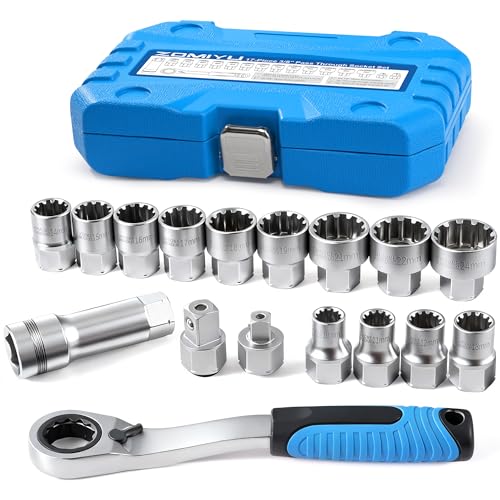
Best pass-through socket sets at a glance
| Best for | Recommended type | Typical included sizes | Access advantage | Main limitation |
|---|---|---|---|---|
| Regular automotive and workshop use | GearWrench pass-through set | Metric 10–19 mm; SAE approximately 3/8–3/4 in, depending on set | Open center accepts long threaded studs | Bulkier head than a slim conventional ratchet |
| Occasional repairs on mixed fasteners | Crescent X6 pass-through set | Common metric and SAE sizes, often with universal-style sockets | One socket profile can cover several fastener shapes | Universal sockets are less ideal for badly damaged fasteners |
| Small toolboxes and household maintenance | Compact metric pass-through set | 8–19 mm, usually in 1 mm or selected increments | Replaces several deep sockets for protruding studs | May omit larger sizes and SAE fittings |
| Low-cost backup or infrequent use | Basic 3/8-inch pass-through set | Metric 8–19 mm or SAE 1/4–3/4 in | Affordable clearance tool for occasional jobs | More play, simpler case, and less refined ratchet mechanism |
Why pass-through sockets save clearance
A standard socket stops at the back of the fastener. A pass-through socket has a hollow center, allowing the threaded end of a bolt or stud to pass through the ratchet head and socket. This matters when removing a nut from a long suspension stud, threaded rod, water-heater fitting, faucet supply connection, or alternator bracket.
With a normal socket, you may need a deep socket, an extension, or a crowfoot arrangement. Each option adds length or changes the direction of force. A pass-through tool can keep the ratchet close to the nut while the stud disappears through the center.
The clearance saving is not universal. A pass-through ratchet head is often wider and taller than a conventional 3/8-inch ratchet, so it can be a poor choice beside a frame rail or between closely spaced fasteners. Its advantage is axial clearance behind the nut, not necessarily side-to-side clearance.
Head-to-head: what separates the better sets
GearWrench: the strongest all-round choice
GearWrench’s pass-through systems are aimed at mechanics who use the feature repeatedly rather than treating it as a novelty. Sets commonly combine metric and SAE sockets, a pass-through ratchet, adapters, and accessories. The useful size coverage generally starts around 10 mm and extends to 19 mm on the metric side, with common fractional sizes around 3/8 to 3/4 inch.
The main reason to choose this type of set is the ratchet. A fine-tooth mechanism gives more usable movement when only a small swing arc is available. Check the particular kit before buying, because tooth counts and included adapters vary between versions. A 72-tooth ratchet, for example, advances in 5-degree increments; a 45-tooth mechanism advances 8 degrees. That difference is significant around brackets and engine accessories.
GearWrench is the better pick for frequent automotive work, mixed metric and SAE fasteners, and buyers who would rather purchase one reasonably complete system than add missing sizes later.
Crescent X6: useful when fasteners are imperfect
Crescent X6 pass-through kits are notable for universal-style socket geometry. Instead of relying only on six precise contact points, the socket profile is designed to work with several common fastener shapes, including some rounded or partially damaged heads.
That versatility is helpful for household repairs, older equipment, and maintenance where the exact fastener condition is unknown. The trade-off is that a universal profile should not be treated as a substitute for a correctly sized six-point socket on high-torque, heavily corroded fasteners. Use the closest proper fit whenever the fastener is accessible.
Choose a Crescent-style universal pass-through set when versatility matters more than maximum precision, particularly if you want one kit for both metric and SAE work.
Compact metric sets: the sensible small-toolbox option
A compact metric pass-through set is often the best value for a home mechanic who works mainly on modern vehicles, bicycles, appliances, and furniture hardware. An 8–19 mm range covers many common nuts without the weight and cost of a large mixed set.
Look for the actual included sizes rather than assuming every millimeter is present. Some sets include 8, 10, 11, 12, 13, 14, 15, 17, and 19 mm but omit 16 and 18 mm. Those omissions may not matter for household use, but they can be frustrating on automotive brackets.
A compact set is also easier to carry into a crawlspace or onto a ladder. Its weakness is specialization: if your work includes older machinery, imported equipment, or plumbing with fractional nuts, you may soon need SAE sockets or separate conventional tools.
What to check before buying
1. Included sizes and usable range
For general vehicle work, prioritize metric sizes from 10 to 19 mm, especially 10, 12, 13, 14, 15, 17, and 19 mm. For older American vehicles, lawn equipment, and some workshop machinery, a useful SAE range is 3/8 to 3/4 inch.
Do not judge coverage by the largest number alone. A set ending at 19 mm but missing 16 or 18 mm may have less practical coverage than a slightly smaller set with fewer gaps.
2. Fastener compatibility
Pass-through sockets are not automatically compatible with every drive tool. Many use a proprietary hollow ratchet and socket interface rather than a conventional square-drive socket system. Some kits include adapters for standard sockets, but those adapters may remove the central clearance that makes the tool useful.
Confirm whether the kit works with:
- Metric and SAE hex nuts.
- Long studs and threaded rod.
- Six-point or universal socket profiles.
- Torque wrenches or breaker bars through included adapters.
- Extensions and universal joints, if the manufacturer permits them.
A pass-through ratchet is usually not the first choice for loosening severely seized fasteners. Use penetrating fluid, a conventional breaker bar, or a suitable impact-rated tool where appropriate. Many pass-through sockets are intended for hand tools and should not be used with an impact wrench unless explicitly marked for impact use.
3. Ratchet head access
Compare the head dimensions, not just the tooth count. A smaller head may fit between a nut and a surrounding bracket, while a fine-tooth mechanism reduces the swing required to make progress. Reversible direction control should be operable with one hand and should not protrude so far that it catches on nearby components.
Remember the geometry: the socket can save substantial space behind the fastener, but the ratchet head still occupies space around it. If side clearance is the problem, a slim conventional ratchet, offset wrench, or crowfoot may be better.
4. Case design
Cases are more important for pass-through sets than they appear. The sockets are often unusual enough that loose storage makes it easy to confuse sizes or lose the proprietary ratchet.
Prefer a case with molded size markings, positive socket retention, a separate location for adapters, and hinges that do not flex excessively. A compact case with every socket locked in place is more useful than a larger case containing empty spaces and poorly labeled clips.
Decision matrix: which set fits your situation?
| Your situation | Best choice | Why |
|---|---|---|
| Under $50, occasional use | Basic compact metric set | Covers common nuts without paying for rarely used sizes |
| Weekly vehicle maintenance | Complete mixed metric/SAE set | Reduces gaps and provides a more capable ratchet |
| Very tight swing arc | Fine-tooth pass-through ratchet | Requires fewer degrees of movement per click |
| Damaged or uncertain fasteners | Universal-style pass-through set | Offers more shape tolerance, though proper sizing remains preferable |
| Mostly large nuts or threaded rod | Set with larger sockets or a dedicated pass-through wrench | Small automotive kits may stop before the required sizes |
Worked clearance example
Suppose a nut sits on a stud with 45 mm of exposed thread behind it. A standard shallow socket may bottom out after roughly 15–20 mm of usable depth, and a deep socket may extend 50 mm or more behind the nut. If a bracket is only 35 mm away, neither option is convenient: the shallow socket may not engage fully, while the deep socket contacts the bracket.
A pass-through socket lets the stud enter the hollow ratchet head. The tool can remain close to the nut while the 45 mm of thread occupies the open center. The clearance benefit is therefore approximately the exposed-stud length that would otherwise need to fit inside a socket—subject to the pass-through system’s maximum stud diameter and head dimensions.
Durability and ownership realities
The ratchet mechanism usually wears before the sockets. Dirt, dried grease, and side-loading can make the selector rough or cause inconsistent engagement. Keep the head clean, avoid using the ratchet as a hammer, and do not add a pipe for extra leverage unless the manufacturer specifically allows it.
Inspect the socket opening for burrs and deformation, particularly after removing corroded nuts. Clean the set with a lightly oiled cloth and keep it dry before closing the case. Do not grind the socket opening to accommodate an oversized stud; this can weaken the socket and create poor nut engagement.
One common mistake is using the largest available socket because the nut appears close to that size. A loose fit rounds corners quickly. Test the socket by hand, make sure it seats fully, and switch to a conventional six-point socket if the pass-through profile does not grip securely.
Final verdict
The best pass through socket set is the one whose clearance advantage matches your actual problem. Choose a GearWrench-style mixed set for frequent automotive work and broad coverage, a Crescent X6-style universal set when fastener condition is unpredictable, and a compact metric set for low-cost household or occasional maintenance. Before buying, verify every included size, the ratchet head dimensions, compatibility with adapters, and whether the case keeps the proprietary parts organized. Pass-through tools are not a replacement for a complete socket collection, but around long studs and protruding bolts they can solve a clearance problem that standard sockets cannot.