What's inside
- Best wheel torque wrench picks by situation
- Comparison: which specifications actually matter?
- How to match the range to your vehicle
- Drive size, sockets, and extension compatibility
- Length and accuracy: where convenience becomes a problem
- Correct wheel-torque procedure
- Ownership realities and maintenance
- Related Guides
As an Amazon Associate I earn from qualifying purchases. This post may contain affiliate links at no extra cost to you.
The best wheel torque wrench for most passenger cars, SUVs, and light trucks is a 1/2-inch-drive click wrench covering roughly 50–250 ft-lb, with a documented accuracy of about ±4%, a long handle, and enough clearance to use a short impact-rated extension or six-point socket safely.
Torque matters because wheel fasteners need to be tight enough to clamp the wheel securely, but not so tight that studs stretch, rotors distort, or roadside removal becomes difficult. The right choice depends less on maximum torque than on usable range, calibration, access around the wheel, and whether the wrench fits your vehicle’s specified lug-nut setting.
As an Amazon Associate we earn from qualifying purchases at no extra cost to you.


Our Top Picks
 LEXIVON Torque Wrench 1/2-Inch Drive Click 10~150 Ft-Lb/13.6~203.51/2"DR. 10-150 FT-LB2.5 x 3 x 18 inches3 PoundsCheck on Amazon
 EPAuto 1/2-inch Drive Click Torque Wrench1/2 Inch Drive (10-150 ft.-lb.)17.4 x 3.3 x 2.6 inches3.5 poundsCheck on Amazon
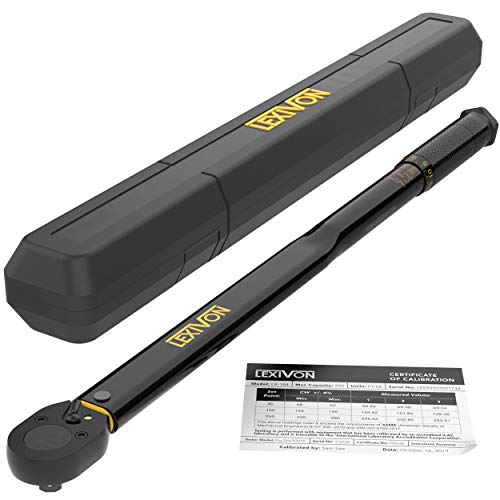 LEXIVON 1/2-Inch Drive Click Torque Wrench 25-250 Ft-Lb/33.9-338.91/2"DR. 25-250 FT-LB3 x 3 x 24 inches6.4 PoundsCheck on Amazon

Best wheel torque wrench picks by situation
- Best general-purpose choice: Tekton 24320. This 1/2-inch-drive click wrench covers 25–250 ft-lb and is a practical fit for many cars, crossovers, SUVs, and light trucks. Its broad range is useful for both wheel work and larger chassis fasteners, although settings near the bottom of its range are less ideal than with a smaller wrench.
- Best for frequent shop or fleet use: Gearwrench 85077. Its 1/2-inch drive and approximately 30–340 ft-lb range suit higher-torque truck and SUV applications. The extra capacity is valuable for heavy-duty work, but it is larger, heavier, and unnecessarily broad for a small passenger car.
- Best for a compact, high-quality mechanical design: CDI 2503MFRMH. This 1/2-inch-drive micrometer torque wrench is commonly specified for 30–250 ft-lb applications and has a locking adjustment mechanism. It is a strong choice when repeatable settings and long-term serviceability matter more than the lowest purchase price.
- Best for fast setting and reduced spring tension: Precision Instruments C2FR100F. This 1/2-inch-drive split-beam wrench covers 20–100 ft-lb. It is especially useful for vehicles with lower wheel torque specifications, but its maximum is too low for many trucks and some large SUVs.
- Best budget category. A 1/2-inch-drive click wrench rated from about 50–250 ft-lb is usually the sensible low-cost option. Choose one with a stated accuracy, an engraved or clearly readable scale, a reversible ratchet, and a calibration certificate rather than selecting solely by price.
Comparison: which specifications actually matter?
| Tool or type | Drive | Typical torque range | Approx. length | Best use | Main limitation |
|---|---|---|---|---|---|
| Tekton 24320 | 1/2 in. | 25–250 ft-lb | 18 in. | Mixed passenger cars, SUVs, and light trucks | Less precise choice at very low settings |
| Gearwrench 85077 | 1/2 in. | 30–340 ft-lb | 24 in. | Large SUVs, trucks, and higher-torque work | Bulky for compact-car wheel wells |
| CDI 2503MFRMH | 1/2 in. | 30–250 ft-lb | About 19 in. | Frequent, repeatable wheel service | Costs more than basic click wrenches |
| Precision Instruments C2FR100F | 1/2 in. | 20–100 ft-lb | About 18 in. | Cars with lower lug-nut specifications | Insufficient capacity for many trucks |
| General 3/8-inch wheel wrench | 3/8 in. | 10–100 ft-lb | 14–18 in. | Small cars and low-torque fasteners | Limited socket and extension capacity |
Published dimensions can vary slightly by revision, and torque-wrench accuracy is normally stated over a defined percentage of the scale. Treat the figures above as buying guides, then confirm the manufacturer’s current specification before ordering.
How to match the range to your vehicle
Find the wheel-fastener torque in the owner’s manual or an authoritative service procedure. Do not substitute a generic value based only on wheel diameter. A compact car may specify approximately 75–100 ft-lb, while a crossover may require 90–110 ft-lb, a half-ton truck commonly falls around 100–150 ft-lb, and some heavy-duty applications exceed 150 ft-lb. These are examples, not universal settings.
A useful sizing rule is to place your required torque between about 20% and 80% of the wrench’s stated range. For a 110 ft-lb lug specification:
- A 25–250 ft-lb wrench places the setting at 44% of its range and is well suited.
- A 30–340 ft-lb wrench places it at only about 32%, still usable but less convenient for fine adjustment.
- A 20–100 ft-lb wrench cannot reach the required value and must not be forced beyond its limit.
If a household has two vehicles, a 1/2-inch wrench covering 30–250 ft-lb is usually the most versatile single-tool solution. If one vehicle uses 80 ft-lb and another uses 175 ft-lb, two tools can improve control: a 3/8-inch wrench for the car and a 1/2-inch wrench for the truck.
Drive size, sockets, and extension compatibility
A 1/2-inch drive is the default for wheel work because it accepts common 17, 19, 21, and 22 mm impact sockets and tolerates the leverage required for larger lug nuts. A 3/8-inch drive can be excellent for small cars, but its socket selection and maximum capacity are narrower. A 1/4-inch torque wrench is not a wheel tool.
Use a six-point socket that fits the lug nut exactly. Thin-wall sockets may be necessary for recessed or decorative nuts, but they need enough wall thickness to avoid cracking. If the socket cannot reach the nut, use a short, straight extension. A fixed extension generally has little practical effect on a properly seated socket, but universal joints, wobble extensions, and angled adapters can change the loading and should be avoided unless the tool manufacturer permits them.
Do not use a torque wrench to break loose tight lug nuts. Do not add a cheater pipe to its handle. For stubborn fasteners, use a breaker bar, then clean and inspect the threads before torqueing.
Length and accuracy: where convenience becomes a problem
Long handles reduce the hand force needed to reach a high setting. At 150 ft-lb, a 24-inch handle requires about 75 pounds of force at the grip, while an 18-inch handle requires about 100 pounds, ignoring friction and leverage losses. The shorter wrench is easier to store and maneuver, but the longer wrench is more comfortable on truck wheels.
A long wrench also needs room to swing. In a crowded wheel well, a 24-inch model may hit the ground, bodywork, or suspension before the lug nut reaches the required torque. A 16- to 19-inch wrench is generally easier around passenger cars.
For wheel service, a stated accuracy of ±4% is a reasonable target. Accuracy is only useful when the setting can be read clearly. Micrometer scales are precise but require careful reading; split-beam designs are quick to set and usually do not require spring relaxation after every use. Digital models offer audible or visual alerts, but batteries, displays, and electronics add ownership considerations.
Correct wheel-torque procedure
- Confirm the specification. Check the owner’s manual and determine whether the value applies to dry, clean threads. Never lubricate studs unless the vehicle manufacturer specifically requires it.
- Prepare the mating surfaces. Remove rust, dirt, and paint flakes from the hub face and wheel mounting surface. Keep friction surfaces free of grease.
- Start every lug nut by hand. Turn it several rotations to prevent cross-threading. If it binds immediately, remove it and inspect the threads.
- Snug in a star or crisscross pattern. Use a normal ratchet or hand tool, not the torque wrench, for the initial seating.
- Set the wrench while unloaded. Adjust the handle to the specified value, lock it, and pull smoothly from the marked grip. Do not jerk or pull from the end of an extension.
- Torque in sequence. Follow the star pattern until each fastener clicks once at the target setting. Recheck the pattern once if the wheel was initially loose or the contact surfaces required cleaning.
- Recheck after driving only when specified. Some vehicles or aftermarket wheel manufacturers request a check after a short drive; follow that instruction rather than applying a blanket rule to every car.
Ownership realities and maintenance
The most common failure is not the ratchet mechanism but incorrect storage and handling. A click wrench left set near its maximum for months can lose calibration, especially on inexpensive models. Return a conventional micrometer click wrench to its lowest marked setting after use, without forcing below the minimum. Split-beam tools often have different storage instructions, so follow their manuals.
Keep the tool clean and dry, wipe it after use, and store it in its case. Never use penetrating oil on the scale or internal mechanism unless the manufacturer specifies it. Have the wrench checked periodically if it is used professionally, dropped, overloaded, or exposed to extreme conditions. Occasional home wheel changes may justify checking calibration every few years; frequent shop use warrants a shorter interval based on the manufacturer’s guidance.
For most owners, the final decision is simple: choose a 1/2-inch-drive, 30–250 ft-lb mechanical wrench for broad vehicle coverage; choose a 20–100 ft-lb tool for low-torque cars; and move to a 30–340 ft-lb, longer wrench when truck and heavy-duty wheel work is routine. Pair it with the correct six-point socket and a careful installation sequence, and the tool will be safer and more useful than a larger-capacity wrench selected by maximum number alone.