What's inside
- Best Claw Hammers: Strong, Comfortable Picks for Driving and Pulling Nails
- Quick picks by project
- Curved claw versus straight claw
- How much hammer head weight do you need?
- Forged steel, titanium, and handle materials
- Grip comfort is more than soft rubber
- Decision matrix: match the hammer to your situation
- Nail-pulling technique that protects the work
- Durability and ownership realities
As an Amazon Associate I earn from qualifying purchases. This post may contain affiliate links at no extra cost to you.
Our Top Picks



Best Claw Hammers: Strong, Comfortable Picks for Driving and Pulling Nails
The best claw hammers for most homeowners are 16-ounce curved-claw models with a forged steel head, a balanced handle, and a grip that stays secure without creating hot spots; choose a lighter 12-ounce hammer for trim and a straight-claw or framing hammer when pulling, prying, and rough construction matter more than finish quality.
Quick picks by project
- Best all-purpose choice: A 16-ounce curved-claw hammer with a forged steel head and fiberglass or hickory handle.
- Best for trim, picture hanging, and light repairs: A 10- to 12-ounce smooth-face hammer with a short, well-balanced handle.
- Best for renovation and demolition: A 20- to 28-ounce straight-claw hammer, preferably with a shock-reducing handle.
- Best traditional option: A 16-ounce hickory-handled hammer from a long-established maker such as Vaughan or Stanley.
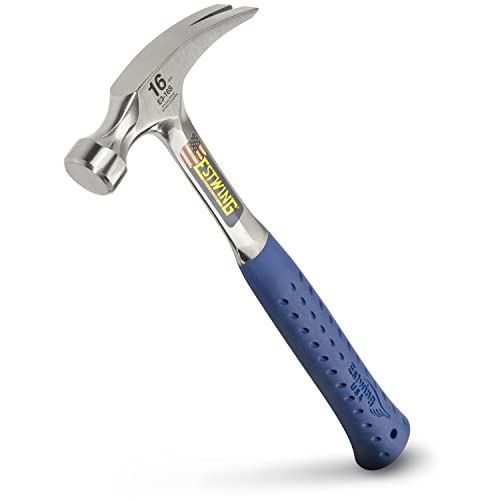
- Best one-piece durability design: An Estwing-style forged steel hammer with an integral steel handle and molded grip.
- Best premium framing-oriented option: A Stiletto titanium hammer when reduced head weight and repeated overhead work justify the higher cost.
Curved claw versus straight claw
Curved claws: better for everyday nail pulling
A curved claw forms a rounded fulcrum, so it can roll against a board and pull a nail with relatively little hand force. The deeper curve also gives better purchase on partially driven nails. This makes it the most useful pattern for household repairs, shelving, fencing, furniture assembly, and general carpentry.
As an Amazon Associate we earn from qualifying purchases at no extra cost to you.



The trade-off is reach. A curved claw usually cannot pull a nail as far from a surface as a straight claw, and its shape is less useful for prying boards apart. Its leverage can also damage soft wood if the claw is rocked directly against a finished surface. Put a scrap block beneath the head when protecting trim or flooring matters.
Straight claws: more reach and prying leverage
A straight claw is longer and more pointed. It can reach buried nail heads, split boards apart, and work in demolition or framing situations where the hammer doubles as a small pry tool. The narrow tips are useful for starting a nail in a tight corner.
That extra reach does not automatically mean easier nail removal. A straight claw often needs more clearance behind the nail, and its less-rounded fulcrum can mark wood quickly. It is usually excessive for occasional household work, but valuable for renovation, roofing, framing, and pallet disassembly.
How much hammer head weight do you need?
| Head weight | Typical use | Advantages | Limitations |
|---|---|---|---|
| 8–12 oz | Small brads, trim, picture hooks, light assembly | Precise, less tiring, easier in confined spaces | Slow on long nails; limited pulling leverage |
| 14–16 oz | General repairs, shelves, furniture, basic framing | Best balance of driving force, control, and portability | Can be tiring during prolonged overhead work |
| 18–20 oz | Framing, decking, fence work, renovation | Drives larger nails efficiently; stronger claw and face options | More hand and wrist fatigue; easier to dent soft wood |
| 22–28 oz | Heavy framing, demolition, prying, spikes | High striking energy and substantial claw leverage | Bulky, tiring, and poorly suited to delicate work |
Head weight is not the same as total hammer weight. A 16-ounce head may become a roughly 20- to 24-ounce tool after adding the handle, grip, and eye area. Balance matters as much as the number stamped on the head: a hammer that feels head-heavy can be tiring even if its listed weight looks reasonable.
Forged steel, titanium, and handle materials
Forged steel
Forged steel is the conventional choice because it combines high impact resistance, affordable pricing, and broad availability. The striking face should be hardened enough to resist mushrooming but not so brittle that it chips. A smooth face is preferable for visible finish work; a milled or checkered face grips nail heads better but leaves a pattern of marks when it misses.
One-piece forged steel designs, including the style used by Estwing, eliminate the separate head-to-handle joint. They are durable and resistant to loosening, although the steel transmits more vibration unless the grip and shape absorb it effectively.
Titanium
Titanium heads, used by brands such as Stiletto, are lighter than steel for a similar striking profile. The reduced head weight can make repeated overhead framing less tiring, while a longer handle can preserve useful swing speed. The cost is substantially higher than a conventional steel hammer, and titanium is not necessary for occasional nail driving.
Hickory
Hickory has a long record in professional tools because it is resilient, comfortable, and replaceable. It also provides useful vibration damping. Inspect a wooden handle before every use: avoid cracks, loose heads, severe dents, or a wedge that is backing out. Keep hickory dry and do not soak it in water to make it swell permanently.
Fiberglass and composite handles
Fiberglass handles resist splitting and generally require less maintenance than wood. Many have a separate rubberized grip that improves control. The grip can eventually split, become slippery with oils, or separate from the core, and the handle is usually not as practically replaceable as hickory.
Grip comfort is more than soft rubber
A good handle should let you hold the hammer near the end for driving force and choke up near the head for control. Look for a grip long enough to accommodate different hand positions, with a modest flare or non-slip texture at the butt. Extremely soft foam can feel comfortable at first but may compress, tear, or become slick sooner than a firm elastomer grip.
Handle length affects both control and leverage. A compact 12- to 13-inch handle fits drawers and tight spaces. A general-purpose 14- to 16-inch handle provides a useful compromise. Framing hammers commonly extend to about 16 or 17 inches, producing more swing speed but requiring more clearance and control.
Decision matrix: match the hammer to your situation
| Your situation | Recommended configuration | Why |
|---|---|---|
| Rare household repairs and limited storage | 12–16 oz curved claw, 14–15 inch handle | One compact tool covers most nails without unnecessary bulk |
| Beginner who wants maximum control | 12–16 oz smooth-face steel head, balanced fiberglass or hickory handle | Moderate weight reduces wild swings and surface damage |
| Frequent framing or deck construction | 18–22 oz straight or moderately curved claw, 16-inch handle | More driving energy and stronger nail-pulling leverage |
| Demolition and board separation | 20–28 oz straight claw with long handle | Long claws reach behind material and provide prying leverage |
| Long overhead work and fatigue concerns | 14–16 oz titanium or lightweight balanced design | Lower head mass can reduce repeated swing effort, at higher cost |
| Finish carpentry and visible wood | 10–16 oz smooth face with curved claw | Better placement and less risk of checkered-face marks |
Nail-pulling technique that protects the work
For a stubborn nail, first expose enough of the head for the claw to grip. Slide both claw tips beneath the head rather than catching it at an angle. Pull with the handle aligned as close as practical to the nail shaft. If the nail will not move, place a wood block under the hammer head to increase the claw’s effective leverage while spreading pressure across a larger area.
As the nail rises, reposition the claw closer to the surface. This keeps the nail from bending and reduces the chance of snapping the head off. On finished boards, use a thicker protective block or pull the nail from the reverse side whenever possible.
A simple leverage example explains why the block helps: if the claw provides a 3-inch lever arm and the distance from the fulcrum to the nail is 1 inch, the ideal mechanical advantage is about 3:1. Moving the fulcrum closer to the nail can increase pulling force, though the real result depends on friction, nail rust, wood hardness, and claw fit.
Durability and ownership realities
- What wears first: Grip surfaces can become slick or split; wooden handles can loosen or crack; striking faces can mushroom after repeated impacts or misuse.
- Head maintenance: Wipe away moisture and apply a light rust-preventive film to uncoated steel if the hammer is stored in a damp workshop.
- Common mistake: Do not strike hardened steel punches, chisels, or other hammers with a general claw hammer unless the tool is specifically rated for that job. Chips can become dangerous projectiles.
- Another mistake: Do not use the claw as a substitute for a large pry bar. Excessive side loading can bend the claw or damage the handle.
- Storage: Keep the hammer dry, avoid leaving it on concrete, and store it where the claw cannot catch clothing or skin.
For most buyers, a 16-ounce curved-claw hammer is the safest starting point: it drives common nails, removes them with useful leverage, and remains manageable for beginners. Move to a 12-ounce model for precision and trim, a 20-ounce straight-claw model for renovation, or a premium titanium design only when your frequency of use and fatigue concerns justify the added expense.