What's inside
As an Amazon Associate I earn from qualifying purchases. This post may contain affiliate links at no extra cost to you.
For ordinary wheel lug nuts, a click-type torque wrench is usually easier to use. Set the value, pull steadily, and stop when it clicks. A digital wrench can make the target easier to read and may add alerts or a measurement display, but it asks you to manage batteries, buttons, and sometimes more settings.
Either can tighten lug nuts accurately when it is suitable for the vehicle’s torque specification, in good condition, and used correctly. The key is not to keep pulling after the target is reached—or to use a torque wrench to break loose stubborn fasteners.
As an Amazon Associate we earn from qualifying purchases at no extra cost to you.


Our Top Picks
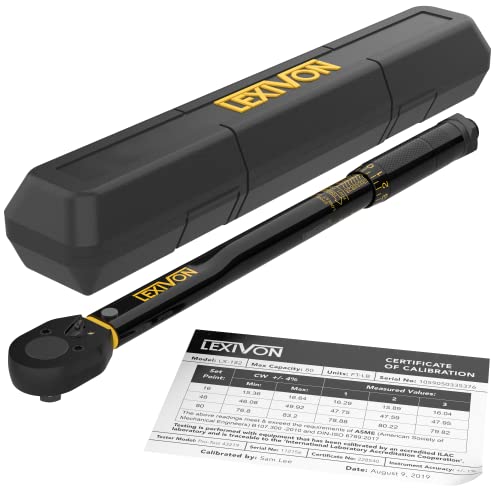 LEXIVON 3/8-Inch Drive Click Torque Wrench 10~80 Ft-Lb/13.6~108.53/8"DR. 10-80 FT-LB2.5 x 3 x 14 inches2.3 PoundsCheck on Amazon
 EPAuto 1/2-inch Drive Click Torque Wrench1/2 Inch Drive (10-150 ft.-lb.)17.4 x 3.3 x 2.6 inches3.5 poundsCheck on Amazon
 LEXIVON Torque Wrench 1/2-Inch Drive Click 10~150 Ft-Lb/13.6~203.51/2"DR. 10-150 FT-LB2.5 x 3 x 18 inches3 PoundsCheck on Amazon


Quick comparison
| What matters | Click-type | Digital |
|---|---|---|
| Setting the torque | Turn the handle to the marked scale and lock it | Enter a value with buttons; some show several units |
| Knowing when to stop | Feel or hear a click, then release | Watch or listen for an alert, vibration, or target display |
| Power | No batteries | Needs batteries or charging |
| Best fit | Simple, occasional wheel work | Frequent work or users who value a clear readout and alerts |
| Common misuse | Misreading the scale or leaving it set under tension | Wrong units, low batteries, or continuing to pull after the alert |
How a click-type wrench feels in use
A click-type wrench has a scale on the handle. You unlock the handle, turn it until the scale matches the vehicle’s specified torque, then lock it. The markings can take a moment to read, especially on a dual-scale wrench, but the process becomes familiar after a few uses. Check whether the scale is in foot-pounds (ft-lb) or newton-metres (N·m); confusing them can produce a large error.
When tightening, keep the socket square on the lug nut and pull smoothly from the handle. At the set torque, the wrench clicks or gives slightly. Stop immediately and relax your pull. A click is a stop signal, not a cue to make one more hard pull. Repeatedly clicking the same nut can overtighten it.
For someone changing seasonal tires twice a year, that straightforward routine is often a good reason to choose a click-type torque wrench in the correct range. Check the wrench’s working range before buying: a common automotive setup is a 1/2-inch drive, but the tool must also cover the torque value specified in the owner’s manual or service information.
How a digital wrench changes the job
A digital wrench replaces the mechanical scale with a screen and controls. Depending on the tool, you may set a target, choose between units such as ft-lb and N·m, and get a beep, light, vibration, or on-screen reading as you approach it. That can be easier to read than small handle markings, particularly in a dim garage or for someone who struggles to line up a scale.
The extra feedback is helpful, but it does not make the job foolproof. You still have to select the right torque and unit, pull steadily, and stop at the target. A wrench left in the wrong unit can be more misleading than a simple scale. Batteries can also fail, and some digital tools have menus or alerts that take practice. If the display goes blank or the wrench signals a fault, do not guess; use a working, correctly rated tool instead.
A digital automotive torque wrench is worth considering if you use a torque wrench regularly, need clear unit conversion, or find mechanical scales hard to read. For occasional lug nuts, those features may not justify the extra cost and upkeep.
The part that matters more than the display
Start by checking the vehicle’s specified torque. There is no universal lug-nut setting: passenger vehicles often fall somewhere around 80–140 ft-lb, but that broad range is not a substitute for the correct specification. Wheel type, vehicle design, and fastener details matter. Do not use a generic number just because it worked on another car.
Use the correct socket and inspect the studs and nuts for damage, dirt, or corrosion. Unless the vehicle or wheel maker specifies otherwise, tighten clean, dry threads. Oil or anti-seize changes friction and can cause excess clamping force at the same wrench setting. Seat the wheel, snug the nuts by hand, then tighten them in a star or crisscross pattern in stages. Finish with the torque wrench, pulling smoothly rather than jerking it.
Do not use a torque wrench as a breaker bar to loosen nuts, and do not use an impact wrench for the final torque setting. An impact can tighten a nut far beyond the intended value before you have time to react. After driving, follow the vehicle or wheel maker’s guidance on rechecking torque; do not assume every setup requires the same interval.
Which is easier—and which should you buy?
For most DIY wheel changes, click-type is easier overall: fewer steps, no battery to maintain, and a clear stop cue once you learn the scale. It is also the cheaper option, and a sound, suitable click wrench is enough for correct lug-nut tightening. Look for a readable scale, a lock that holds the setting, and a torque range that puts your vehicle’s specification comfortably inside—not at the edge of—the wrench’s range.
Choose digital if the display and alerts solve a real problem for you, or if you use the tool often enough that its added features are useful. Compare the display readability, unit selection, battery type, and any calibration or accuracy information. Whichever type you buy, use a reputable tool and have it checked or calibrated according to its maker’s guidance, especially after a drop or heavy misuse.
In practical terms, the click wrench wins on simplicity and low maintenance; digital wins on readability and extra feedback. Neither compensates for the wrong torque setting, poor tightening sequence, or pulling past the signal. For a twice-a-year tire swap, a properly ranged click wrench is usually the sensible buy.