What's inside
- Quick picks by toolbox situation
- What makes the best socket set organizer?
- Rails: the most flexible option
- Trays: fastest identification in a toolbox drawer
- Cases: best for transport and complete sets
- Head-to-head comparison
- How to check whether an organizer will fit
- Durability and maintenance realities
- Final buying advice
- Related Guides
As an Amazon Associate I earn from qualifying purchases. This post may contain affiliate links at no extra cost to you.
The best socket set organizer for most home and mobile toolboxes is a labeled rail for a small working set, while a molded tray is the better choice for a complete collection and a locking case is best when sockets must travel without falling out.
As an Amazon Associate we earn from qualifying purchases at no extra cost to you.



Our Top Picks



Quick picks by toolbox situation
| Situation | Best format | Why it fits | Typical capacity |
|---|---|---|---|
| Small drawer or limited budget | Clip-on socket rails | Low cost, narrow footprint, easy to rearrange | 10–20 sockets per rail |
| Full-size mechanic’s drawer | Molded socket tray | Fast visual identification and stable storage | 40–80 sockets |
| Tools carried to jobs | Locking storage case | Protects the set and keeps sockets captive in transit | 40–100 sockets |
| Mixed metric and SAE collection | Color-coded rails or two-sided tray | Reduces size confusion and makes gaps obvious | 20–60 sockets |
| Deep impact socket collection | Heavy-duty rail with large clips | Handles heavier sockets better than thin plastic trays | 8–16 impact sockets per rail |
What makes the best socket set organizer?
Start with compatibility rather than the number of clips. A useful organizer must match the socket drive size, distinguish metric from SAE, and fit the actual drawer or toolbox compartment. A rail that holds 3/8-inch sockets securely is not a solution for a 1/2-inch impact set, even if its advertised capacity looks attractive.
For most buyers, the important specifications are:
- Drive-size compatibility: 1/4-inch, 3/8-inch, and 1/2-inch sockets need different posts or clips. Some universal systems use interchangeable clips, but verify this before buying.
- Size labeling: Raised, molded numbers last longer than adhesive labels. Laser-etched or printed markings are useful, but can become difficult to read after years of oil and abrasion.
- Retention: The socket should click onto its post firmly but release with one hand. Excessively tight clips slow down work; loose clips let sockets spill into a drawer.
- Footprint: Measure the usable drawer length and depth, not the outside dimensions of the toolbox. Drawer slides, liners, and dividers consume space.
- Material: ABS or glass-filled nylon generally survives better than brittle, thin plastic. Steel rails tolerate abuse, but their clips may scratch or loosen if bent repeatedly.
Rails: the most flexible option
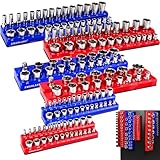
Socket rails use a long strip with individual clips or posts. Brands such as Ernst Manufacturing, Lisle, and Olsa Tools offer rail-style organizers in several drive sizes and configurations. The main advantage is modularity: you can remove unused clips, separate metric and SAE sets, or arrange only the sizes used for a particular vehicle.
Rails are usually the best socket set organizer for a shallow top drawer. A typical rail is about 12 to 20 inches long and holds roughly 10 to 20 sockets, depending on spacing. A set of three rails can therefore store 30 to 60 sockets without taking the height of a molded tray.
Choose rails with positive retention clips rather than simple open hooks. Positive clips reduce spills when a rail is lifted, but inspect how the clip releases. Some inexpensive designs require the socket to be pulled upward with considerable force, which can make the rail move around inside the drawer.
Rail drawbacks
Rails provide less protection against dirt and impact than cases. They also make socket-size labeling dependent on small tags or markings. If a rail is stored loose in a portable tool bag, sockets can still detach unless the organizer has a locking end or the rail is secured with a strap.
Trays: fastest identification in a toolbox drawer
Molded trays arrange sockets in rows, commonly separating 1/4-inch, 3/8-inch, and 1/2-inch drive sizes. Hansen Global is well known for molded socket trays, while other tool-storage manufacturers sell similar plastic and metal layouts. A full tray often holds 40 to 80 sockets, including shallow and deep versions.
The tray is the strongest choice when the organizer will stay in a rolling cabinet. Large, permanently marked size positions make missing sockets immediately visible. Many trays place metric sizes on one side and SAE sizes on the other, or use different colors for each measurement system.
Before buying, check whether the tray is designed for standard sockets, deep sockets, or both. Deep sockets may need taller posts or a second level of clearance. A tray that fits standard sockets can leave deep sockets protruding above a shallow drawer, preventing the drawer from closing.
Tray drawbacks
A tray wastes space when your collection has many gaps. For example, a tray with 60 positions may occupy the same area whether you own 60 sockets or 25. Some molded trays also use posts that fit one manufacturer’s socket profile better than another’s. Test the retention concept against your actual sockets where possible, especially with thin-wall or impact sockets.
Cases: best for transport and complete sets
A hinged or locking case keeps sockets contained while the toolbox is moved between a workshop, vehicle, and job site. Cases are often supplied with complete socket sets and may include ratchets, extensions, adapters, and bit sockets. Their molded recesses generally hold sockets more securely than an open rail.
Cases are less convenient for frequent tool selection. You normally need to open the lid and scan several rows, and a broken hinge or latch can compromise the entire storage system. Some cases also have little room for adding replacement sockets, so they are better for a defined kit than for a growing collection.
For mobile work, prioritize a lid that closes over every socket, reinforced hinges, and latches that cannot be triggered by pressure from inside a tool bag. A case with a carry handle is useful only if the handle is attached to the shell rather than a thin removable insert.
Head-to-head comparison
| Feature | Rail | Molded tray | Storage case |
|---|---|---|---|
| Typical material | Steel or reinforced plastic | ABS, polypropylene, or reinforced plastic | Impact-resistant plastic with molded inserts |
| Typical capacity | 10–20 sockets per 12–20-inch rail | 40–80 sockets | 40–100 sockets, often with accessories |
| Drawer height needed | About 1–2 inches | About 2–4 inches | About 3–6 inches when open or stacked |
| Size visibility | Good with printed or labeled clips | Excellent with molded markings | Good, but depends on lid and insert layout |
| Transport security | Fair unless clipped or strapped down | Fair to good | Excellent when latched |
| Expansion | Excellent | Limited by fixed positions | Usually poor |
| Typical market range | $8–$30 per rail or rail set | $20–$70 | $35–$150, depending on contents |
How to check whether an organizer will fit
Measure the drawer’s clear interior from the narrowest points. Then allow roughly 1/2 inch of clearance in both length and width so the organizer does not bind against the drawer liner or dividers. For a tray, also measure height with the deepest socket installed.
For example, a drawer with 22 inches of usable length and 15 inches of usable depth can accept a 20-by-13-inch tray with approximately 1 inch of clearance on each side. If the tray is 3 inches high and the drawer opening is only 2 1/2 inches, the fit fails even though the floor area is suitable.
For rails, calculate capacity from the number of clips rather than the rail’s overall length. If one rail has 16 clips and you own 42 sockets in that drive size, three rails provide 48 positions and leave six spaces for future additions. That is more useful than buying a 64-position tray with awkward unused sections.
Durability and maintenance realities
The first parts to wear are usually plastic clips, labels, and tray posts—not the main rail or case shell. Heavy sockets gradually enlarge flexible clips, while repeated sideways pulling can crack a post. Keep the socket aligned with the post and pull vertically instead of twisting it off at an angle.
- Wipe oil and metal filings from rails and trays with a dry cloth before they accumulate.
- Use mild soap and water on removable plastic organizers, then dry them fully before storing sockets.
- Do not use strong solvents on printed labels or unknown plastics.
- Replace loose clips rather than bending them repeatedly; bent clips usually lose tension quickly.
- Keep impact sockets on organizers designed for their greater weight.
Final buying advice
Choose a rail if flexibility, low cost, and shallow-drawer storage matter most. Choose a molded tray if the set will live in one toolbox and instant size recognition is the priority. Choose a locking case when preventing spills during transport matters more than rapid access. For a mixed collection, a practical setup is one labeled rail for frequently used 3/8-inch sockets, a separate rail for 1/4-inch sizes, and a deeper tray or case for 1/2-inch and impact sockets.
The best socket set organizer is therefore the one that matches how the sockets are used, not simply the organizer with the highest advertised capacity. Confirm drive size, measure the drawer, and check retention with your actual sockets before committing to a large fixed layout.