What's inside
As an Amazon Associate I earn from qualifying purchases. This post may contain affiliate links at no extra cost to you.
Our Top Picks


The best budget socket set for most home repairs
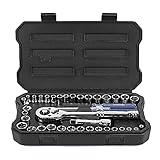
The best budget socket set for most home and DIY repairs is a 3/8-inch-drive set with both metric and SAE sockets, a reversible ratchet, and a case that keeps each size in place. It covers many household, bicycle, furniture, and light automotive jobs without the bulk of a large mechanic’s kit. Choose a 1/4-inch set for small fasteners and tight spaces, or a 1/2-inch set when you regularly work with larger, tightly fastened hardware.
For a useful budget purchase, prioritize complete size coverage and a dependable ratchet over a high socket count. A set padded with deep accessories you rarely use can be less useful than a smaller, clearly labeled set with the sizes your projects actually require. The comparison below describes common configurations; exact contents and weights vary by manufacturer, so check the package before buying.
As an Amazon Associate we earn from qualifying purchases at no extra cost to you.



Compare the drive sizes before you compare the piece counts
| Set type | Typical socket coverage | Typical ratchet length | Approximate set weight | Best fit |
|---|---|---|---|---|
| 1/4-inch drive | About 4–14 mm and 5/32–9/16 in | About 4–6 in | About 1–3 lb | Small fasteners, appliance panels, bicycles, and confined spaces |
| 3/8-inch drive | About 6–19 mm and 1/4–3/4 in | About 6–10 in | About 3–8 lb | General home repair and occasional light automotive work |
| 1/2-inch drive | About 10–24 mm and 3/8–1 in | About 10–18 in | About 6–15 lb | Larger fasteners and jobs that need more leverage |
These are practical ranges, not promises about any particular kit. A 3/8-inch set with unusually broad coverage may include smaller sockets through an adapter, but an adapter does not make a small ratchet a substitute for a larger drive when extra leverage is needed. For stubborn fasteners, use a correctly sized breaker bar rather than forcing a compact ratchet.
Choose by the work you actually do
| Your situation | What to look for | Why |
|---|---|---|
| Occasional repairs, tight budget | Compact 3/8-inch set; metric and SAE; shallow sockets | A versatile core set avoids paying for accessories that may stay unused. |
| Small projects or cramped access | 1/4-inch drive; short ratchet; 6-point sockets | The smaller head fits more easily around light-duty hardware. |
| Automotive work on mixed-age equipment | 3/8-inch set with metric and SAE, deep sockets, and extensions | Older or modified equipment can have a mix of fastener standards and recessed nuts. |
| Frequent work on large fasteners | 1/2-inch drive, or a separate 1/2-inch set | The larger drive is better suited to higher loads; confirm the tool’s limits and use appropriate torque procedures. |
| Limited storage or a mobile toolbox | Small, latching case with molded size labels | A secure layout makes missing pieces easier to notice and keeps the kit portable. |
If you can buy only one set, a 3/8-inch kit is generally the most balanced starting point. If your projects are mostly small appliances or furniture hardware, a 1/4-inch kit may be the more comfortable choice. A socket set is not a complete tool collection: you may still need a screwdriver, pliers, hex keys, or a breaker bar depending on the repair.
What makes an inexpensive set worth owning?
Coverage: metric, SAE, shallow, and deep
Metric sizes are common on modern equipment, while SAE sizes appear on some older machines, vehicles, and household hardware. If you work across a mix of items, a dual-system set reduces interruptions. For a project with known fastener sizes, a smaller single-system kit can be a better-value purchase.
Shallow sockets cover most exposed nuts and bolts. Deep sockets reach nuts on long threaded studs or recessed hardware. A budget set does not need every conceivable size, but missing the size you use repeatedly is more inconvenient than owning a large assortment of rarely needed pieces. Check whether the size range has gaps, and whether deep sockets are included in both measurement systems.
Socket material and shape
Most general-purpose hand sockets are made from chrome vanadium steel, often marked Cr-V. This is a common material for hand-tool sockets, but the label alone does not tell you everything about heat treatment, fit, or long-term quality. For routine household use, look for clearly marked sizes and sockets that sit squarely on the fastener.
Six-point sockets contact the flats of a hex fastener and are a sensible choice when grip matters. Twelve-point sockets are easier to position in restricted angles, but can be more prone to slipping on a damaged or soft fastener if the fit is poor. Do not use chrome hand sockets with an impact wrench; impact-rated sockets are designed for that use and are typically made and finished differently.
Ratchet quality matters more than a huge count
The ratchet is the part you handle repeatedly, so inspect its selector, direction switch, and grip. A smoothly operating mechanism with a secure, reversible switch is more useful than a high advertised piece count. Tooth counts are not a complete measure of quality, but a finer-tooth mechanism generally needs less swing to engage, which can help in restricted spaces.
Budget ratchets can wear or develop play before the sockets do, especially if used to break loose stuck fasteners. Use the ratchet for turning, not as a substitute for a breaker bar. If the ratchet mechanism becomes rough, skips, or no longer holds securely, stop using it under load. A replaceable ratchet can also extend the useful life of a set when its sockets remain serviceable.
Case portability and the missing-socket problem
A compact case is valuable only if the sockets stay put. Look for molded labels that are readable without removing every socket, firm retention, and hinges and latches that close securely. A bulky case full of loose accessories can be harder to store than a smaller kit with the right core sizes. Before purchase, consider whether the case fits your toolbox, vehicle compartment, or shelf.
A quick value calculation
Compare likely use, not just the price tag. Suppose a basic set costs $30–$50 and you expect to use it for 20 repairs over five years. That works out to roughly $1.50–$2.50 per repair, before considering the value of avoiding a separate tool purchase. A $60–$100 set used only a handful of times may be poor value unless its extra deep sockets, drive size, or sturdier ratchet solve a specific need.
These are broad market ranges for budget and entry-level sets, not quotes for a particular product; prices and included accessories change. The useful question is whether the added cost buys coverage you will use, rather than simply a larger piece count.
Ownership tips that help a budget set last
- Match the socket exactly to the fastener. A loose fit can round the corners, particularly on worn or corroded hardware.
- Keep sockets clean and dry, then return them to their labeled slots. Dirt can make markings harder to read, and moisture can encourage corrosion.
- Use extensions to reach recessed fasteners, not to add leverage. For extra leverage, choose a properly rated breaker bar.
- Do not hammer a hand socket or use it with an impact tool unless it is specifically impact-rated.
- After a job, check that the case still contains the sizes you need. Replacing a lost common socket is usually cheaper and less wasteful than replacing the whole set.
Bottom line
For a first toolkit, choose a compact 3/8-inch-drive set with metric and SAE coverage, a reversible ratchet, and a secure, labeled case. Step down to 1/4-inch drive if tight access and small fasteners dominate your repairs; step up to 1/2-inch drive when larger fasteners are a regular part of the work. The best budget socket set is the one whose drive size, socket range, and case fit your real jobs—not the one with the most pieces on the box.