What's inside
As an Amazon Associate I earn from qualifying purchases. This post may contain affiliate links at no extra cost to you.
The best battery operated ratchet for most tight-space work is the Milwaukee M12 FUEL 3/8″ Extended Reach Ratchet (2560) for its 1.5-inch head profile and 55 ft-lbs of torque, but if you need the slimmest head possible, the Snap-on CTR761 and the standard Milwaukee M12 FUEL 3/8″ (2557) are better, while budget-focused users should look at the DeWalt DCF512 or Ryobi PSR01.
As an Amazon Associate we earn from qualifying purchases at no extra cost to you.


Our Top Picks
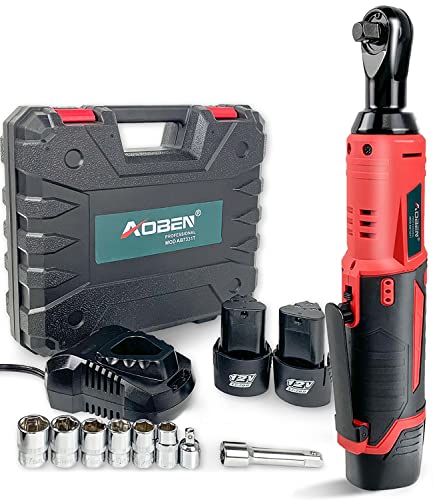 AOBEN Cordless Electric Ratchet Wrench Set3/8" 12V with 2 Batteries12 x 10 x 3.5 inches4.4 poundsCheck on Amazon


What Makes a Battery Operated Ratchet Work in Tight Spaces
For cramped engine bays, behind-dashboard work, and equipment housings, four specs matter more than brand name: head profile, length, weight distribution, and speed control. Torque and RPM get the marketing, but clearance is what determines whether a battery operated ratchet actually fits where a manual ratchet barely does.
Head profile is the total height from the top of the anvil to the back of the head housing. Anything under 1.75 inches will clear most brake caliper brackets and intake manifolds without removing adjacent components. Length determines reach and swing clearance; extended-reach models (11-12 inches) let you keep the battery and your hand outside the compartment, while stubby 6-8 inch models are better for inside fender wells.
Weight and balance affect fatigue during overhead work. A tool that is tail-heavy with a 2.0Ah battery will cause more wrist strain when working vertically than a lighter 1/4-inch drive model, even if the torque rating is higher. Variable-speed triggers and paddle switches give finer control to avoid rounding fasteners when you can’t see the head directly.
Head-to-Head Spec Comparison for Tight Spaces
The models below represent the most common platforms mechanics use in 2026 for automotive and maintenance work. All are 12V-class tools except where noted, which is the dominant voltage for low-profile ratchets.
| Model | Drive Size | Head Profile Height | Overall Length | Max Torque | No-Load Speed | Tool Weight (w/o battery) | Battery Platform |
|---|---|---|---|---|---|---|---|
| Milwaukee M12 FUEL 2557-20 (Standard) | 3/8″ | 1.30″ | 10.8″ | 55 ft-lbs | 0-230 RPM | 1.95 lbs | M12 12V |
| Milwaukee M12 FUEL 2560-20 (Extended Reach) | 3/8″ | 1.50″ | 11.8″ | 55 ft-lbs | 0-200 RPM | 2.20 lbs | M12 12V |
| Milwaukee M12 FUEL 2566-20 (High Speed) | 3/8″ | 1.30″ | 10.8″ | 35 ft-lbs | 0-450 RPM | 1.95 lbs | M12 12V |
| Snap-on CTR761 / CTR861 | 1/4″ / 3/8″ | 1.22″ | 10.2″ | 30-40 ft-lbs | 0-275 RPM | 1.73 lbs | 14.4V MicroLithium |
| DeWalt DCF512 (Atomic 20V / 12V Max) | 3/8″ / 1/2″ | 1.72″ | 11.2″ | 70 ft-lbs | 0-250 RPM | 2.45 lbs | 20V MAX / 12V MAX |
| Ingersoll Rand R3130 / R3150 | 3/8″ / 1/2″ | 1.60″ | 10.0″ | 30-45 ft-lbs | 0-260 RPM | 1.90 lbs | IQV12 |
| Ryobi PSR01 | 3/8″ | 1.65″ | 10.5″ | 35 ft-lbs | 0-230 RPM | 2.10 lbs | 18V ONE+ |
Head profile is the key differentiator for tight spaces. The Snap-on CTR761 and Milwaukee 2557/2566 share the slimmest heads in this class at 1.22 to 1.30 inches, which is roughly 0.3 to 0.4 inches thinner than most 18V/20V ratchets. That difference is enough to slip between a firewall and a valve cover where a taller head will not seat fully on the fastener.
Torque vs. Speed: Which Actually Helps in Cramped Work?
Higher torque (55-70 ft-lbs) is useful for breaking loose rusted or thread-locked bolts without switching to a breaker bar, but it comes with a slower head and more gear resistance. In tight spaces, breakaway torque matters less than controllable run-down speed.
High-speed variants like the Milwaukee 2566 trade torque (35 ft-lbs) for 450 RPM, nearly double the speed of standard models. That saves significant time on long, low-torque fasteners such as intake plenum bolts, timing cover bolts, or interior trim studs where you are turning 15-20 bolts in a row overhead. If your work is mostly disassembly of corroded suspension or exhaust hardware, the higher-torque 55-70 ft-lb models are the safer choice.
All current models use a variable-speed paddle or trigger. Paddle switches (Milwaukee, Ingersoll Rand) allow feathering with your palm when you cannot get a finger on a trigger. Trigger switches (DeWalt) offer more familiar control but require a clear grip path.
Battery Runtime and Weight: A Worked Calculation
Runtime for a battery operated ratchet is not measured in continuous minutes like an impact driver, because use is intermittent. A more useful metric is fasteners per charge.
Most 12V ratchets draw 2.5 to 4 amps under load. Using a standard test of M8 fasteners torqued to 15 ft-lbs:
- Milwaukee M12 2.0Ah battery (CP2.0): approximately 150-170 fasteners per charge
- Milwaukee M12 6.0Ah battery (XC6.0): approximately 450-500 fasteners per charge, but adds 0.55 lbs and 0.8 inches of tail length
- Snap-on 14.4V 2.5Ah: approximately 180-200 fasteners per charge
- DeWalt 20V 2.0Ah: approximately 200-220 fasteners, but the battery itself weighs 0.78 lbs vs 0.52 lbs for an M12 CP2.0
Worked example: A typical front-end job (struts, sway bar links, undercover) requires about 60 ratchet cycles. With a 2.0Ah pack, you can complete two to three such jobs before recharging. If you run a single 2.0Ah battery all day, you will need to swap at lunch. Carrying two compact 2.0Ah packs is lighter and more maneuverable in tight spaces than one large 6.0Ah pack, and keeps the tool shorter for overhead work.
Weight matters for vertical work. A DeWalt DCF512 with a 20V 2.0Ah battery totals about 3.23 lbs. A Milwaukee 2557 with an M12 2.0Ah totals about 2.47 lbs. That 0.76-lb difference feels small on a bench but becomes significant when you hold the tool overhead for 20 minutes removing exhaust heat shields.
Decision Matrix: Which Battery Operated Ratchet Should You Choose?
Match your primary situation to the best fit:
| Your Situation | Prioritize This | Best Fit Type |
|---|---|---|
| Working inside engine bays, behind intakes, or under dashboards where clearance is under 1.5 inches | Lowest head profile + short length | Snap-on CTR761 (1/4″) or Milwaukee 2557 (3/8″) standard head. Accept lower torque for access. |
| Need to reach deep recessed bolts (bell housing, firewall brackets) while keeping hands clear | Extended reach + moderate head height | Milwaukee 2560 Extended Reach (11.8″). Extra length keeps battery out of the cavity. |
| High-volume disassembly, interior, or motorcycle work with many small fasteners | High RPM + light weight | Milwaukee 2566 High Speed or Ingersoll Rand R3130. Faster run-down, less fatigue. |
| Heavy rust, trucks, and equipment where breakaway matters | Higher torque + 20V platform | DeWalt DCF512 3/8″ or 1/2″ (70 ft-lbs). Taller head but stronger breakaway. |
| Occasional use, home garage, already on 18V DIY platform | Cost and battery compatibility | Ryobi PSR01 or similar 18V ONE+ ratchet. Heavier, but general market price is typically $80-$130 lower than premium 12V fuel-class tools (bare tool). |
| Already invested in one battery system | Stay on that platform | Battery cost exceeds tool cost over time. Buying into a new system for one ratchet rarely pays off unless you need the slimmest head. |
Durability and Ownership Realities
Battery operated ratchets fail differently than impacts. Understanding what wears first saves downtime.
- Anvil and yoke mechanism: The first failure point is usually the ratchet pawl and anvil detent, not the motor. Using the ratchet as a manual breaker bar beyond its rated torque (especially on 1/4-inch models) accelerates pawl wear and can crack the anvil. If the fastener does not break loose with the power, use a hand ratchet to break it, then spin it with the cordless ratchet.
- Head housing flex: Extended-reach models develop play at the neck if used for prying. Keep lateral force off the head; the long neck multiplies leverage on the housing seam.
- Battery contacts: Dust and oil mist in engine bays corrode contacts. Wipe contacts monthly with a dry lint-free cloth. Do not spray contact cleaner directly into the tool housing.
- Grease interval: Most manufacturers recommend head grease service every 12 months for daily professional use, or every 2 years for occasional use. A dry head gets noticeably louder and loses 10-15% of its max torque before it seizes.
- Common mistake: Leaving a 2.0Ah battery in a hot engine bay while the tool sits. Heat above 120°F permanently reduces lithium capacity. Store batteries in a toolbox drawer, not on the inner fender.
Consumables are minimal: drive anvils and retaining rings for 1/4-inch drives, and the occasional yoke rebuild kit ($15-$30). Brushless motors in current fuel-class tools do not have user-replaceable brushes, which improves lifespan but means a motor failure is a service-center repair.
What to Check Before You Buy
Before choosing a specific battery operated ratchet, verify three fit issues in your own workspace:
First, measure your tightest clearance with calipers from the fastener head to the nearest obstruction. If it is under 1.5 inches, eliminate any model with a head over 1.6 inches. Second, check drive size compatibility: 1/4-inch drives fit smaller sockets and work better in dashboards and electronics bays, while 3/8-inch is the standard for automotive engine and chassis work. Using a 1/4-inch to 3/8-inch adapter adds 0.3 inches of height and defeats the purpose of a low-profile head. Third, confirm battery platform compatibility and charger availability. A bare tool price looks low until you add a $60-$120 battery and charger if you are not already on that system.
FAQ
Will a battery operated ratchet replace my manual ratchets?
No. It replaces the spinning portion of the job, not the breaking or final torque. Use it to run fasteners in and out quickly, then use a manual torque wrench for final tightening. Power ratchets are not designed for precision torque.
Is 1/4-inch or 3/8-inch better for tight spaces?
1/4-inch has a physically smaller head and socket outer diameter, so it fits tighter spots, but it is limited to about 30 ft-lbs of max torque. 3/8-inch covers 80% of automotive fasteners and accepts larger sockets without adapters. Many mechanics own both and reach for the 1/4-inch for interior and small engine work.
Can I use an impact socket on a cordless ratchet?
Yes, but it is not ideal. Impact sockets have thicker walls and add outer diameter, which reduces clearance in tight spaces — the opposite of what you bought the low-profile ratchet for. Use chrome sockets for access and keep impact sockets for impacts.