What's inside
As an Amazon Associate I earn from qualifying purchases. This post may contain affiliate links at no extra cost to you.
Our Top Picks
 DEWALT ATOMIC 20V MAX Brushless Cordless RatchetOne Size15.79 x 2.8 x 2.99 inches2.6 poundsCheck on Amazon

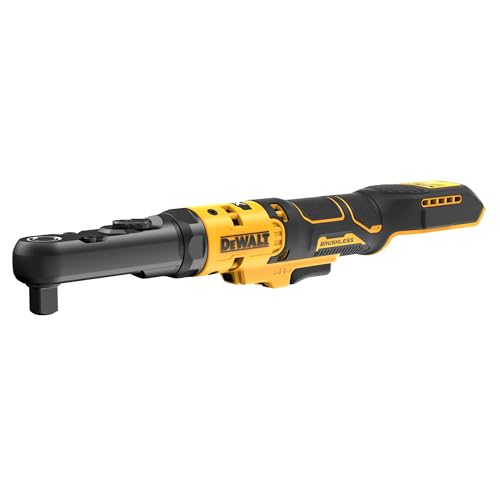


Best DeWalt Cordless Ratchets: Compare 12V and 20V Models
For most automotive work, choose a DeWalt 12V 3/8-inch cordless ratchet for its slimmer, lighter setup; choose the 20V model when you already own 20V batteries or want a higher-speed option for accessible fasteners. Neither is a substitute for a breaker bar or a calibrated torque wrench: use the ratchet to run fasteners on and off, then loosen stubborn bolts by hand and tighten to specification with a torque wrench.
DeWalt 12V vs. 20V: the practical differences
DeWalt’s cordless ratchet choices are mainly a compact 12V model and a more powerful 20V model, with head and anvil configurations varying by specific kit or bare-tool listing. The “3/8” in a DeWalt 3/8 cordless ratchet refers to its square-drive size, not the tool’s overall head width. Always check the exact model’s product specifications before buying: head dimensions, included battery, and published speed can differ.
As an Amazon Associate we earn from qualifying purchases at no extra cost to you.
As an Amazon Associate we earn from qualifying purchases at no extra cost to you.


The 12V tool is generally the better fit for tight engine bays and overhead work because its battery platform allows a smaller, lighter tool-and-pack combination. The 20V tool is appealing for a shared shop battery system and fast work on reachable fasteners, but the larger battery can make the assembled tool bulkier. Higher no-load speed helps spin a free-running nut off sooner; it does not mean the tool can safely break loose a seized bolt.
| Buying factor | DeWalt 12V ratchet | DeWalt 20V ratchet |
|---|---|---|
| Platform | 12V MAX battery system | 20V MAX battery system |
| Typical drive choice | 3/8-inch square drive on the compact automotive-oriented model | 3/8-inch square drive on the common automotive-oriented model; verify exact variant |
| Published no-load speed | Up to about 250 rpm on the commonly listed 12V model | Up to about 250 rpm on the commonly listed 20V model |
| Tool weight, bare | About 1.5 lb | About 2.5 lb |
| Head clearance | Usually the better choice for cramped access; compare the stated head length and height for the exact model | Allow more room for the tool body and battery, especially when working close to a frame or firewall |
| Battery compatibility | Uses DeWalt 12V MAX packs; not interchangeable with 20V MAX packs | Uses DeWalt 20V MAX packs; not interchangeable with 12V MAX packs |
| Best fit | Frequent close-quarters automotive work and lower tool weight | Existing 20V tool owners and accessible, repetitive fastening |
Figures are representative of commonly listed DeWalt 12V and 20V ratchet versions. Bare-tool weights exclude the battery; actual weight and dimensions depend on model and pack. Check the manufacturer’s current specification for the exact part number.
Which one should you buy?
- Choose 12V for tight access and long sessions. A smaller battery and lighter tool are useful under a dashboard, around suspension components, or anywhere you repeatedly reposition your wrist. If clearance is your first concern, compare the tool’s head dimensions—not just its drive size.
- Choose 20V if you already have DeWalt 20V MAX batteries. Sharing packs with other tools can make the purchase more economical, and the ratchet suits fasteners with clear access. It is less compelling if the larger battery crowds the working area.
- Choose by drive size as well as voltage. A 3/8-inch drive is a versatile automotive size for many socket sets. A 1/4-inch drive is better suited to smaller fasteners and compact sockets; a 1/2-inch drive is aimed at larger sockets, but a cordless ratchet still should not be used as a high-torque impact wrench.
- For occasional household use, consider whether a cordless ratchet earns its place. If you only remove a few fasteners at a time, a hand ratchet may be cheaper and easier to store. A cordless model pays off when repeated run-down and removal saves meaningful time.
Speed, torque, and safe use: what the specs don’t tell you
A no-load speed of roughly 250 rpm is a maximum without a fastener under load. Actual speed falls as resistance rises, and the tool’s motor is not a reliable way to judge final tightening torque. Use it to remove a bolt after it has been loosened, or to run a nut down until it is nearly seated. Finish by hand or with a torque wrench, following the vehicle or equipment manufacturer’s specification.
For a stuck fastener, use a hand ratchet or breaker bar first. Applying force to the cordless ratchet’s head can overload the mechanism or damage the tool. Keep fingers clear of pinch points, use the correct socket, and stop if the socket starts to bind or the fastener is cross-threaded. A ratchet’s trigger control helps with speed, but it does not make powered tightening foolproof.
Battery and ownership costs
Battery compatibility can determine the real cost more than the bare-tool price. A bare tool is usually the lower-cost route if you own the right platform; a kit may be better value if it includes a battery and charger you need. General market prices vary by retailer, kit contents, and promotions, so compare the complete package rather than treating bare-tool and kit prices as equivalent. A 12V pack cannot power a 20V tool, or vice versa.
As a simple decision check, estimate how often you will use the ratchet. If it saves five minutes on each of 12 repair sessions a year, that is about one hour saved annually. If you only do two small jobs a year, the time saving is modest; if you regularly service vehicles or equipment, avoiding repeated hand turns can justify the tool more readily. This calculation is about convenience, not a promise of a particular battery runtime.
Keep the ratchet working well
- Remove the battery before cleaning or inspecting the tool. Wipe away oil and grit; avoid soaking the housing or directing compressed air into openings.
- Keep the drive square and socket clean. A worn or poorly fitting socket can slip, round a fastener, or put unnecessary strain on the head.
- Inspect the anvil, socket retention, and housing periodically. Stop using the tool if the drive is loose, the head makes unusual noises, or the trigger behaves inconsistently.
- Don’t use the ratchet as a lever or hammer. The head mechanism is intended to turn fasteners, not take side loads or impact blows.
- Store batteries dry and follow DeWalt’s charging and storage instructions. Avoid leaving a pack exposed to extreme heat, such as inside a hot vehicle.
Bottom line
The DeWalt 12V cordless ratchet is the more sensible pick for cramped automotive access, lighter handling, and repeated overhead work. The 20V version is a better platform match if you already own 20V MAX tools and have enough room around the fastener. Before ordering, verify the exact model’s drive size, head dimensions, bare-tool weight, included accessories, and battery platform. Those details matter more in daily use than voltage alone.