What's inside
As an Amazon Associate I earn from qualifying purchases. This post may contain affiliate links at no extra cost to you.
Our Top Picks
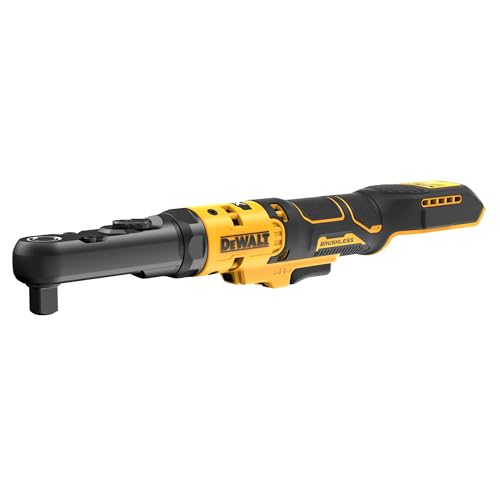


Which DeWalt 20V Ratchet Should You Buy?
For a DeWalt 20V ratchet, choose the 3/8-inch DCF513 if you want a compact, sealed-head tool for routine automotive and equipment work; choose the 1/2-inch DCF512 when your sockets and fasteners call for a half-inch drive. Both are cordless ratchets in DeWalt’s 20V MAX battery system, but neither is a substitute for an impact wrench when a fastener is badly seized or needs high breakaway force.
The key trade-off is fit: the 3/8-inch model uses smaller sockets and is generally easier to place in tighter spaces, while the 1/2-inch model accepts larger-drive sockets but has a bulkier head. Check the exact kit and tool-only listing before buying, since included batteries and accessories vary.
As an Amazon Associate we earn from qualifying purchases at no extra cost to you.


DCF513 vs. DCF512 at a glance
| Feature | DCF513 3/8-inch | DCF512 1/2-inch |
|---|---|---|
| Drive size | 3/8 in (9.5 mm) | 1/2 in (12.7 mm) |
| Maximum fastening torque | 70 ft-lb (95 N·m) | 70 ft-lb (95 N·m) |
| Maximum breakaway torque | Not specified as a powered breakaway rating | Not specified as a powered breakaway rating |
| Tool length | About 14 in (356 mm) | About 14 in (356 mm) |
| Head style | Sealed head, designed to resist exposure to shop fluids | Sealed head, designed to resist exposure to shop fluids |
| Battery platform | DeWalt 20V MAX | DeWalt 20V MAX |
Published specifications can vary by region or listing revision. DeWalt does not give a single dependable runtime figure for either ratchet: actual work per charge depends on battery capacity, fastener condition, socket size, and how long the motor is run. Treat the torque figure as a fastening specification, not a promise that the tool will loosen every bolt at that torque.
Pick by the work, not just the drive size
- For tight engine bays and mixed maintenance: Start with the DCF513. A 3/8-inch drive is a common fit for smaller automotive sockets and helps keep the socket end compact. The tool’s overall length still matters; a compact ratchet is not necessarily a short-reach ratchet.
- For larger sockets already in your kit: Choose the DCF512 if your regular jobs use 1/2-inch-drive sockets. This avoids relying on a drive adapter, which adds length and can create another point of play.
- For occasional home or equipment repairs: Either can make repetitive spin-off and run-down work faster. If you only need a ratchet occasionally and already own good hand tools, a 20V tool may be unnecessary.
- For frequent shop use: Prioritize the drive that matches your socket inventory, then consider keeping a compact battery on the tool. A larger battery can extend work time but may make the handle heavier and less convenient in confined positions.
- For stubborn or rusted fasteners: Break the fastener loose with a hand ratchet or suitable impact tool, then use the cordless ratchet to run it out. Do not use the ratchet as a long breaker bar.
Reach and head clearance: check the whole setup
Tool length alone does not tell you whether a ratchet will fit. The socket adds length beyond the drive, and the battery can interfere with your hand or nearby parts. Before buying, compare the clearance where the ratchet head must sit, the space needed for the handle to swing, and the room for the battery at the base.
If you are choosing a DeWalt 3/8 ratchet 20V for a cramped location, measure the available opening and compare it with the tool’s head dimensions in the current manufacturer specification. A slimmer socket may help, but an extension adds reach and reduces the room available for the tool body. The same check is especially important for a DeWalt 1/2 ratchet 20V: its larger sockets often need more surrounding clearance, even when the fastener itself is easy to reach.
Where the head fits but the battery does not, a smaller-capacity compatible pack can improve access. Where the handle cannot swing, neither drive size solves the problem; a hand ratchet, extension, or different tool configuration may be more suitable.
Battery fit, runtime, and ownership costs
Both models use DeWalt 20V MAX batteries, so owners of that platform can generally use their existing compatible packs. “20V MAX” is DeWalt’s battery-system name; it does not mean every battery has the same capacity, weight, or runtime. Confirm compatibility in the manual for the specific tool and battery, particularly if you own an older pack.
For access work, a smaller 20V MAX pack is often the practical choice: it keeps the tool lighter and can reduce interference around the handle. A higher-capacity pack is useful for extended repetitive work, but adds bulk. There is no reliable universal number of bolts per charge because a clean, free-spinning fastener uses far less energy than a corroded one.
To estimate whether your existing battery is adequate, use a simple shop check rather than an advertised runtime assumption:
- Start with a fully charged pack and the socket size you actually use.
- Run a representative set of fasteners, stopping the tool as soon as each is seated or loose.
- Note the battery indicator and how the tool feels in the tightest work area.
- If access is awkward, try a smaller compatible pack before buying another tool; if charge runs short during regular work, consider a higher-capacity pack.
That check separates two different problems: insufficient runtime calls for more battery capacity or a spare pack, while poor access calls for a different tool or setup.
Use and maintenance that protect the ratchet
These are powered ratchets, not impact tools. Use a hand tool to initially loosen a tight fastener, and finish tightening by hand when the application requires controlled final torque. The ratchet’s published maximum torque is not a calibrated torque-wrench setting.
Sealed heads are intended to provide protection against shop-fluid exposure, not to make the tool waterproof or immune to contamination. Wipe the tool after oily work, keep debris out of the drive and controls, and follow DeWalt’s manual for cleaning and service. Stop using it if the head develops abnormal play, grinding, or inconsistent operation; continued use can worsen internal wear. Avoid forcing the mechanism with a cheater bar, and use impact-rated sockets only with tools designed for impact use.
Bottom line
Buy the DCF513 for the more versatile 3/8-inch socket size and easier access with smaller sockets; buy the DCF512 when half-inch-drive sockets are central to your work. If you already own DeWalt 20V MAX batteries, that platform compatibility can make either a tool-only purchase sensible. Before deciding, verify head clearance, battery space, and the drive size of the sockets you use most—those factors matter more than the shared torque rating.