What's inside
- Corded vs. Cordless Electric Ratchet: Core Difference
- How to Match Drive Size, Torque, and Speed to Your Work
- Electric Ratchet Comparison Table: Real Models and Specs
- Decision Matrix: Which Electric Ratchet Fits Your Situation
- Runtime Worked Example: Will a 2.0Ah Battery Last a Job?
- Durability and Ownership Realities
- Buying Tips for Faster Fastener Removal Without Damage
- Frequently Asked Questions
As an Amazon Associate I earn from qualifying purchases. This post may contain affiliate links at no extra cost to you.
The best electric ratchet for faster fastener removal is a cordless 3/8-inch drive model with 35-60 ft-lbs of torque and 200-300 RPM for most automotive and equipment work, while a corded 3/8-inch electric ratchet makes sense only if you work continuously in one bay and want to avoid battery management.
As an Amazon Associate we earn from qualifying purchases at no extra cost to you.



Our Top Picks
 Milwaukee 2457-20 M12 Cordless 3/8" Sub-Compact 35 ft-Lbs3/8"9.47 x 2.94 x 1.76 inches1 PoundsCheck on Amazon


Corded vs. Cordless Electric Ratchet: Core Difference
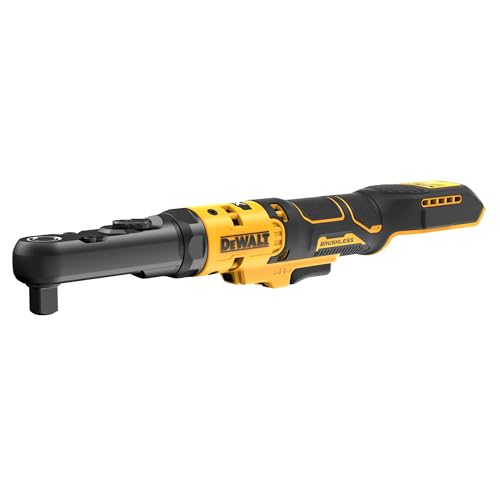
Corded and cordless electric ratchets do the same job — spinning fasteners quickly once breakaway torque is done by hand or an impact — but they solve different workflow problems. A cordless electric ratchet runs on a lithium-ion battery pack and trades continuous runtime for portability and a slimmer head. A corded electric ratchet plugs into a 120V AC outlet, delivers unlimited runtime and consistent speed, but adds cord drag, outlet dependence, and often a bulkier motor housing.
For woodworking-adjacent work like assembling jigs, servicing shop machinery, or maintaining a work van, the cordless option wins on access. For a stationary assembly station where you drive dozens of 5/16-inch and 3/8-inch bolts per hour, a corded model removes charging downtime entirely.
How to Match Drive Size, Torque, and Speed to Your Work
1. Drive Size: 1/4-inch vs. 3/8-inch vs. 1/2-inch
- 1/4-inch drive: Best for small fasteners (M5-M8, 10mm-13mm heads), under-dash, motorcycle, lawn equipment, and cabinet hardware where clearance is tight. Lower torque reduces risk of snapping small bolts.
- 3/8-inch drive: The most versatile. Fits 10mm-19mm sockets that cover most engine bays, suspensions (for spin-off after breaking loose), and shop machinery. Choose this if you own one electric ratchet.
- 1/2-inch drive: Rare in electric ratchet form. Useful for larger fasteners on trucks and farm equipment, but most users are better served by a 3/8-inch ratchet with an adapter than a dedicated 1/2-inch electric ratchet, which is heavier and slower.
2. Torque: What It Can Actually Do
Electric ratchets are not impact wrenches. They are designed to run fasteners quickly at low resistance. Published max torque is typically 20-60 ft-lbs, but usable breakaway assistance is lower. If a bolt requires more than about 25-30 ft-lbs to crack, you still need a manual ratchet or breaker bar first, then use the electric ratchet to spin it out. Do not use an electric ratchet to final-torque critical fasteners — finish with a torque wrench.
3. Speed (RPM) and Head Profile
Speed matters more than peak torque for fastener removal time. 200-275 RPM is the sweet spot for control; 300+ RPM saves seconds on long bolts but can be harder to control in tight spaces. Head profile determines whether you can reach the bolt at all. Standard heads are about 1.5 inches thick; extended-reach or long-neck models add 4-6 inches of reach for deep engine compartments but add weight and flex.
4. Runtime and Battery Reality
Cordless runtime depends on battery capacity (Ah), fastener length, and load. A 2.0Ah 12V battery will typically drive 150-250 fasteners (M8 x 30mm) on a charge. A corded model has no runtime limit but the cord limits reach to about 6-8 feet from the outlet unless you add an extension cord, which introduces trip and voltage drop considerations in a busy shop.
Electric Ratchet Comparison Table: Real Models and Specs
These are current production models as of 2026. Specs are manufacturer-published nominal values; actual output varies with socket, extension, and battery state.
| Model (Type) | Drive Size | Max Torque | No-Load Speed | Head Thickness / Length | Tool Weight (bare) | Power Source |
|---|---|---|---|---|---|---|
| Milwaukee M12 FUEL 2557-20 (Cordless) | 3/8-in | 55 ft-lbs | 230 RPM | 1.56 in / 10.84 in | 1.98 lbs | M12 12V 2.0Ah battery |
| Milwaukee M12 FUEL 2558-20 (Cordless) | 1/4-in | 40 ft-lbs | 275 RPM | 1.46 in / 10.84 in | 1.92 lbs | M12 12V 2.0Ah battery |
| Milwaukee M12 FUEL 2560-20 Extended Reach (Cordless) | 3/8-in | 55 ft-lbs | 200 RPM | 1.56 in / 15.0 in | 2.45 lbs | M12 12V 2.0Ah battery |
| DeWalt DCF512B 20V MAX XR (Cordless) | 3/8-in | 60 ft-lbs | 280 RPM | 1.65 in / 12.0 in | 3.2 lbs with 2.0Ah | 20V MAX 2.0Ah battery |
| Ingersoll Rand R3130 IQV20 (Cordless) | 3/8-in | 45 ft-lbs | 260 RPM | 1.61 in / 11.1 in | 2.8 lbs with 2.0Ah | 20V 2.0Ah battery |
| ACDelco ARW1209-P (Cordless) | 3/8-in | 45 ft-lbs | 230 RPM | 1.7 in / 11.0 in | 2.7 lbs with 2.0Ah | 12V Li-ion 2.0Ah |
| Generic Corded 3/8-in AC Electric Ratchet (Corded) | 3/8-in | 35-40 ft-lbs | 170-200 RPM | 1.75 in / 11.5 in | 2.9 lbs | 120V AC, 6 ft cord |
Cordless 12V platforms like Milwaukee M12 dominate electric ratchets because the motor and battery can sit inline with the handle, keeping the head thin. 20V platforms offer slightly higher torque and commonality if you already own 20V drills or impacts, but usually weigh 0.5-1.0 lb more.
Decision Matrix: Which Electric Ratchet Fits Your Situation
| Your Situation | Best Choice | Why |
|---|---|---|
| Mobile repair, engine bays, tight spaces, occasional use | Cordless 3/8-in standard, 12V | Lightest weight, thinnest head, easy one-hand use |
| Small fasteners, motorcycles, shop jigs, M5-M8 bolts | Cordless 1/4-in, 12V | Lower torque prevents over-driving, smaller anvil and sockets |
| Deep-set bolts, trucks/SUVs, long intake or chassis work | Cordless 3/8-in extended reach | Extra 4-6 in reach without adding universal joints that wobble |
| Own DeWalt, Makita, or Craftsman 20V tools already | Same-voltage 3/8-in cordless | Shares batteries and charger, lower ownership cost |
| Fixed bench, assembly line, all-day shop use in one location | Corded 3/8-in AC ratchet | No charging, no battery fade at end of shift |
| Tight budget, infrequent use, 1-2 times per month | Entry cordless 12V 3/8-in (ACDelco type) or 20V store-brand | General market range typically $90-$160 for kit, adequate for spin-off duty |
Runtime Worked Example: Will a 2.0Ah Battery Last a Job?
To estimate whether you need a second battery, use this simple calculation based on watt-hours.
Formula: Battery energy (Wh) = Voltage (V) x Capacity (Ah). Available energy x 0.75 (efficiency loss) / load per fastener = fasteners per charge.
Example: Milwaukee M12 2.0Ah = 12V x 2.0Ah = 24Wh. Usable energy after heat and drivetrain loss approx. 18Wh. Spinning a clean, lightly oiled M8 x 40mm bolt with a 3/8-in ratchet at 230 RPM takes roughly 0.07-0.10Wh. 18Wh / 0.08Wh = ~225 bolts per charge. Add rust, threadlocker, or longer bolts (M10 x 60mm) and consumption doubles to 0.15Wh, cutting the count to ~120. A 20V 2.0Ah pack (40Wh, ~30Wh usable) yields about 300-375 clean M8 bolts or 180-200 rusty ones.
Takeaway: One 2.0Ah battery handles a typical brake job, valve cover, or mower deck teardown. For a full engine teardown or a day of continuous disassembly, carry two batteries or use a corded model.
Durability and Ownership Realities
Electric ratchets are durable, but not maintenance-free. What wears first is predictable:
- Ratchet anvil and pawl: The directional switch and pawl teeth are the first mechanical wear point if users apply manual breaker-bar force sideways. Avoid using the electric ratchet to crack tight bolts. If it clicks without spinning, stop and break it loose manually.
- Head yoke and needle bearings: Grit and metal shavings migrate into the open head. Blow out the head with compressed air after dirty jobs and add a single drop of air-tool oil on the anvil pivot monthly if the manual allows it. Do not soak the head in solvent.
- Trigger and variable-speed switch: Dust and drops cause intermittent speed control. Store the tool with the battery removed and the direction locked to center.
- Battery contacts: Vibration loosens packs. Clean contacts with a dry cloth; never use abrasive files. Cold shops below 40F temporarily reduce runtime by 15-25%.
- Corded models: The cord strain relief at the handle fails before the motor does. Keep the cord off the floor edge and never yank to unplug. Brushes on older AC motors eventually need replacement after 800-1000 hours.
Common mistakes that shorten life: using extensions over 6 inches to gain reach (adds leverage that stresses the yoke), using impact sockets that are heavy and increase inertia on start-up (use chrome sockets on electric ratchets), and final-torquing with the ratchet instead of a torque wrench, which overloads the clutch.
Consumables to budget: You will not replace brushes on brushless cordless models, but expect to replace the battery every 3-5 years with regular use. General market ranges as of 2026 are roughly $90-$160 for an entry cordless kit with one battery, $150-$250 for brushless 12V/20V kits from major brands, and $180-$320 for extended-reach brushless kits. Replacement 2.0Ah batteries typically run $35-$70 depending on voltage platform. Corded AC models generally fall in the $70-$130 range.
Buying Tips for Faster Fastener Removal Without Damage
- Choose brushless if you will use the tool weekly. Brushless motors run cooler, are shorter, and extend runtime about 20% over brushed.
- Check head thickness with your tightest clearance in mind. A 0.15-inch difference decides whether you clear a firewall or alternator bracket.
- Look for a paddle or trigger with variable speed, plus a safety lock to prevent accidental start in a toolbox.
- Prefer tools with an integrated LED at the head. It is not a gimmick — it lights recessed bolt wells where you cannot fit a shop light.
- If buying into a new battery platform, compare the weight of the bare tool plus the battery you will actually carry. A lighter bare tool with a 4.0Ah battery may end up heavier than a slightly heavier tool with a 2.0Ah compact pack.
Frequently Asked Questions
Can an electric ratchet replace an impact wrench?
No. An electric ratchet provides steady rotation, while an impact wrench delivers hammer blows to break rust and torque. Use the ratchet to save time spinning fasteners after they are loose, and to start threads without cross-threading. Use an impact to loosen.
Will a 1/4-inch electric ratchet handle automotive lug nuts?
No. Lug nuts typically require 80-150 ft-lbs and are too large for a 1/4-inch anvil. Even a 3/8-inch electric ratchet is not intended for lug nuts. Use an impact wrench or manual lug wrench first.
Is a corded electric ratchet more powerful than cordless?
Not necessarily. Modern cordless 12V and 20V brushless ratchets match or exceed corded torque while being lighter at the head. Corded models win on uninterrupted runtime, not peak power.
Do I need a special socket for an electric ratchet?
Use regular chrome hand sockets. Impact sockets are thicker and heavier, which increases strain on the ratchet head and slows speed. Avoid chrome adapters stacked on adapters, which add wobble and reduce torque transfer.