What's inside
As an Amazon Associate I earn from qualifying purchases. This post may contain affiliate links at no extra cost to you.
For most workshop and repair jobs, start with the Knipex Cobra 10-inch water pump pliers; choose the 7¼-inch version for tighter spaces, the Pliers Wrench for scratch-sensitive flat-sided parts, and a dedicated diagonal cutter for wire. Those tools solve different problems: jaw opening determines what fits, while jaw geometry and cutting design determine how well each tool works once it does.
As an Amazon Associate we earn from qualifying purchases at no extra cost to you.



Our Top Picks


Compare the main Knipex plier types
The figures below are published specifications for common versions. Knipex specifications can differ slightly by model number and market, so check the exact listing before buying. Jaw capacity is not a promise that every object at that maximum will be easy to grip: shape, access, and material matter too.
| Type and example model | Length | Maximum capacity | Approx. weight | Best suited to |
|---|---|---|---|---|
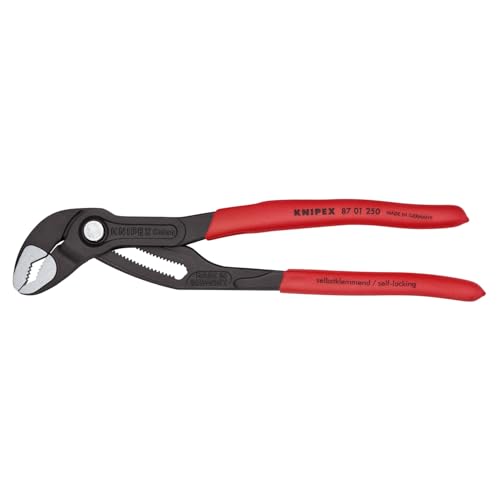
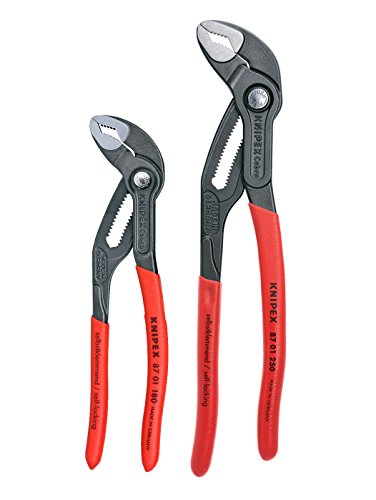
| Cobra water pump pliers, 87 01 250 | 250 mm (10 in) | 50 mm (2 in) across flats; 46 mm pipe diameter | About 335 g | General plumbing, irregular shapes, and larger fittings |
| Cobra water pump pliers, 87 01 180 | 180 mm (7¼ in) | 36 mm (1⅜ in) across flats; 32 mm pipe diameter | About 170 g | Smaller fittings and cramped access |
| Pliers Wrench, 86 03 250 | 250 mm (10 in) | 46 mm (1¾ in) across flats | About 555 g | Hex fasteners and finished surfaces that need broad, parallel jaws |
| High Leverage Diagonal Cutter, 74 02 200 | 200 mm (8 in) | Cutting capacity varies by wire type and hardness | About 280 g | Cutting wire and cable rather than gripping fittings |
Capacity figures are not interchangeable: the Cobra figures distinguish a hexagonal object measured across flats from a round pipe measured by diameter. A cutter’s capacity, meanwhile, depends on the wire material and the specific cutter version. Don’t use a cutter’s length or leverage rating as a substitute for checking its published cutting chart.
Choose by the job, not just by size
For gripping pipe and awkward shapes: Cobra
Cobra pliers adjust at a push-button joint and lock into a chosen position. Their toothed jaws are designed to bite into pipe and irregular parts, making them effective where a smooth-jaw tool might slip. The trade-off is that those teeth can mark polished, plated, or soft surfaces. Use a suitable protective layer when the finish matters, and avoid relying on the tool to loosen a fastener that calls for a correctly sized wrench.
The 10-inch 87 01 250 is a versatile workshop choice if you routinely handle plumbing fittings, larger hose clamps, or mixed-size parts. The 7¼-inch 87 01 180 is easier to carry and maneuver, but its smaller capacity and shorter handles offer less reach and leverage. If your work regularly involves parts near the smaller model’s maximum, stepping up a size can make positioning more comfortable.
For nuts and finished surfaces: Pliers Wrench
The Pliers Wrench uses smooth, parallel jaws that close evenly around flat-sided parts. Its push-button adjustment offers multiple positions, and the lever action can provide strong clamping force. This makes it a better fit than toothed Cobra jaws for installing or removing hex nuts, holding stock, or working on a finish that you don’t want to scar.
It costs more than a basic adjustable wrench in many markets and is heavier than a same-length Cobra. It also isn’t a dedicated substitute for every wrench: keep the jaws square to the work, seat them fully, and select a position that lets the jaws close securely. For delicate finishes, a protective jaw covering can add protection, though it may reduce grip or limit the maximum opening.
For clean wire cuts: choose a dedicated cutter
Diagonal cutters are for severing wire, not twisting fittings or gripping nuts. A high-leverage design uses its geometry to reduce hand effort on appropriate materials. Knipex makes multiple cutter patterns and edge types; select one by the wire you actually cut, including its diameter and hardness. A cutter intended for soft copper wire may be damaged by hard piano wire or hardened fasteners. Follow the model’s cutting-capacity chart rather than assuming all 200 mm cutters can handle the same material.
Which model makes sense for your workshop?
| Your situation | Good starting choice | Why |
|---|---|---|
| One general-purpose gripping tool for a home workshop | Cobra 87 01 250 | A useful balance of reach, capacity, and portability |
| Frequent work in cabinets, under sinks, or in a compact tool bag | Cobra 87 01 180 | Smaller body is easier to position, with less capacity than the 10-inch model |
| Regular work on hex fasteners or surfaces that can be scratched | Pliers Wrench 86 03 250 | Smooth, parallel jaws are better suited to flat-sided parts |
| Mostly cutting electrical or general workshop wire | A Knipex diagonal cutter rated for that wire | Purpose-built cutting edges outperform gripping tools for cutting |
| Occasional repairs on a tight budget | One correctly sized Cobra, then add a cutter if needed | A specialist tool is worthwhile only when the job calls for it |
How to size and use them without damaging parts
Before buying, measure the largest part you expect to grip. For a hex nut, measure across two opposite flat sides; for pipe, measure its outside diameter. Compare that measurement with the correct capacity column, then allow room to get the jaws around the part and position your hand. A tool rated exactly at the part’s size may be awkward if access is poor or the part has an unusual profile.
- Set the opening before loading the tool. Adjust the joint so the jaws seat squarely rather than catching on a corner.
- Pull in a controlled direction. Keep the work secure and your hand clear of pinch points; don’t add a pipe or other extension to the handle.
- Match the jaw to the material. Use toothed jaws where bite matters and smooth jaws where surface protection matters.
- Use cutters only within their rating. Cut near the joint when the design calls for it, and wear eye protection because offcuts can fly.
Build quality and ownership realities
Knipex pliers are generally made from forged steel, with model-specific hardening, coatings, and handle finishes. The material and finish differ across product families; confirm the specification for the exact model rather than assuming every tool has identical corrosion protection. Tool steel can rust if stored damp, so wipe tools dry after use and keep them in a dry case or drawer. A light film of suitable oil at the joint can help maintain smooth adjustment.
On a Cobra, dirt or metal debris can make the push-button joint feel gritty; clean around the adjustment mechanism instead of forcing the button. On cutters, the edges are the critical wear area. Cutting material harder than the tool is rated for can chip or nick them, and damaged edges may no longer cut cleanly. Pliers Wrench jaw faces can also pick up burrs if used on rough or hardened stock. These tools have no routine consumable parts for ordinary use, but damaged cutting edges or badly worn jaws are reasons to replace or service the tool—not to compensate with more force.
Prices vary by size, finish, and seller; as a broad market guide, common Knipex pliers often range from roughly $25 to $70, with larger or specialist models sometimes costing more. If you use a tool weekly for five years, that’s about 260 uses: a $50 tool costs roughly 19 cents per use before considering wear or replacement. For occasional household repairs, buying only the type you need is usually more sensible than paying for a full set.
The short recommendation
Pick the 10-inch Cobra for the most versatile toothed grip, the 7¼-inch Cobra when access and weight matter more than maximum opening, the Pliers Wrench for hex parts and finish-sensitive work, and a properly rated diagonal cutter for wire. If your jobs span all three categories, these tools complement one another; none is a safe or effective stand-in for the others.