What's inside
As an Amazon Associate I earn from qualifying purchases. This post may contain affiliate links at no extra cost to you.
The best snap ring pliers for most repair work are a convertible set with interchangeable tips, while fixed-tip pliers are the better choice when you repeatedly service one circlip size and need a faster, more rigid tool. Before choosing, check the ring’s installed or free-state diameter, whether it is internal or external, and the diameter and angle of the holes in its ears. Those details matter more than the number of pieces in a snap ring pliers set.
As an Amazon Associate we earn from qualifying purchases at no extra cost to you.


Our Top Picks


Interchangeable or fixed-tip: which suits your repairs?
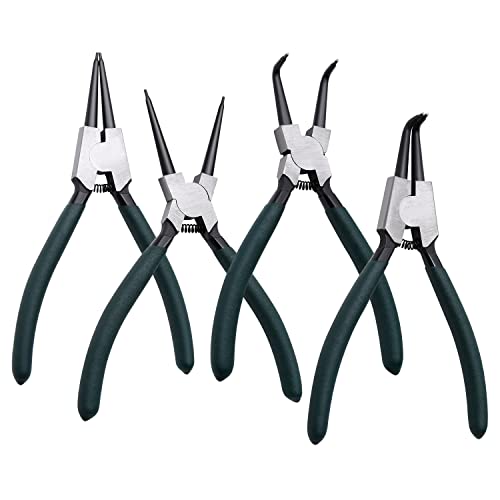
Interchangeable-tip pliers use a reversible or replaceable head to switch between internal and external circlips. They conserve drawer space and cover several jobs with one handle. Their trade-off is a joint or conversion mechanism that can introduce play, and tip changes take time. A dependable pair should lock securely in each mode; tips that twist or wobble under spring pressure make a small circlip harder to control.
Fixed-tip pliers have a dedicated orientation and tip geometry. A fixed internal pair spreads a circlip inside a bore; a fixed external pair compresses one around a shaft. There is no mode conversion, so they are quick to grab and often feel more rigid. The downside is that a useful range of sizes and angles may require several pairs.
| Design or tip size | Typical fit and use | What to check |
|---|---|---|
| Interchangeable, roughly 0.9–1.5 mm tips | Small light-duty rings in compact assemblies | Hole diameter, tip alignment, and whether the set includes 90-degree tips |
| Interchangeable, roughly 1.8–2.5 mm tips | General repair work on moderate-size shafts and bores | Maximum ring range in both internal and external modes |
| Fixed-tip, roughly 1.8–2.5 mm | Repeated service of rings that accept that tip size | Correct internal or external action and tip angle for access |
| Fixed-tip, roughly 2.5–3.5 mm | Larger, more strongly sprung circlips | Whether the ring’s holes can accept the tips without bending or slipping |
These are practical tip-diameter bands, not universal circlip-size ratings. Manufacturers specify capacity differently, and a tool’s advertised ring range does not guarantee that its tips fit every ring in that range. Confirm the maker’s capacity chart and compare it with the ring’s ear-hole diameter and working diameter.
Choose by the job, not by piece count
| Your situation | Better starting choice | Reason |
|---|---|---|
| Occasional household or workshop repairs; limited storage | Convertible set with straight and angled tips | One handle covers more orientations and both circlip actions. |
| Frequent work on a known machine or assembly | Fixed internal and external pairs matched to its rings | Fewer conversions and less potential movement at the head. |
| New to circlip work; mixed small and medium jobs | Mid-range set with clear capacity markings | Versatility helps, but readable size limits reduce mismatches. |
| Large, stiff rings or repeated production work | Dedicated fixed-tip pliers sized for the ring | A purpose-matched tool is easier to control under higher spring load. |
| Very tight access around a shaft or inside a bore | Set with suitable 45- or 90-degree tips | Tip angle can matter more than adding another handle. |
For a general-purpose purchase, look for a snap ring plier set with both internal and external operation, straight and angled tips, and a stated range for each configuration. Prefer clearly specified tip diameters and a positive locking or retaining mechanism over a large assortment with vague compatibility claims. A case is useful if it keeps each tip size labeled; loose tips are easy to mix up.
Four checks that separate a useful set from a frustrating one
1. Match tip diameter and shape to the circlip
The tips must enter the holes fully without excessive clearance. Too-small tips can slip out as the ring springs; oversized tips may not seat or can damage the ears. Blunt or poorly aligned tips are also more likely to skate. For frequently serviced equipment, keep one sample circlip or record its hole diameter and installed location before buying.
2. Check the conversion method
Some convertible pliers switch modes with a lever; others require repositioning or reversing the head. Either can work. What matters is that the head locks positively and returns to alignment after conversion. A mechanism that is awkward with oily hands or loosens during use is a poor fit for regular repair work. If speed and rigidity matter more than compact storage, fixed-tip pairs are simpler.
3. Assess grip and control
Look for handles that remain secure with gloves and provide enough length to control the spring force without requiring an awkward squeeze. A return spring can make repeated cycles easier, but it should not open the jaws so forcefully that it becomes difficult to place the tips. Fine work benefits from a slender nose and a clear view of the circlip; larger rings call for a handle and joint that do not flex noticeably.
4. Verify capacity in both modes
Internal and external ranges are not interchangeable. A set may handle a particular ring diameter externally but have a different limit internally. Check the published minimum and maximum for each mode, and avoid operating at the extreme end of the stated range when the ring is stiff. If the job is recurring, buy for the actual ring rather than the widest claimed capacity.
Using snap ring pliers safely and without damaging the ring
-
Identify the circlip and access direction. Internal rings sit in a bore and are expanded for removal; external rings sit on a shaft and are compressed. Confirm whether the ring is reusable and note its orientation before removing it.
-
Select and inspect the tips. Use tips that seat fully in both holes. Check that interchangeable tips are secured and aligned, and that the pliers are set to the correct internal or external mode.
-
Control the ring as you load it. Wear eye protection and keep your face and hands out of the ring’s likely path. Circlips store spring energy and can fly free. Use a small amount of controlled movement rather than forcing the handles to their limit.
-
Remove or install the ring squarely. Keep the pliers aligned with the shaft or bore so the ring does not twist. During installation, make sure the circlip seats fully in its groove; do not assume it is secure just because it appears level.
-
Check seating and condition. Inspect the groove and ring for burrs, distortion, or damage. Replace a circlip that is bent, cracked, or no longer retains its shape, and verify full engagement before returning the assembly to service.
Durability and ownership: what wears first
On convertible pliers, the changeover joint and tip-locking surfaces are common sources of lost precision: repeated loading can create play or let a tip loosen. On any design, tips can bend, round over, or wear at their ends, especially when used on rings that are too large or stiff. Handles and return springs may also loosen or fatigue, but a poor tip fit is often the first sign that control is declining.
After use, wipe off oil, grit, and metal debris, particularly around the pivot and conversion mechanism. A light film of tool oil on the joint helps resist corrosion; keep the tips clean so they seat securely in circlip holes. Store interchangeable tips in labeled slots and avoid using pliers as general gripping or prying tools. Those shortcuts damage tip alignment and can turn a manageable circlip job into a slipping, uncontrolled one.
In short, the best snap ring plier set for varied, occasional repairs is a well-made convertible design with clearly stated capacities and useful tip angles. For repeated work on known circlips—or for larger, stiff rings—dedicated fixed-tip pliers sized to the job are usually the more dependable choice.