What's inside
As an Amazon Associate I earn from qualifying purchases. This post may contain affiliate links at no extra cost to you.
Our Top Picks
 LEXIVON Bike Torque Wrench 1/4-Inch Dr. 15-Piece Kit1/4"DR. 1.48-19.18 FT-LB Kit4.69 x 10.35 x 2.28 inches1.3 poundsCheck on Amazon
 KEEMEETOOLS 1/4 Inch Drive Torque Wrench 20-260 In-Lb1/4" 20-260IN9.45 x 1.18 x 1.18 inches0.9 poundsCheck on Amazon
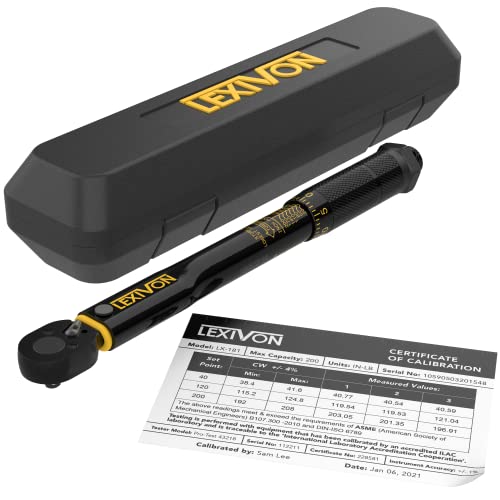

Best 1/4-Inch Torque Wrenches for Precise Fastening
For delicate fasteners, the best 1 4 torque wrench is a calibrated click or micrometer wrench whose working range puts your target torque near the middle of its scale—not at the bottom—and whose head fits the available space. A 1/4-inch drive suits small sockets and low-torque work, but it does not automatically make a wrench accurate at very low settings. Check the calibration range, stated accuracy, scale increments, and head dimensions against the fasteners you actually tighten.
What to compare before choosing
- Working range: Match the wrench to the manufacturer’s specified torque. Avoid choosing a wide-range tool that only reaches the target at the very bottom of its scale, where setting and reading can be less convenient.
- Accuracy: Many reputable click-type wrenches specify ±4% accuracy, often in the clockwise direction and within a stated portion of the scale. Read the exact conditions: a published figure is not necessarily guaranteed across the entire range or in both directions.
- Readability: A clear primary scale plus fine increments helps prevent setting errors. Micrometer-style handles are compact; digital displays can be easier to read but depend on batteries and may add cost.
- Ratchet head: A compact head helps in tight spaces, while a fine-tooth ratchet needs less swing to engage. Tooth count alone does not establish torque accuracy or durability.
- Calibration and storage: Look for a manufacturer’s calibration statement, service options, and a proper case. After use, return an adjustable click wrench to its lowest marked setting—not below it—unless its manual says otherwise.
1/4-inch torque wrench comparison
The figures below are representative specifications for established product lines. Exact ranges and accuracy can vary by model, regional version, and drive size; verify the specific part number before buying. “Not stated here” means the specification should be checked in that model’s current documentation rather than inferred from another version.
As an Amazon Associate we earn from qualifying purchases at no extra cost to you.


| Product or type | Drive and range | Accuracy / setting | Head and scale considerations | Best fit |
|---|---|---|---|---|
| TEKTON 1/4-inch micrometer click wrench (TRQ21101) | 1/4 in; 20–200 in-lb (about 2.3–22.6 N·m) | ±4% clockwise; 1 in-lb increments | Reversible ratchet; micrometer handle with inch-pound scale | Frequent small-fastener work where an inch-pound scale is convenient |
| Capri Tools 1/4-inch micrometer torque wrench (CP31200) | 1/4 in; 20–200 in-lb (about 2.3–22.6 N·m) | ±4% clockwise; 1 in-lb increments | Reversible ratchet; graduated handle; confirm the current model’s head dimensions | A comparable inch-pound alternative for workshop or equipment maintenance |
| CDI 1/4-inch micrometer torque wrench | 1/4 in; ranges vary by model | Model-specific; consult the certificate or specification sheet | Professional-style micrometer setting; head size and scale depend on variant | Users who value documented calibration and available service support |
| Digital 1/4-inch torque wrench | Commonly low-torque ranges; varies by model | Model-specific; check accuracy, units, and operating limits | Display can simplify reading; head may be bulkier and batteries are required | Occasional users who want a direct numerical readout or multiple units |
The TEKTON and Capri Tools examples cover approximately the same broad inch-pound range, so neither is automatically better for a fastener specified at the lowest end. For a target of 25 in-lb, for example, the setting is close to the bottom of a 20–200 in-lb scale. If that value is critical, consider a lower-range wrench that places it farther into its working range. A smaller range can improve practical setting resolution, though the manufacturer’s accuracy specification still matters more than the number of scale marks alone.
Choose by the job, not by drive size alone
| Your situation | Suitable choice | Why |
|---|---|---|
| Small screws or fittings with a specified torque below the middle of a 20–200 in-lb range | Lower-range 1/4-inch wrench, selected to bracket the target comfortably | Keeps the setting away from the scale’s lower limit and makes adjustments easier to distinguish |
| Regular bench work; clear units and simple operation matter | 1/4-inch micrometer click wrench with an inch-pound scale | No battery dependency; familiar, repeatable setting once the scale is learned |
| Occasional work or frequent switching between units | Digital 1/4-inch wrench, if its range and accuracy match the job | A display can reduce unit-conversion and scale-reading mistakes, at added cost and complexity |
| Tight access around small components | Compare head height and length before buying; consider a compact-head model | A 1/4-inch drive does not guarantee a small ratchet head or enough handle clearance |
| Fasteners beyond the 1/4-inch wrench’s range | Move to a suitable 3/8 torque wrench or 1/2-inch wrench | A larger drive generally supports higher torque and larger sockets, but does not replace matching range to the specification |
When a 3/8-inch or 1/2-inch wrench makes more sense
A 1/4 torque wrench is intended for small sockets and relatively low torque. If the required setting exceeds its rated capacity, do not use an adapter or a longer handle to force the job; choose a wrench rated for the load. A 3/8 torque wrench is a common middle ground for automotive and general mechanical work, while a 1/2-inch model is more suitable for many higher-torque fasteners and larger sockets. These are broad patterns, not substitutes for the equipment maker’s torque specification.
Searches for the “best 3 4 torque wrench” may mean a 3/4-inch drive, which is a different, heavy-duty category—not a larger version for delicate fasteners. Likewise, the best 3 8 torque wrench or best torque wrench 1 2 depends on the required torque range, accuracy, and access. Choose the smallest drive that safely covers the specified torque and socket size, rather than buying by drive size as a proxy for precision.
Setup habits that protect accuracy
- Confirm the unit and specification. Convert carefully if the manual gives N·m but the wrench is marked in in-lb. For example, 10 N·m is about 88.5 in-lb; do not confuse inch-pounds with foot-pounds.
- Set the value and lock the handle. Align the main scale and fine scale as the manual shows. A partly locked handle can shift during tightening.
- Pull smoothly at the grip. Keep the wrench aligned with the fastener and stop at the first click. Repeated clicks can add torque, especially on small fasteners.
- Use the correct tightening direction. A reversible ratchet may turn both ways, but the wrench’s stated accuracy may apply only clockwise. Check the manual before using it counterclockwise.
- Store it unloaded. Return an adjustable click wrench to its lowest marked setting and keep it clean and dry in its case. Do not use it as a breaker bar.
Calibration is not permanent. Heavy drops, repeated use near the limits, incorrect storage, or a wrench that clicks inconsistently are reasons to arrange a calibration check or replacement. For occasional home use, a correctly ranged, clearly marked micrometer wrench is often the practical choice; for critical or frequent work, prioritize documented calibration and accessible service over extra features.