What's inside
As an Amazon Associate I earn from qualifying purchases. This post may contain affiliate links at no extra cost to you.
Our Top Picks
 Starrett Steel Combination Square with Square Head12"1 x 1.4 x 12.3 inches1.22 PoundsCheck on Amazon


The short answer
For cabinet layout, a Starrett 12-inch combination square is the more versatile tool; a Woodpeckers precision square is usually the quicker, simpler choice for checking and marking a fixed 90-degree corner. If you already own a reliable combination square, you may not need the dedicated square. If you’re buying your first layout tool and expect to mark depths as well as check squareness, the Starrett makes more sense.
The important caveat: both names cover products and configurations that can differ. Check the exact ruler length, head style, graduations, and stated accuracy before buying. A brand name alone won’t tell you whether a particular square fits your work.
As an Amazon Associate we earn from qualifying purchases at no extra cost to you.


What each tool does
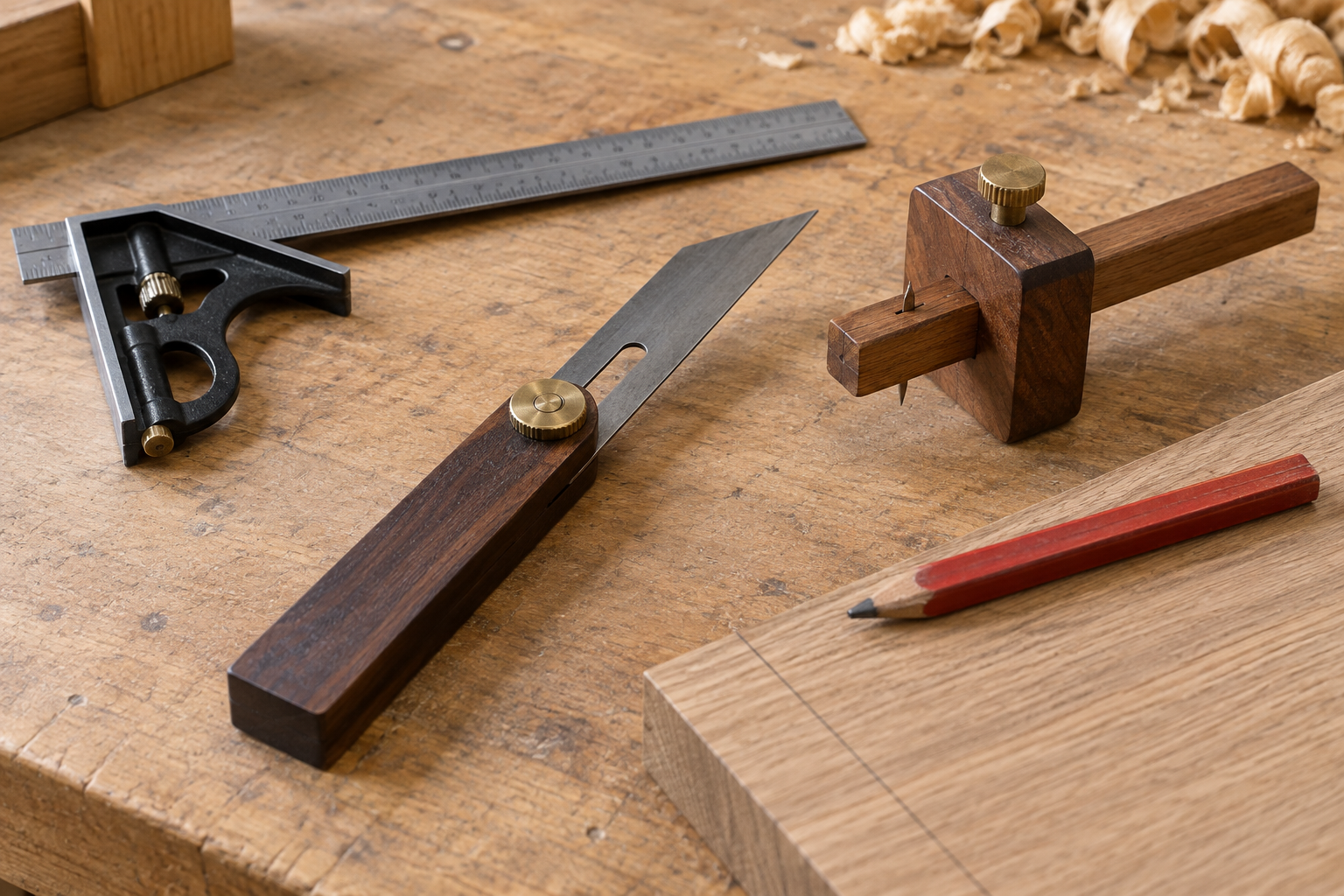
A 12-inch combination square has a ruler that slides through a head. The head can be locked at different positions, letting you check or mark 90-degree and 45-degree angles, set a repeatable distance from an edge, and use the ruler independently. That range is useful when laying out cabinet parts, setting hardware locations, or checking a machine setup.
A precision square is a dedicated reference for checking and marking an angle, generally 90 degrees. Its blade and stock are fixed relative to each other, so there’s no sliding ruler or locking mechanism to adjust. For checking a cabinet side against a shelf or marking a square line across a narrow board, that simplicity is an advantage.
Cabinet-layout comparison
| Consideration | Starrett 12-inch combination square | Woodpeckers precision square |
|---|---|---|
| Main strength | One tool handles several measuring and marking jobs | Fast, straightforward 90-degree checks and marks |
| Depth and offset layout | Ruler can be set to a chosen distance from an edge | Depends on the specific model; a fixed square is not a substitute for a sliding rule |
| Adjustment | Head must be positioned and locked; the ruler can shift if poorly clamped | No sliding head to set or lock |
| Best cabinet uses | Marking shelf-pin offsets, checking 45-degree cuts, general bench layout | Checking panel corners, marking short crosscuts, verifying assembly |
| Trade-off | More versatile, but has more parts and setup steps | Simple and quick, but does fewer jobs |
Accuracy in practice
For a cabinet, the square is only one part of the accuracy chain. A small error can compound: if opposite sides of a panel are not parallel, a square can mark a perfect 90-degree line from one edge and still leave the part out of dimension. Check the reference edge first, and compare diagonals when checking a cabinet box. Equal diagonals are a useful check that a rectangular assembly is not racked.
Before trusting either square, make a simple flip test. Draw a line against the tool on a straight, flat board, flip the square over against the same reference edge, and draw a second line from the same point. If the lines diverge noticeably over several inches, investigate the tool or your reference edge before laying out a run of parts. Don’t assume the printed graduations are more accurate than the square’s working edge; verify critical offsets with a reliable ruler or caliper.
With the combination square, confirm that the ruler is seated and the head is firmly locked before marking. Sawdust between the ruler and stock, a loose lock, or a ruler that has been knocked out of alignment can produce a misleading check. A fixed square avoids those particular failure modes, but it still needs a clean, undamaged edge and careful contact against the work.
Which one should you buy?
Choose the Starrett if you want a general-purpose 12-inch tool and will use the sliding head for more than occasional corner checks. It is a better fit for a shop where one tool needs to cover depth marks, 45-degree checks, and layout across parts wider than a small square can span. A 12-inch combination square is the more practical first purchase when versatility matters.
Choose a Woodpeckers precision square if your main job is quickly checking or marking 90-degree corners and you value a dedicated, ready-to-use reference. It can be especially convenient during cabinet assembly, when you repeatedly check panels and joints rather than measure offsets. Look at the blade length and the specific model’s stated accuracy before ordering: a small square may be excellent for a drawer part but awkward for a wide cabinet panel. A Woodpeckers precision square makes more sense as a focused checking tool than as your only measuring tool.
If the premium price is hard to justify, a sound, checked 12-inch combination square from another reputable maker can be perfectly adequate for cabinet work. Test it before relying on it. A cheaper square that checks true and holds its setting is more useful than an expensive one you haven’t verified.
Make the tool work for the job
For repeatable cabinet layout, use the same reference face and edge throughout a part whenever possible. Mark offsets from a known edge instead of measuring from a previous pencil line, and keep the square’s stock firmly against the work while drawing the line. On sheet goods, a 12-inch blade won’t reach across a full cabinet side, so use a straightedge or track for long cuts and reserve the square for checking corners and short marks.
In practical terms, the Starrett wins on range, while the Woodpeckers wins on simplicity as a dedicated square. Buy the combination square if you need one tool to do several layout jobs; buy the precision square if you already have measuring tools and want a convenient 90-degree reference. Neither replaces checking the work, the reference edge, and the assembled cabinet itself.