What's inside
As an Amazon Associate I earn from qualifying purchases. This post may contain affiliate links at no extra cost to you.
A stacked dado set usually produces more accurate grooves than a wobble dado blade, especially when you need repeatable widths or a flat-bottomed cut. The reason is mechanical: stacked cutters remove material across the groove at once, while a wobble blade tilts a single blade to create width. That tilt can leave a slightly dished bottom and makes fine width adjustments less predictable.
That does not make a wobble blade useless. It can be a reasonable budget choice for occasional cuts in plywood or other work where a small amount of bottom unevenness will be hidden. The right choice depends on the fit you need, how often you will change widths, and whether your saw is approved to use the accessory.
As an Amazon Associate we earn from qualifying purchases at no extra cost to you.



Our Top Picks
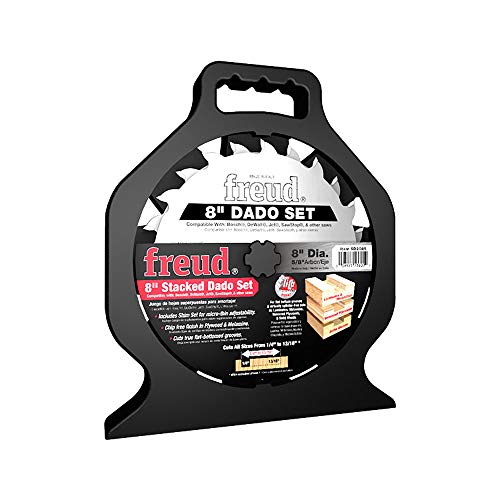 Freud Pro Dado Set with Premium Tico Hi-DensityOne Size2 x 9 x 11.8 inches5.69 poundsCheck on Amazon


How the two designs cut
A stacked dado set combines two outer blades with one or more chippers between them. Adding or removing chippers changes the cutting width. The outer blades score the groove edges; the chippers clear material from the center. Because the cutters sit parallel to the arbor, a properly set-up stack can leave a broad, flat bottom.
A wobble dado uses one blade mounted on an adjustable angled hub. Turning the adjustment changes the blade’s angle, which changes the width of the cut. The blade sweeps through the material in an arc. It is faster to adjust than sorting through shims and chippers, but the cutting geometry does not produce the same flat floor as a stack.
Accuracy and groove-bottom quality
For a snug dado joint, width matters more than the label on the cutter. A groove that is too wide leaves a loose shelf or divider; one that is too narrow forces assembly and can split the workpiece. Stacked sets make it easier to approach a target width in small increments using the supplied shims. You should still cut a test groove in scrap from the same stock: nominal plywood thickness is often not its actual thickness.
The wobble blade’s adjustment scale is a starting point, not a guarantee of finished width. Blade runout, arbor condition, saw alignment, and the material can all affect the result. Its angled cut also tends to make the groove bottom concave. That may be acceptable for a hidden joint, but it reduces bearing area and can prevent a flat-bottomed groove from seating cleanly.
Neither setup compensates for a poorly aligned fence, a blade that is not seated correctly, or stock that moves during the cut. Check the width with calipers if the fit is critical, and inspect the bottom with a straightedge. A test cut is cheaper than discovering the error after cutting a full panel.
Stacked vs. wobble at a glance
| Factor | Stacked dado set | Wobble dado blade |
|---|---|---|
| Groove bottom | Typically flat when assembled and adjusted correctly | Typically dished because the blade cuts at an angle |
| Width adjustment | Change chippers and shims; more setup | Adjust the hub; quick, but verify with a test cut |
| Repeatability | Good once the stack is recorded and installed consistently | Can be adequate, but relies on the adjustment and setup |
| Best fit | Cabinet joinery, shelves, and repeat work | Occasional, less demanding grooves |
| Main drawback | Higher cost and more parts to manage | Less suitable for flat-bottomed, precise joints |
Setup, compatibility, and safety
Before buying either type, check the saw manual. Some portable table saws, jobsite saws, and contractor saws do not permit dado cutters, or allow only a specified maximum width. The arbor must be long enough for the cutter stack, and the saw needs the correct throat plate. Do not assume that a dado set fits just because its arbor hole matches.
Install a stacked set in the order specified by its manufacturer, with the outer blades facing the correct direction. Use only the chippers and shims supplied or approved for that set; improvised spacers can cause poor seating or unsafe operation. Confirm the stack clears the throat plate and does not contact the insert or saw housing when turned by hand with the saw unplugged.
Use the saw’s appropriate guard or dado safety equipment, and follow the manual’s instructions for the operation. Keep hands out of the cutter path and use a push block or suitable hold-down where needed. A dado setup removes a lot of material in one pass; forcing the work or taking an unnecessarily deep cut can overheat the cutters, burn the stock, or cause the saw to bog down. For deep grooves, several shallower passes can be easier on the saw and produce a cleaner result.
Which should you buy?
Choose a stacked set if you make cabinet parts, dados for shelves, or any joint where the groove needs a flat floor and a controlled fit. It is also the better investment if you expect to repeat widths: write down the cutter and shim combination that worked for a given material, then confirm it with scrap on the next setup. Compare stacked dado blade sets by maximum width, included chippers, arbor size, and whether the maker lists your saw type as compatible.
A wobble blade can be fine for occasional grooves in a project where the bottom will not show and a slightly imperfect fit is not a problem. It costs less and is quick to adjust, so it may make sense for a hobbyist who will use it rarely. But if you need a true flat-bottomed cut or a close-fitting joint, its lower purchase price can be a false economy. Look at wobble dado blades only after confirming that your saw’s manual permits them.
A practical decision rule
For precision and repeatability, buy a compatible stacked dado set. For a few forgiving grooves, a compatible wobble blade may do the job, provided you test the width and accept its less-flat bottom. If neither accessory is approved for your saw, do not force the choice: a router with a straight bit and guide, or repeated table-saw passes with a standard blade and a carefully set fence, can cut the groove safely within the tool’s limits.