What's inside
As an Amazon Associate I earn from qualifying purchases. This post may contain affiliate links at no extra cost to you.
Our Top Picks
 Swanson 12-Inch Combo Square with Stainless Steel Rule12 Inch5 x 5.75 x 0.75 inches0.77 poundsCheck on Amazon


What each tool measures
A combination square and a digital caliper solve different small-measurement problems. A combination square checks a workpiece against a straightedge and a reference face: think marking a line 1 inch from an edge, checking whether a cut is square, or setting a blade height. A digital caliper measures the distance between two surfaces, inside a hole, or across an edge. It is the more direct choice for checking thickness, diameter, and small offsets.
For woodworking, neither replaces the other. The right choice depends on whether you need to compare a dimension to a reference or read the dimension itself. If you mostly build from lumber and sheet goods, a decent square may get more use. If you make small parts, fit hardware, or need repeatable measurements in fractions of a millimeter, calipers earn their place.
As an Amazon Associate we earn from qualifying purchases at no extra cost to you.


At a glance
| Job | Combination square | Digital caliper |
|---|---|---|
| Check a board edge for square | Very good; the stock registers against the edge | Poor fit for the job |
| Measure thickness or diameter | Possible, but awkward and less precise | Very good within its jaw capacity |
| Mark a line parallel to an edge | Very good, with a pencil or knife | Not designed for marking |
| Read a measurement quickly | Depends on the rule graduations and your eyesight | Easy to read, but depends on calibration and clean contact |
| Typical care issue | Check for a loose head or damaged rule | Keep jaws clean; protect from dust, moisture, and drops |
When the combination square is the better buy
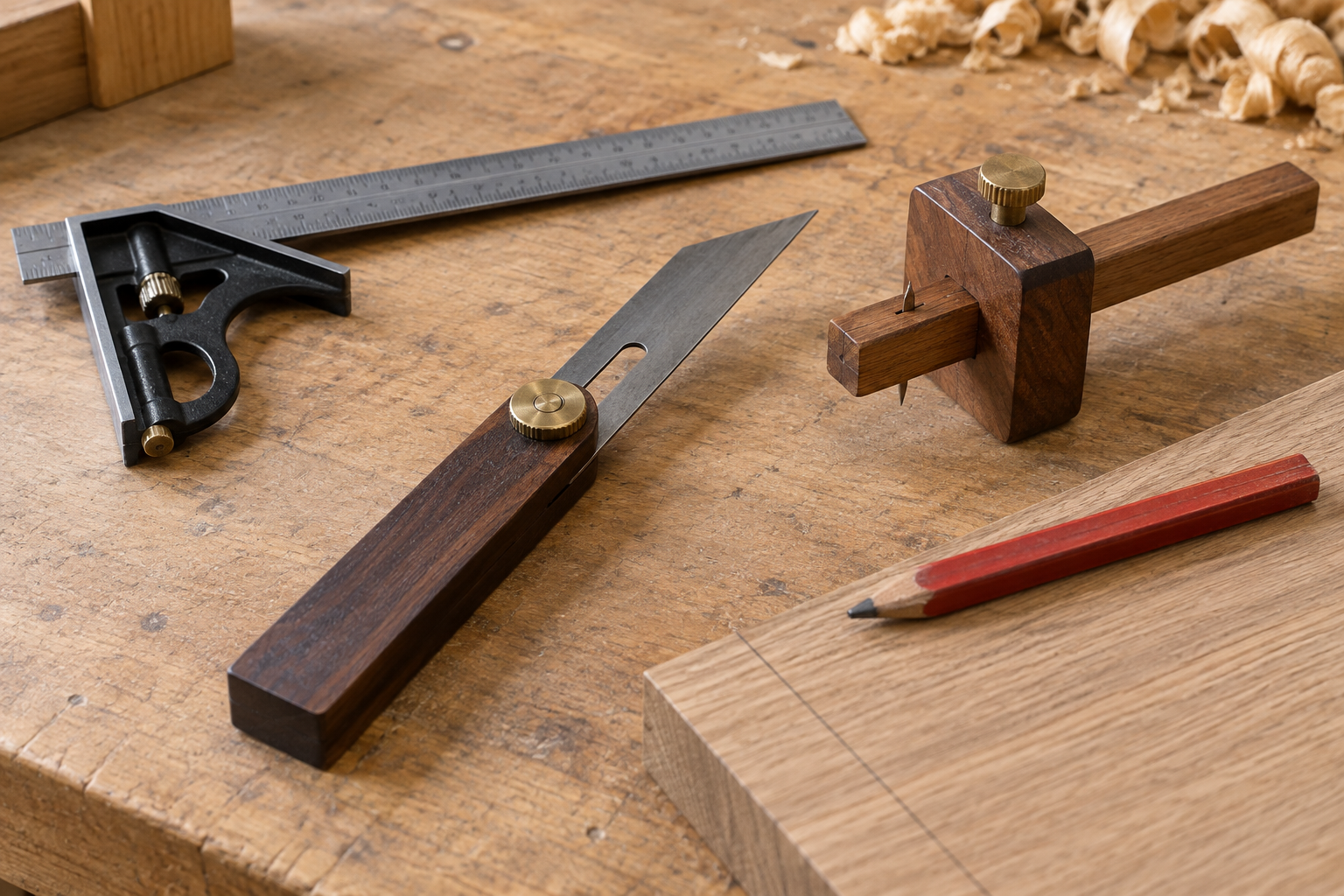
A combination square is useful whenever the work has a reliable reference edge. Set the head against a board and use the rule to mark a line at a fixed distance. It also checks whether a cut is 90 degrees and can help transfer a measurement from one piece to another. Many have a 45-degree face and a small bubble level, though neither feature turns a basic square into a precision layout system.
Its main advantage is not fine measurement resolution; it is controlled contact. A caliper can tell you that a board is 19.1 mm thick, but it cannot readily show whether the end of that board is square. A square can. This matters when fitting a drawer front or checking a saw cut, where a tiny angle error can leave a visible gap across a wide face.
There is a catch: an inexpensive square may not be square. Test it by drawing a line along the rule, flipping the tool, and drawing a second line from the same edge. If the lines diverge, the tool or reference edge is off. Also check that the head locks firmly and that the rule does not shift when you apply light pressure. For general shop layout, a 12-inch combination square is a practical size; shorter rules are easier to handle on small parts.
When a digital caliper is the better buy
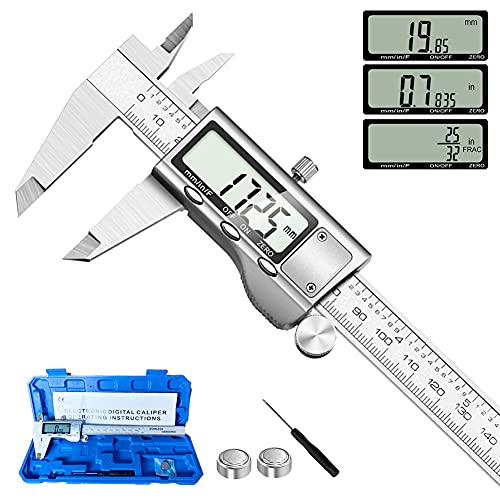
Calipers are faster when you need an actual dimension. Their outside jaws measure stock thickness or dowel diameter; the smaller inside jaws measure openings; and the depth rod measures shallow holes and recesses. A common 6-inch caliper has enough range for most small woodworking parts and is easier to read than a rule when comparing, for example, a 6.3 mm bit with a drilled hole.
Resolution is not the same as accuracy. A display that reads to 0.01 mm does not guarantee that the tool is accurate to 0.01 mm. For woodworking, that resolution is often more than you need. Dust trapped between the jaws, tilted contact, or squeezing soft wood can change the reading by several hundredths of a millimeter—or more. Take light pressure, keep the faces parallel, and check the zero before measuring. A caliper is also a poor choice for measuring a long board: jaw capacity is limited, and the tool is easy to hold crooked.
A basic 6-inch digital caliper is sufficient for most small shop work. Stainless-steel models tend to feel more solid than very cheap plastic-bodied versions, but even a well-made electronic caliper should be kept away from wet glue, heavy sawdust, and drops. If you only need to measure thickness occasionally, a rule or a simple mechanical caliper may be cheaper and dependable enough.
Choose by the work, not the display
For a box maker, furniture builder, or anyone checking joinery, start with a square if you do not own one. Use it to verify reference edges and mark repeatable offsets. Add a caliper when you often fit small hardware, compare stock thicknesses, size dowels, or check whether a tenon is close to its target. If you do both kinds of work, owning both is sensible: they overlap less than their names might suggest.
For example, to fit a 6 mm dowel into a hole, a caliper can measure the dowel and the opening, but it cannot tell you whether the hole is centered or whether the adjoining face is square. To lay out a shoulder line on a tenon, a square is the natural tool; to compare the tenon’s thickness on several faces, a caliper is quicker. Use the square for geometry and the caliper for dimensions.
Avoid common measurement errors
Do not treat a single caliper reading on rough-sawn wood as the final truth. Measure at several points and note the spread; a board can vary by 0.5 mm or more across its width. Avoid crushing the fibers with the jaws, especially on softwood. On a combination square, seat the head fully against a clean edge rather than a rounded or chipped corner. A small gap at the reference face creates a misleading line even if the tool itself is accurate.
For repeat work, check tools against a known reference occasionally. A square can be tested with the flip test; calipers should close cleanly to zero and can be checked against a known gauge or a measured block. If readings jump or fail to repeat, clean the contact surfaces and inspect for damage before adjusting your work to match the tool.