What's inside
- Collation Is Not Just Packaging
- Framing Collation: Paper Tape vs. Plastic Strip vs. Wire Weld
- Angle, Gauge, and Head Size Matter More Than Brand
- Shank Styles and Coatings: Where Holding Power Comes From
- Framing Nails Are Not Trim Nails
- Comparison: Collated Nail Systems at a Glance
- How to Buy Without Wasting Money
As an Amazon Associate I earn from qualifying purchases. This post may contain affiliate links at no extra cost to you.
Collation Is Not Just Packaging
Collated nails are held together so a nail gun can feed them, but the material that holds them dictates what gun you can use, how the nails behave on entry, and what you leave behind in the joint. The nail itself — diameter, length, shank, and coating — determines holding power. The collation determines compatibility, jobsite mess, and in some cases, code compliance. You cannot mix them. A 21-degree plastic-strip nailer will not take 30-degree paper tape, even if the nail length and shank look identical.
For framing and structural work, you are choosing between 2-1/8″ to 3-1/2″ nails in .113″ to .148″ diameter. For trim, you are down to 1″ to 2-1/2″ in 15-gauge (.072″) and 16-gauge (.063″). The wrong choice shows up as jams, blowouts, weak joints, or callbacks for popped trim.
Framing Collation: Paper Tape vs. Plastic Strip vs. Wire Weld
These are the three collations you will see for framing nails, and they each lock you into a nailer angle.
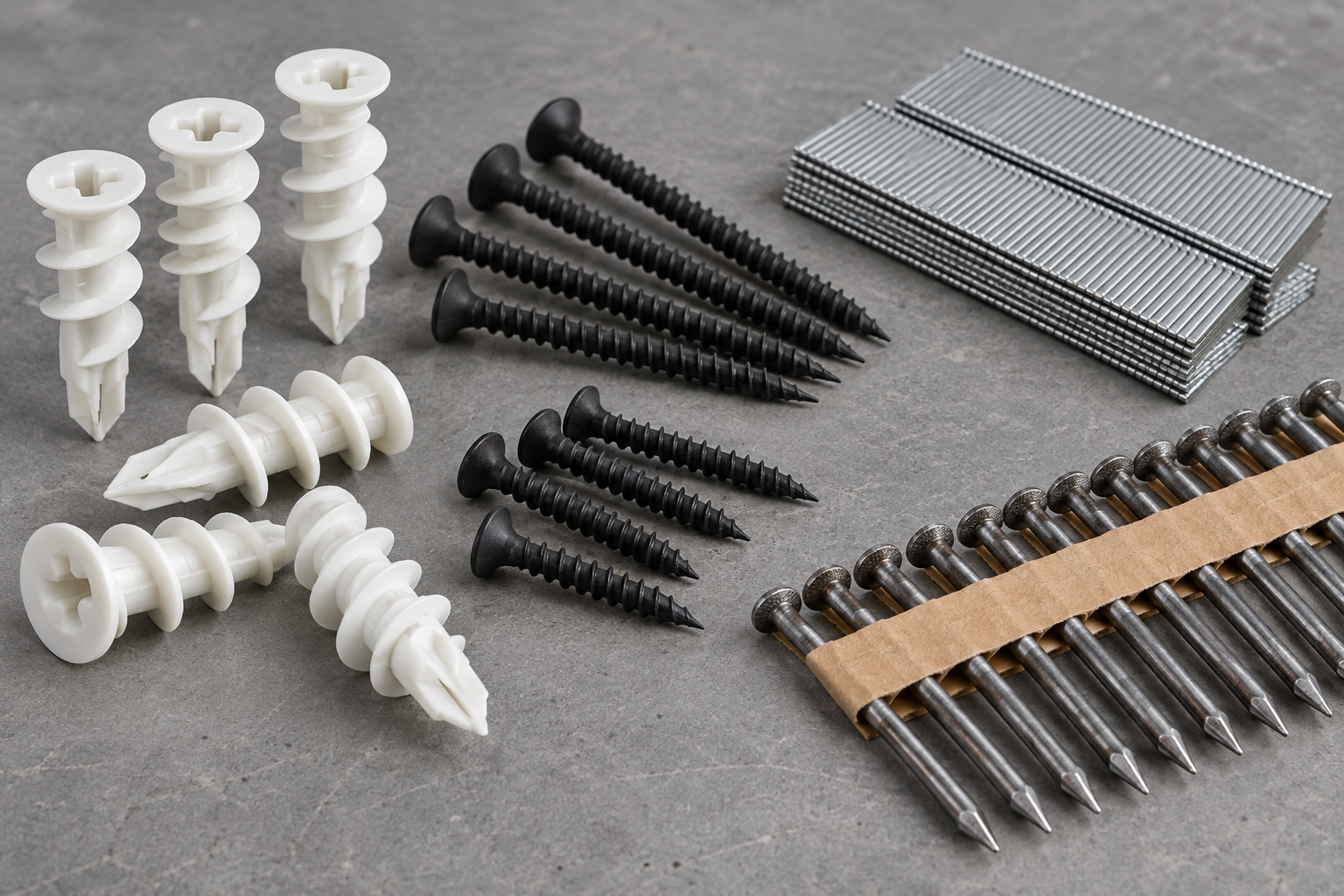
Paper tape (28 to 34 degrees) is the most common for modern framing guns. The nails are held by paper strips that tear away on firing. The paper disintegrates and does not leave debris in the lumber. That matters for inspections and for engineered lumber, where bits of plastic wedged between nail shank and wood can slightly reduce friction and shear values. Paper-taped nails are also the only type accepted in some jurisdictions for seismic and hurricane tie-downs because they leave a clean joint. Downside: paper absorbs moisture. Leave a stick out overnight in damp air or rain and the tape swells, causes misfeeds and jams.
Plastic strip (21 degrees) holds nails with two brittle plastic strips. The gun shears the plastic on firing and ejects fragments. It feeds very reliably, even when dirty, and the 21-degree angle gives you a more compact magazine that is easier to maneuver in tight bays between studs. The failure mode is the plastic itself. It shatters and flies — eye protection is mandatory — and small shards can get trapped under a nail head, preventing full seating. On deck and sheathing jobs you will be picking plastic out of the work area all day.
Wire weld (28 degrees, and coil) uses thin wires welded to the shanks. Feeds well and is less moisture-sensitive than paper. The weld leaves a small burr on the shank and the wire fragments can rust if left on the surface, which leads to staining on exposed work like fencing or cedar siding. Most full-head wire-weld nails are 28 degrees, while many coil framing nailers use wire-weld coils of 50-300 nails. Coils give you higher capacity and are faster for sheathing and decking, but coil nailers are heavier and bulkier overhead.
If you are buying your first framing nailer and do not already own nails, paper tape collated framing nails with a 30 to 34-degree gun gives you the widest acceptance for code work and the cleanest drive. If you frame in wet weather or value reliability over debris, a 21-degree plastic-strip system is the workhorse alternative. The cheaper option is fine for non-structural work like crates or temporary bracing, but do not use plastic collated nails where an engineer has specified paper tape.
Angle, Gauge, and Head Size Matter More Than Brand
Nail angle is not adjustable. It is built into the magazine. Common framing angles are 21 degrees (full round head, plastic), 30-34 degrees (clipped or offset full head, paper), and 15 degrees for coils. A clipped-head nail (the head is D-shaped) lets more nails fit per stick, but some codes do not allow clipped heads for structural shear walls because of reduced head surface area. If you are pulling a permit, buy offset full-head or full round-head nails. The price difference is a few dollars per box and it removes an inspection argument.
For trim, gauge tells you everything about the hole you will leave. 15-gauge finish nails (.072″ diameter) have a larger, angled head that seats well and resists pull-through in door jambs, baseboard, and crown where wood movement is significant. 16-gauge (.063″) leaves a smaller hole and is better for prefinished trim, window casing, and anywhere you want less putty work. 18-gauge brads are not trim nails in the structural sense — they have almost no holding power and are for tacking small profiles, not hanging doors.
Length rules are simple and worth following. For framing, the nail should penetrate the receiving member by at least 1-1/2 times the thickness of the material being fastened. For trim, 1″ penetration into solid framing or blocking is the minimum for anything that will be stressed, like baseboard that takes kicks or a door jamb that takes hinge load. A 2″ 16-gauge nail through 3/4″ baseboard into drywall alone will fail. It will hold paint, not the board.
Shank Styles and Coatings: Where Holding Power Comes From
Smooth shank is cheapest and drives easiest. It also has the lowest withdrawal resistance, about 30-40% less than a ring shank of the same diameter. Use smooth for temporary work or where code allows it for interior non-structural framing.
Ring shank adds annular rings that bite into wood fiber. In Douglas fir or SPF, a 3-1/2″ x .131″ ring shank has roughly 2x the pull-out resistance of a smooth .131″. It is harder to pull if you need to disassemble, and it increases the chance of splitting hardwoods if you do not adjust pressure.
Screw shank (spiral) sits between the two and is common in deck and subfloor nails. It drives with a twisting action and holds well in engineered subfloor.
Coatings are not cosmetic. Bright (uncoated) nails are for interior dry service only; they will rust and streak. Hot-dipped galvanized (HDG) is the standard for exterior, pressure-treated lumber (ACQ/CA-C), and high-humidity areas. Electro-galvanized is thinner and not rated for treated lumber or ground contact — it will corrode in a year outdoors. Vinyl coating is a lubricant for driving, not corrosion protection. Many hot dipped galvanized ring shank framing nails also have a vinyl flash coat to help them sink without excessive gun pressure.
Framing Nails Are Not Trim Nails
A framing nailer hits with 90-120 PSI and drives .131″ to .148″ nails designed to crush and clamp. A finish nailer drives a much thinner fastener with a countersink head meant to be set slightly below the surface and filled. Using a framing nailer on trim will split the profile and leave a crater you cannot hide. Using a finish nailer to toe-nail a stud will give you a joint that looks connected but has almost no shear strength.
For interior trim, 15-gauge and 16-gauge nails are the decision. 15-gauge heads are full and do not pull through MDF easily, which matters for heavy 5-1/4″ base or solid wood crown that will expand and contract. 16-gauge is ideal for painted poplar, finger-jointed pine, and prefinished casing where hole size matters and loads are light. Most pros own both: 16 gauge finish nails galvanized for everyday casing and base, and a 15-gauge gun for doors, stair skirt, and thick hardwood trim.
If you are attaching trim to masonry or steel, neither is correct. You need hardened trim screws or a powder-actuated system, not a finish nail.
Comparison: Collated Nail Systems at a Glance
| System | Typical Angle / Collation | Nail Size Range | Best Use | Key Trade-off |
|---|---|---|---|---|
| Paper Tape Framing | 30-34° paper strip | 2″ to 3-1/2″, .113″-.148″, clipped or offset full head | Structural framing, shear walls, code inspections | Swells with moisture; jams if left damp |
| Plastic Strip Framing | 21° plastic strip | 2″ to 3-1/4″, .113″-.148″, full round head | General framing, tight bays, wet/dirty sites | Plastic debris under heads, flying shards |
| Wire Weld Coil Framing | 15° wire coil (50-300 nails) | 1-1/2″ to 3-1/4″, .099″-.131″ | Sheathing, decking, fencing, high-volume nailing | Bulky gun; wire fragments can rust/stain |
| 15-Gauge Finish (DA) | 34° glue collated strip | 1-1/4″ to 2-1/2″, .072″ | Doors, heavy base, crown, hardwood trim | Larger hole to fill, more splitting risk on small profiles |
| 16-Gauge Finish | 20° glue collated strip | 1″ to 2-1/2″, .063″ | Casing, baseboard, general painted trim | Less holding power than 15-gauge on heavy trim |
How to Buy Without Wasting Money
Start with the gun you own, then match collation, angle, and head type exactly. If you have not bought a gun yet, choose based on the work you do most. A 30-degree paper tape framer plus a 16-gauge finish nailer covers 90% of residential new construction and remodel for a homeowner or small crew. A coil nailer makes sense only if you sheath, roof, or deck large areas regularly — otherwise the magazine weight is a penalty you pay all day for capacity you do not need.
Do not pay extra for stainless steel unless you are fastening cedar, redwood, or coastal exterior trim where any rust will show through paint. For everything else, hot-dipped galvanized is sufficient and half the price. And do not overbuy length. A 3-1/2″ .131″ nail is not universally better than a 3″ .131″ — it requires more air pressure to set, increases blowout risk on toe-nailing, and costs more per thousand. Use the shortest nail that still gives you proper penetration and head bearing.
Finally, test pressure and depth on scrap from the same pile you are nailing. SPF studs vary in density, and engineered LVL headers are much harder than framing lumber. A nail set 1/8″ proud in LVL is not a nailer problem, it is a pressure and shank choice problem. Turn up pressure in 5 PSI increments, or switch from smooth to ring shank only if you need the extra grip, not by default.