What's inside
As an Amazon Associate I earn from qualifying purchases. This post may contain affiliate links at no extra cost to you.
A 2×12 rafter is a demanding cut for a circular saw: the board is about 1 1/2 inches thick, but a plumb cut across its 11 1/4-inch face is wider than a standard 7 1/4-inch blade can reach in one pass. The saw does not need extraordinary power so much as a stable base, a sharp blade, and a cutting plan that avoids twisting the blade in the kerf.
As an Amazon Associate we earn from qualifying purchases at no extra cost to you.


Our Top Picks
 DEWALT FLEXVOLT 60V MAX* Circular Saw with BrakeOne Size15.35 x 8.23 x 9.65 inches8.2 poundsCheck on Amazon
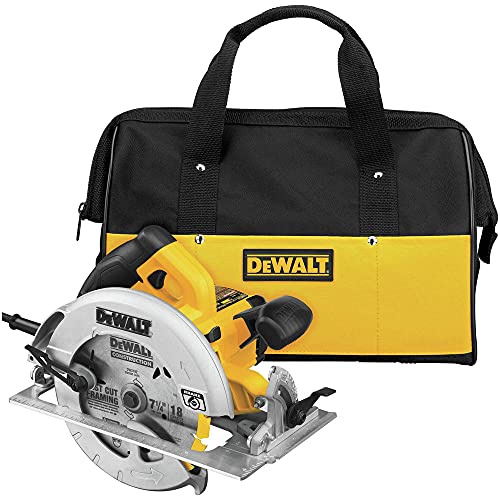
 DEWALT FLEXVOLT 60V MAX* Circular Saw for FramingOne Size18 x 9 x 8.2 inches10.9 PoundsCheck on Amazon



What the job requires
For typical framing lumber, a 7 1/4-inch circular saw has enough depth to cut through a 2×12’s thickness. Its limit is the length of the cut. At 90 degrees, a common 7 1/4-inch saw cuts roughly 2 3/8 inches deep; at 45 degrees, capacity is usually closer to 1 5/8 inches. Check the saw’s stated capacity, especially if making bevel cuts.
A square plumb cut across the wide face needs more than 11 inches of reach. You can cut from both faces, using a marked line and a square to keep the cuts aligned, or use a larger saw designed for deeper cuts. For repeated rafter cuts, a track saw or suitable miter saw may be more accurate, but each has practical limits: many miter saws cannot crosscut a 2×12 in one pass, and a track saw’s rail must be supported and positioned carefully.
Saw types compared
| Option | Best use | Main trade-off |
|---|---|---|
| 7 1/4-inch circular saw | Rafter seats, end cuts, and general framing | Needs cuts from both faces for a full-width plumb cut |
| 10 1/4-inch circular saw | Deeper cuts and occasional full-depth framing work | Heavier, pricier, and less convenient for routine cuts |
| Track saw with long rail | Clean, controlled cuts when setup time is acceptable | Rail setup and support can be awkward on framing stock |
For most people cutting rafters on site, a good 7 1/4-inch saw is the sensible purchase. A larger saw is worthwhile if deep cuts are frequent, not just because a 2×12 sounds like it requires one. Compare 7 1/4-inch framing circular saws by cutting capacity, shoe rigidity, blade visibility, and how easily the bevel and depth locks operate.
Why blades bind—and how to prevent it
Binding happens when the kerf closes on the blade or the blade is forced sideways. A long board sagging under its own weight can pinch a cut; so can a rafter that shifts as the offcut drops. A dull blade, a twisted guide, or pushing through a knot can also slow the saw and increase the chance of kickback.
Support the board on both sides of the cut, but arrange the supports so the offcut cannot fall and pinch the blade. On a long rafter, use stable sawhorses or a cutting table and keep the work from rocking. Clamp it if that can be done without obstructing the saw. Never hold a narrow or moving piece with your hand near the cut.
Use a sharp framing blade suited to the saw—typically a carbide-tipped blade with about 24 teeth for fast rough cuts. A higher-tooth-count blade can leave a cleaner edge but may cut more slowly and load the saw harder. If the saw slows sharply, stop and let the blade come to a full stop before backing out. Do not twist the saw to free a trapped blade.
What to prioritize when buying
For rafters, favor a rigid shoe that stays square, a clear cut-line window, and a depth adjustment that locks without creeping. A dust blower and bright work light help, but they do not compensate for a base plate that flexes or a blade that wanders. Corded saws offer consistent power for long cutting sessions; cordless models are easier to handle on a roof or ladder, but battery weight and runtime matter. Make cuts from a stable platform rather than cutting while perched in an awkward position.
A 15-amp corded saw is a common, capable choice for framing. A quality cordless saw can do the same work, provided its battery platform has enough capacity and the battery is charged. If you already own compatible batteries, the cheaper bare tool may make sense. If not, compare the complete kit price, including battery and charger.
Making a full-width plumb cut
Mark the cut squarely across the face and continue the line onto both edges. Set the saw depth just beyond the board’s thickness; excessive blade exposure makes the cut less controlled. Cut from the first face, keeping the shoe flat and following the line without forcing the saw. Turn the board over, align the second cut to the marks, and finish from the opposite face. A small mismatch can leave a step, so check alignment before starting the second pass.
For angled cuts, set the bevel carefully and verify the saw’s capacity before cutting. A 45-degree setting reduces depth substantially, and some saws cannot cut through a 2×12’s thickness at that angle. Test the setting on scrap of the same thickness. If the saw cannot reach, do not lean harder on it; use a saw with sufficient bevel capacity or finish the cut with an appropriate hand saw.
When to buy a larger saw
A 10 1/4-inch circular saw can make much deeper cuts in one pass, which is useful for large timbers, compound framing work, or frequent cuts that exceed a standard saw’s capacity. The costs are real: these saws are heavier, their blades are less common, and they can be tiring for overhead or repetitive work. For occasional rafters, a standard saw and two careful passes are usually the better trade.
If deep-cut capacity is a recurring need, compare 10 1/4-inch circular saws against the cost of using your existing saw with a guided second cut. For cleaner repeated work, a track saw with a long rail is another option, though it is not automatically faster on rough framing lumber.
Practical pick
Buy a well-built 7 1/4-inch circular saw if rafter cutting is part of general framing work. Pair it with a sharp framing blade, accurate layout, and solid support for the stock. Choose a larger saw only when its extra depth will save repeated setup or solve cuts your current saw cannot reach. Binding is usually a support, alignment, or blade-condition problem—not a reason to buy the biggest saw available.