What's inside
As an Amazon Associate I earn from qualifying purchases. This post may contain affiliate links at no extra cost to you.
Choosing the right Forstner bit diameter for a European cabinet hinge is usually straightforward: match the bit to the hinge cup, not to the screw holes or the hinge’s overall size. Most standard concealed hinges use a 35 mm cup, but smaller hinges may use 26 mm or 30 mm cups. Check the hinge specifications before drilling; a close-looking measurement is not a reliable substitute.
Check the hinge cup diameter
The cup is the round metal housing that sits inside the door. Manufacturers usually list its diameter in millimeters, often as “cup diameter” or “boring diameter.” Common sizes are 35 mm for full-size hinges and 26 mm or 30 mm for compact hinges. If the hinge is already in hand, measure across the cup’s widest outside edge with a ruler or calipers.
Do not measure the hinge arm, mounting plate, or screw spacing. Those dimensions do not tell you what size hole to drill. If you are replacing hinges, verify the new hinge’s cup diameter as well as the old one: a replacement may look similar but use a different cup.
Common cup sizes and bit choices
| Cup diameter | Typical use | What to buy | Practical note |
|---|---|---|---|
| 26 mm | Small or compact hinges | 26 mm Forstner bit | Confirm the hinge specification; this size is less common than 35 mm. |
| 30 mm | Some compact hinges | 30 mm Forstner bit | Do not assume a 35 mm bit will work with a smaller cup. |
| 35 mm | Most standard European concealed hinges | 35 mm Forstner bit | Often stocked individually or in hinge-boring kits. |
Use the exact nominal diameter specified for the hinge. A 35 mm bit makes a nominal 35 mm hole; it is not a universal substitute for 34 mm, 36 mm, or smaller cups. A hole that is too small prevents the cup from seating. An oversized hole can leave poor support around the cup and reduce the material available for screw holding.
Choose the bit, not just the number
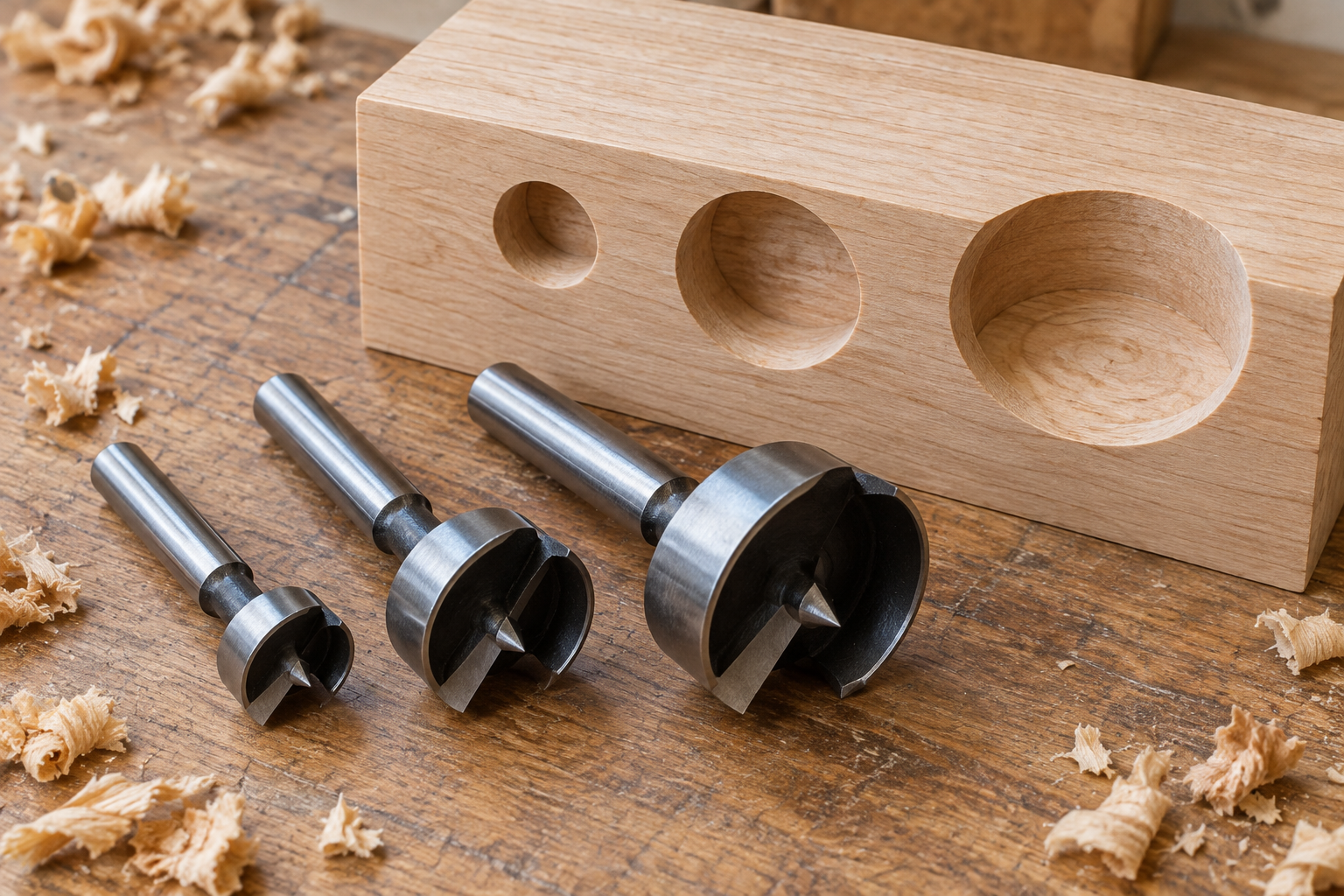
For one or two doors, a basic, sharp 35 mm Forstner bit is often enough if your hinge calls for that size. There is no need to buy a large set when the job requires one diameter. For mixed hinge sizes or future cabinet work, a Forstner bit set covering 26 mm, 30 mm, and 35 mm can be more convenient, though a cheap set may have rough cutting edges or run less true.
For occasional DIY use, a lower-cost bit is reasonable if it is sharp, runs without noticeable wobble, and cuts cleanly in a test piece. For repeated work, compare edge quality, heat buildup, and how well the bit stays sharp. A dull bit burns the surface, wanders, and makes a ragged rim. A premium bit may cut more cleanly and last longer, but it will not compensate for poor setup or a loose drill press.
Forstner bits are intended for controlled, relatively low-speed drilling. A drill press gives the most consistent depth and keeps the hole square to the door. A hand drill can work for a small job with a stable jig, but a large 35 mm bit can grab, wander, or tilt if the drill is not held firmly. A dedicated 35 mm hinge-boring jig helps position the cup hole and guide a handheld drill; it is useful when drilling multiple doors, but unnecessary if you already have a reliable drill press setup.
Position and depth matter just as much
Diameter alone does not determine whether the hinge fits. The distance from the door edge to the near edge of the cup hole is commonly called the setback, and the hinge maker’s template or instructions should specify it. Door thickness and hinge geometry affect the correct position. Measure from the same edge and reference point shown in the instructions; do not copy a measurement from another hinge unless it is the same design.
Set drilling depth so the cup sits flush or at the depth specified by the hinge maker. The exact depth varies by hinge and door, so use the manufacturer’s dimension rather than a guessed universal value. A depth stop on a drill press is reliable; with a hand drill, use a stop collar or a carefully set jig. Test the setup on scrap of the same thickness before drilling the door.
Keep enough material between the cup hole and the door edge. Drilling too close can break through the edge or leave a thin, weak strip that splits when the hinge screws are tightened. Drilling too far from the edge can prevent the hinge arm from closing or aligning correctly. Mark the hole center from the hinge instructions, then check the position against the actual door before cutting.
Avoid common drilling failures
Clamp the door securely and support the back face with scrap wood where possible. This reduces movement and limits tear-out as the bit exits. Start with the center point aligned to your mark, then feed steadily without forcing the bit. If the bit chatters, burns, or pulls the drill sideways, stop and check for a dull edge, excessive speed, or poor support.
Clear chips from the cut rather than letting them pack around the bit. Packed chips increase heat and can make the hole rough or deeper than intended. Before drilling the finished door, bore a test hole in scrap and check that the cup seats without pressure and does not rock. If it does not fit, verify the measured cup diameter and bit size before making the hole larger. Enlarging an oversized or misplaced cup hole is difficult to undo; a test cut is cheap insurance.
For a standard European hinge marked for a 35 mm cup, use a sharp 35 mm Forstner bit, follow the hinge’s setback and depth dimensions, and test on scrap. Spend extra on a better bit or jig when you are drilling many doors or need repeatable placement. For a single repair, a basic bit and careful setup are usually sufficient.