What's inside
As an Amazon Associate I earn from qualifying purchases. This post may contain affiliate links at no extra cost to you.
Forstner bits and self-feed bits can both bore large holes, but they suit different jobs. A Forstner bit is the better choice when the hole needs a clean, flat bottom and controlled edges. A self-feed bit is built to pull itself through framing lumber quickly, usually with a powerful drill. In laminated wood—plywood, veneered panels, or melamine-faced board—the right choice depends on the finish you need and how you can support the work.
As an Amazon Associate we earn from qualifying purchases at no extra cost to you.


Our Top Picks


Quick comparison
| Feature | Forstner bit | Self-feed bit |
|---|---|---|
| Best use | Clean, accurate holes; shallow or flat-bottomed bores | Fast, deep holes in framing lumber |
| Cutting action | Rim scores the perimeter; cutters remove the waste | Threaded point pulls the bit into the work |
| Typical drill | Drill press or variable-speed drill | High-torque drill, often a right-angle drill |
| Laminate edge quality | Generally better, especially with backing and a sharp bit | More prone to breakout and grabbing |
| Bottom of hole | Flat, apart from the center mark | Usually conical or irregular around the feed point |
What makes laminated wood difficult
A laminate or veneer is a thin surface layer bonded to a core. The bit can cut the core cleanly and still chip the face as its cutters exit. Plywood adds another complication: alternating grain directions and glue lines can make the bit cut unevenly. Melamine-coated particleboard is especially prone to chipped edges because its hard, brittle surface does not tolerate a rough exit.
Preventing tear-out matters more than choosing a bit by its name alone. A sharp cutting edge, firm clamping, a stable drill, and support behind the panel all help. For a hole that must look clean on both faces, drill partway from one side, then finish from the other using the exit mark as your guide.
When to choose a Forstner bit
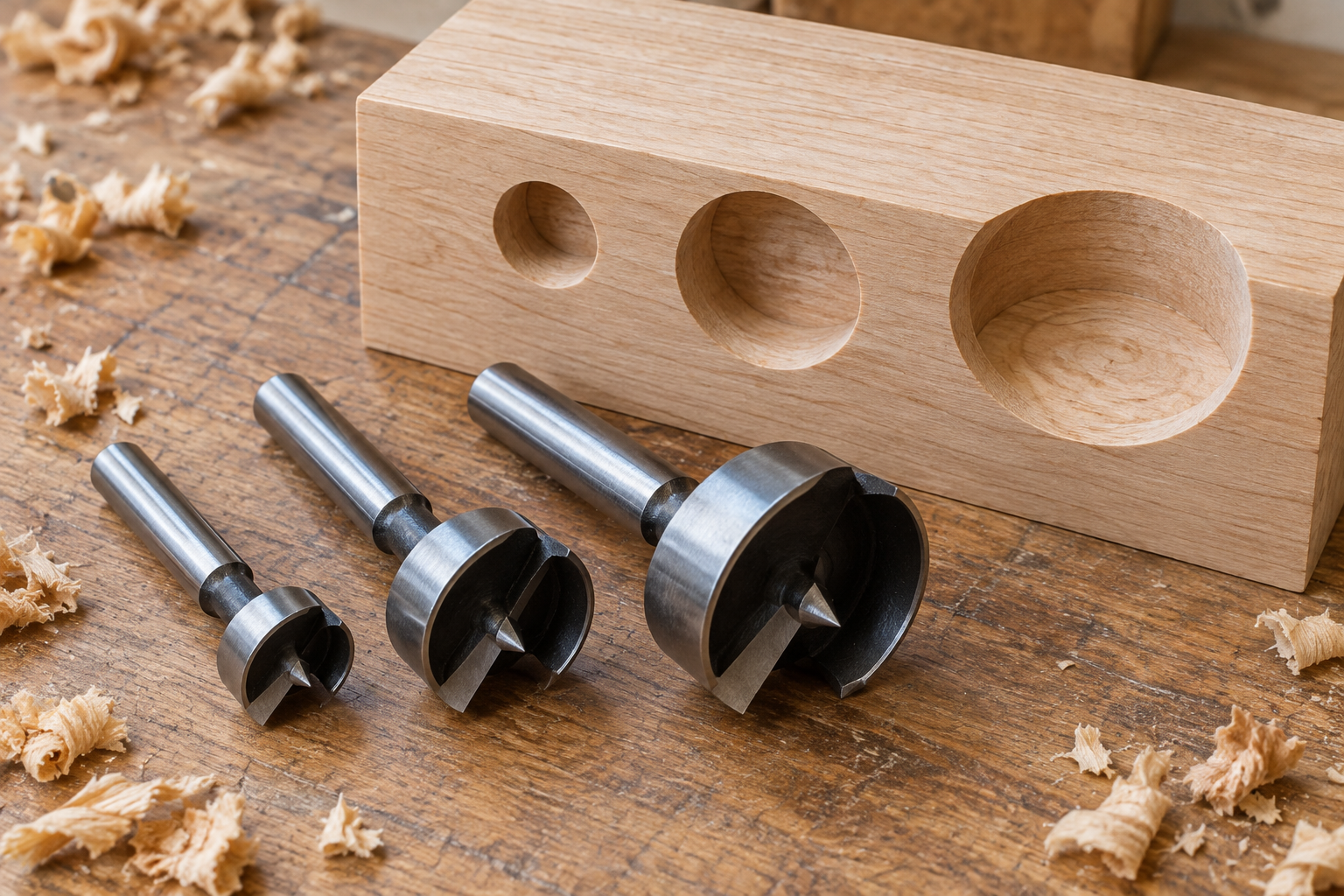
Choose a Forstner bit when appearance and placement matter more than speed. Its rim cuts the hole perimeter before the inner cutters remove material, which helps limit splintering on the entry face. It also makes flat-bottomed holes useful for hardware, counterbores, and shallow recesses. A Forstner bit can be a good fit for holes roughly 1/4 to 2 inches wide, though the size range depends on the set.
For the cleanest result, clamp a sacrificial backing board tightly under the panel. Drill at a moderate speed and keep the bit square. If you are using a handheld drill, start slowly so the rim can score the surface before the bit begins cutting aggressively. A drill press offers better control, particularly for wide bits; large Forstner bits can demand substantial torque and are not a comfortable match for a small, low-powered drill.
For veneered plywood, a sharp bit and backing board will usually give a cleaner edge than a self-feed bit. On thin panels, avoid drilling all the way through in one pass: stop when the point or rim is close to the back, flip the panel, and finish from the other side. If you need a suitable set for furniture or cabinetry work, compare Forstner bit sets by size range and cutter construction rather than assuming every set is equally suited to frequent use.
The trade-off is speed. Forstner bits remove material relatively slowly, and they can overheat or burn wood if you force them, use a dull cutter, or let packed chips stay in the hole. Clear chips from a deep bore as needed. A Forstner bit is also less convenient for drilling deep holes in framing because it lacks the self-feeding action that makes a self-feed bit fast.
When to choose a self-feed bit
Choose a self-feed bit for fast, deep bores in construction lumber, such as holes for wiring or plumbing. The threaded center point pulls the bit forward, so you need less pushing force. That advantage becomes a drawback in finished panels: the bit can grab, pull the drill off line, or tear up the entry surface if it catches a chip or the laminate is unsupported.
Self-feed bits are usually best in a high-torque drill, not a small drill or a lightweight driver. A large bit can stall or twist the tool sharply, especially if the cutter binds in a knot or hits a nail. Keep a firm two-handed grip, use the drill’s side handle where available, and do not rely on the feed screw to control the tool. For construction drilling, self-feed drill bits are a practical choice when speed and depth matter more than a furniture-grade edge.
On laminated wood, a self-feed bit can still work if the hole is hidden or the panel will be covered. Clamp a backing board at the exit, keep the drill perpendicular, and ease off as the feed screw approaches the back face. For exposed holes, test on scrap made from the same material first. The bit’s aggressive pull can make it harder to stop precisely at a shallow depth than with a Forstner bit.
A reliable method for a clean hole
Mark the center, clamp the panel to a stable surface, and place scrap underneath to support the exit face. Use a sharp Forstner bit for visible holes, then drill slowly enough to maintain control without scorching the wood. For a through-hole, stop before the cutter breaks through and complete the hole from the reverse side. On melamine, a strip of painter’s tape can help reduce surface chipping, but it is not a substitute for a backing board or a sharp bit.
If the hole is large, use a drill press when possible. With a handheld drill, check that the bit is square before starting and avoid leaning on it to compensate for a slow cut. If the bit chatters, burns, wanders, or pulls the drill sideways, stop and check for a dull edge, loose workholding, packed chips, or a core that is harder than expected.
Which one should you buy?
For cabinet panels, veneered plywood, melamine, or any hole with an exposed edge, buy a Forstner bit in the sizes you actually use. It is slower, but it gives you better control and a flatter bottom. For rough, deep holes in studs and other framing lumber, a self-feed bit is the more efficient tool. If the hole is hidden and the material is thick, the cheaper or already-owned self-feed bit may be entirely adequate; use backing and test on scrap if the laminate face must stay intact.