What's inside
As an Amazon Associate I earn from qualifying purchases. This post may contain affiliate links at no extra cost to you.
Installing cabinet hinges is a small job with little tolerance for wandering drill bits. A hole only a few millimeters off can leave the hinge crooked, make the door sit unevenly, or strip the screw hole after repeated adjustment. A self-centering drill bit set helps by guiding the bit through the hinge plate’s screw hole, keeping the pilot hole centered automatically.
The best set for this work is not necessarily the largest or most expensive kit. You want a sharp, replaceable bit, a guide sleeve that fits the hinge holes without excessive play, and a size that matches the screws you are using. For most cabinet hinge installations, a compact set of three or four bits is more useful than a 20-piece assortment.
As an Amazon Associate we earn from qualifying purchases at no extra cost to you.


Our Top Picks
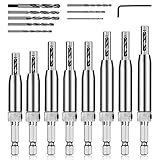
 Bosch CC2430 Clic-Change 1/4in Self-Centering Drill Bit Set3 in0 x 0 x 0 inches0 PoundsCheck on Amazon
 Snappy 3pc Self Centering Hinge Drill Bit Set5/64", 7/64", 9/645.65 x 6.9 x 0.85 inches0.3 PoundsCheck on Amazon

What self-centering drill bits do
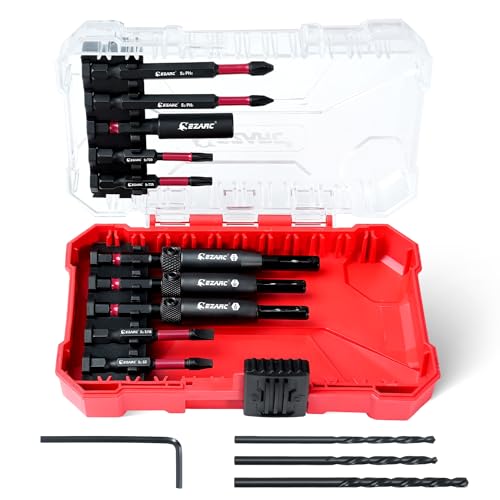
A self-centering bit has a spring-loaded guide sleeve around the drill. The sleeve fits inside a hinge plate or mounting bracket hole. When you press down, the sleeve retracts and exposes the bit, placing the hole in the center of the hardware opening.
These bits are sometimes called Vix bits, although Vix is a brand name that is often used generically. They are designed for pilot holes, not clearance holes. The bit should create a narrow hole for the screw threads while leaving enough wood for the screw to grip.
They also do not bore the large cup hole used by concealed European hinges. For that job, you need a 35 mm hinge-boring bit or a dedicated hinge jig. A self-centering bit is used afterward for the small mounting-plate and hinge-arm screw holes.
Best set for most cabinet hinges
For general cabinet work, look for a self-centering drill bit set for cabinet hinges containing approximately 2 mm, 2.5 mm, 3 mm, and 4 mm sizes. The 2.5 mm or 3 mm bit covers many common hinge screws, while the smaller bit is useful for fine screws in face-frame hinges and the larger bit suits heavier hardware.
If you are installing one style of hinge, a single correctly sized bit may be the better buy. Sets often include sizes that never leave the drawer. Check the screw packaging or measure the screw’s solid shaft, not the outside diameter of the threads. For softwood and MDF, the pilot hole is commonly close to the screw’s core diameter. In hardwood, use a pilot hole nearer the core diameter to reduce splitting and driving torque.
| Set type | Best use | Advantages | Limitations |
|---|---|---|---|
| Single-size hinge bit | Repeated installation with one screw size | Lowest cost; simple and quick | Limited if hardware changes |
| Three- or four-piece set | Mixed cabinet and furniture work | Useful range without much clutter | Quality can vary between sizes |
| Large assorted set | Frequent work with many hardware types | More sizes and replacement options | Often includes redundant sizes and weaker guides |
| Premium replaceable-bit set | Professional or repeated installation | Better fit, durability, and serviceability | Higher price; overkill for one kitchen |
Features that matter more than piece count
Guide fit: The sleeve should enter the hinge hole cleanly but not wobble. Excess clearance defeats the purpose of the tool. Test it in the actual hinge before drilling. Different manufacturers’ hinges can have slightly different hole diameters.
Adjustable depth stop: This is valuable on cabinet doors, where the screw hole may be only 10 to 15 mm deep before reaching the front face or a thin panel. A stop prevents drilling through the door. If the set has no stop, wrap tape around the bit as a visual limit and drill conservatively.
Replaceable bits: Small bits dull quickly, especially in laminate, hardwood, or fiberboard. A replaceable-bit design lets you keep the guide mechanism instead of discarding the complete tool. Look for sets with readily available replacement inserts rather than proprietary parts that are difficult to find.
Spring action: The sleeve should retract smoothly and return without sticking. A gritty or weak spring can leave the bit off-center or cause the sleeve to drag across the hinge finish.
Hex shank: A 1/4-inch hex shank works well in a drill, impact driver, or quick-change holder. An impact driver is convenient, but use its lowest speed and avoid hammering. The small bits can snap if the driver twists suddenly.
When a cheaper set is fine
A budget three-piece self-centering bit set is perfectly adequate for a few hinges on softwood or plywood. It can also be the sensible choice when the hinge will cover the area and minor cosmetic marks are unimportant. Expect less consistent sleeve fit and shorter bit life, but those drawbacks may not matter for 12 or 20 holes.
Do not choose the cheapest set automatically for expensive hardwood doors, dense MDF, or a full kitchen installation. A loose guide can produce visibly uneven hinge positions, and a dull bit creates oversized holes that no screw can tighten properly. In those situations, a better compact set usually costs less than repairing a misplaced hinge or replacing a damaged door.
How to use a self-centering bit correctly
First, clamp or firmly hold the hinge in its final position. If you are installing multiple doors, use the same reference edge and mark the hinge locations consistently. Place the guide sleeve into the hinge hole, keeping the drill perpendicular to the surface.
Run the drill at a moderate speed and apply light pressure. Drill only deep enough for the screw’s threaded length, typically around 10 to 15 mm for cabinet hardware. Withdraw the bit while it is still rotating to clear chips. Do not force the bit through the bottom of the hole.
Drive the screw by hand or with a drill set to a low clutch setting. Overdriving is a common failure mode: it enlarges the pilot hole, crushes MDF fibers, and leaves the hinge loose. If the screw spins without tightening, stop immediately. Move to a slightly larger screw only if the hinge manufacturer allows it; otherwise repair the hole with a suitable wood filler or hardwood plug.
What to buy
For most homeowners, choose a three- or four-piece set with 2.5 mm and 3 mm bits, a smooth spring-loaded sleeve, and a depth stop. A replaceable-bit self-centering set is worth considering if you install hinges regularly. If the job is limited to one cabinet project, match one inexpensive bit to the hinge screws and spend the remaining money on a square, clamps, and a depth stop.
The right bit makes hinge installation more repeatable, but it cannot correct a badly positioned hinge or a misaligned door. Mark carefully, drill shallow pilot holes, and let the guide sleeve do the centering work rather than pushing the drill sideways.