What's inside
As an Amazon Associate I earn from qualifying purchases. This post may contain affiliate links at no extra cost to you.
If you need a clean, flat-bottomed recess for a hinge, shelf pin, bolt head, or plug, a Forstner bit is usually the right tool. A hole saw is better when you need a larger through-hole, especially in thin stock or sheet material. The two tools both remove circular sections, but they leave very different results.
The important distinction is simple: a Forstner bit cuts the bottom of a blind hole; a hole saw cuts around a plug and normally leaves the material in the center. That difference determines the finish, depth control, speed, and price you should expect.
As an Amazon Associate we earn from qualifying purchases at no extra cost to you.



Our Top Picks
 KATA 25 Piece Hole Saw Kit with 3/4"-6"3/4"-6"(19-152mm)9.4 x 9.05 x 2.36 inches3.12 PoundsCheck on Amazon


Forstner Bit vs. Hole Saw at a Glance
| Feature | Forstner bit | Hole saw |
|---|---|---|
| Best use | Flat-bottomed blind holes and clean bores | Fast through-holes and large openings |
| Typical materials | Solid wood, plywood, MDF, some plastics | Wood, plastic, drywall, metal, depending on the blade |
| Bottom of hole | Flat, with a small center mark | Not flat; the pilot drill makes the center hole and the plug remains |
| Edge quality | Very clean with a sharp bit and controlled feed | Clean on the entry face, but prone to breakout on the exit face |
| Typical depth | Controlled blind holes, limited by flute length | Usually through-holes; deep cuts require clearing the plug |
| Large diameters | Available, but require substantial torque | Generally faster and more economical |
How Forstner Bits Cut
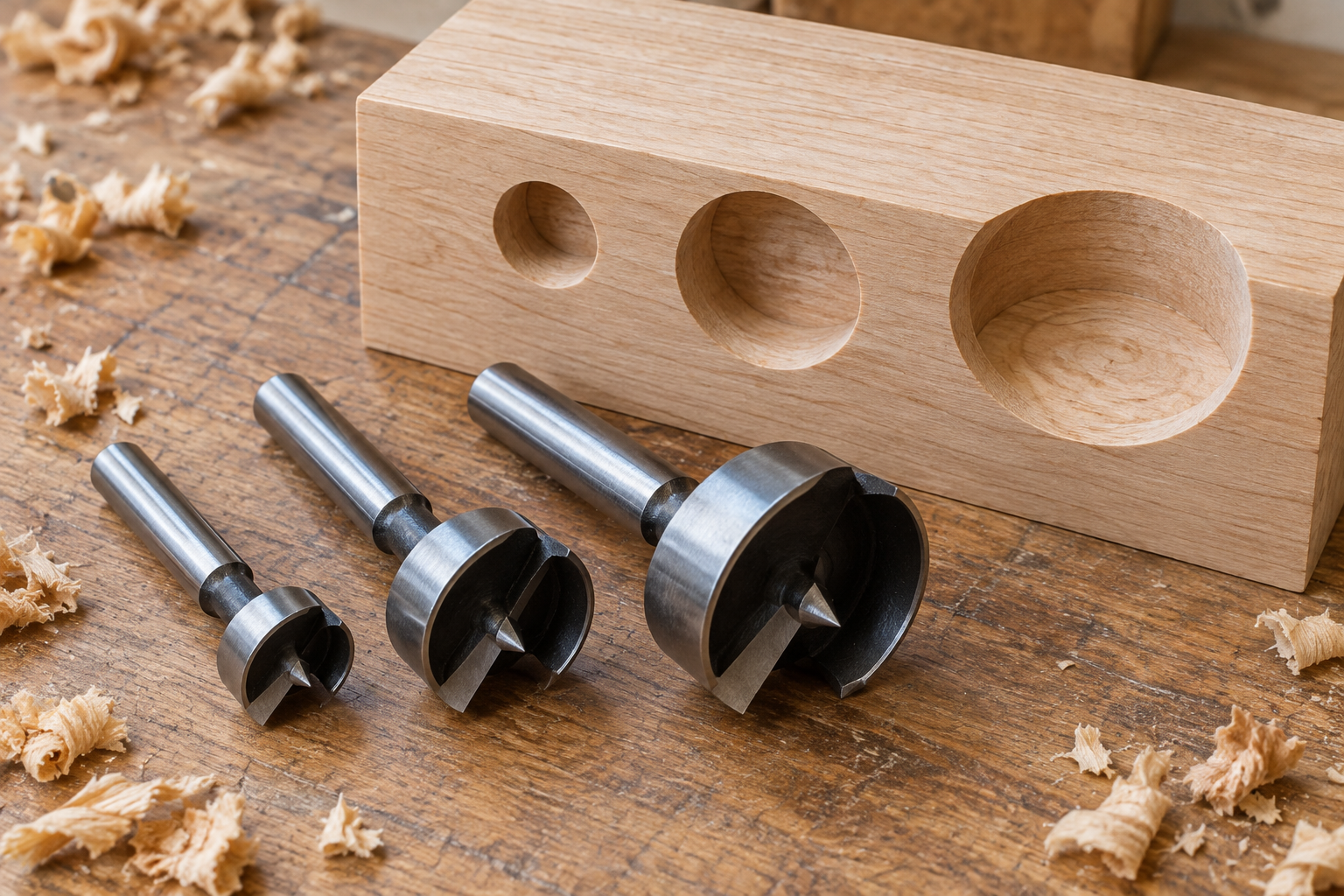
A Forstner bit has a circular rim that scores the perimeter, plus cutting edges that remove the material inside the circle. Many designs also have a small center spur to keep the bit positioned. Because the cutting edges work across the bottom, the result is a genuinely flat-bottomed hole.
That makes a Forstner bit the normal choice for concealed European cabinet hinges, 35 mm hinge cups, counterbores, decorative recesses, and shallow pockets. A stop collar or drill press depth stop can hold the depth within a fraction of a millimeter when the setup is rigid.
Forstner bits work in a handheld drill, but a drill press gives noticeably better results. Large sizes create high torque and can grab at the instant the bit enters or exits. At roughly 1 inch and above, keep both hands on a handheld drill, use a low gear, and avoid leaning your body over the tool.
Speed matters. A 35 mm bit commonly runs better around 500 to 800 rpm in hardwood than at the maximum speed of a cordless drill. A 1/2-inch bit can run faster, often around 1,000 to 1,500 rpm depending on the wood and bit design. These are starting points, not universal settings: burning, smoke, or a squealing cut means the bit is too fast, dull, or being fed too slowly.
How Hole Saws Cut
A hole saw is a toothed cylindrical cup, usually guided by a pilot drill. The teeth cut a ring while the center stays attached as a plug. This is efficient because the saw removes only the annulus, not all the material inside the circle.
That efficiency is why hole saws are useful for running cables, plumbing, vents, and electrical boxes. A 2-inch hole saw can cut a through-hole much faster than a 2-inch Forstner bit, particularly in plywood, drywall, or thin boards. The cheaper option is perfectly adequate when the hole will be covered by a grommet, trim ring, or fitting.
However, a standard hole saw does not produce a flat-bottomed recess. The pilot drill makes a smaller hole in the middle, and the remaining center plug must be removed separately. If you stop before cutting through, you get a circular groove and an attached plug—not a usable flat pocket.
Hole saws also need room for the plug and sawdust. In thick stock, withdraw the saw every few seconds to clear waste. Otherwise the teeth can bind, the drill can stall, and heat can harden resin in the cut. Many saws have side slots for prying out the plug, but removing a deeply wedged plug can still be frustrating.
Which Leaves the Cleaner Hole?
For a blind hole, the Forstner bit wins by a wide margin. Its rim scores the edge before the interior cutters remove the waste, so the opening stays round and the bottom is even. A sharp bit in a drill press can leave an edge clean enough for visible furniture work.
A hole saw can leave a clean entry edge in softwood or plywood, but the exit side is more likely to splinter. Clamp a sacrificial backing board tightly against the underside, and stop just before the pilot breaks through if both faces matter. Then turn the workpiece over and finish from the scored circle.
Neither tool is automatically tear-out-proof. Dull Forstner cutters can burn the perimeter, while aggressive hole-saw teeth can chip veneer. On veneered plywood, masking tape helps, but a backing board and a sharp cutter matter more.
What Should You Buy?
Buy a Forstner bit set if you make furniture, install concealed hinges, or need holes with controlled depth. A set covering roughly 1/4 to 2 inches is more useful than a very large assortment of low-quality bits. For occasional work, a single 35 mm hinge bit or the exact diameter required may be all you need.
Choose a wood hole saw kit for large through-holes in boards, cabinets, drywall, or thin sheet goods. A kit is economical when you need several diameters, but check that it includes an arbor and pilot drill. Some inexpensive sets include thin teeth that dull quickly in plywood or hardwood.
If you work in metal, use a purpose-made bi-metal hole saw kit, cutting oil, and the correct low speed. A wood Forstner bit is not a substitute. For clean, large holes in steel, a hole saw is generally the practical choice, though it still will not create a flat bottom.
Tips for Better Results
Mark the center accurately, clamp the work, and let the cutter do the work rather than forcing it. With a Forstner bit, drill a shallow scoring pass first in brittle veneer, then deepen the hole. With a hole saw, support the exit face and clear chips often.
For a flat-bottomed hole larger than about 2 inches, consider a router with a template or a plunge router bit if the job justifies the setup. For ordinary cabinet and woodworking holes, though, the decision is straightforward: use a Forstner bit for a finished blind recess, and use a hole saw when speed and a through-hole matter more than the bottom.