What's inside
As an Amazon Associate I earn from qualifying purchases. This post may contain affiliate links at no extra cost to you.
Deep, flat-bottom holes are where ordinary Forstner bits stop being useful. A standard bit may cut a clean recess, but its short body runs out of reach before the hole is deep enough. Adding a bit extension can solve the reach problem, but it also adds runout, vibration, and another connection that can loosen under load.
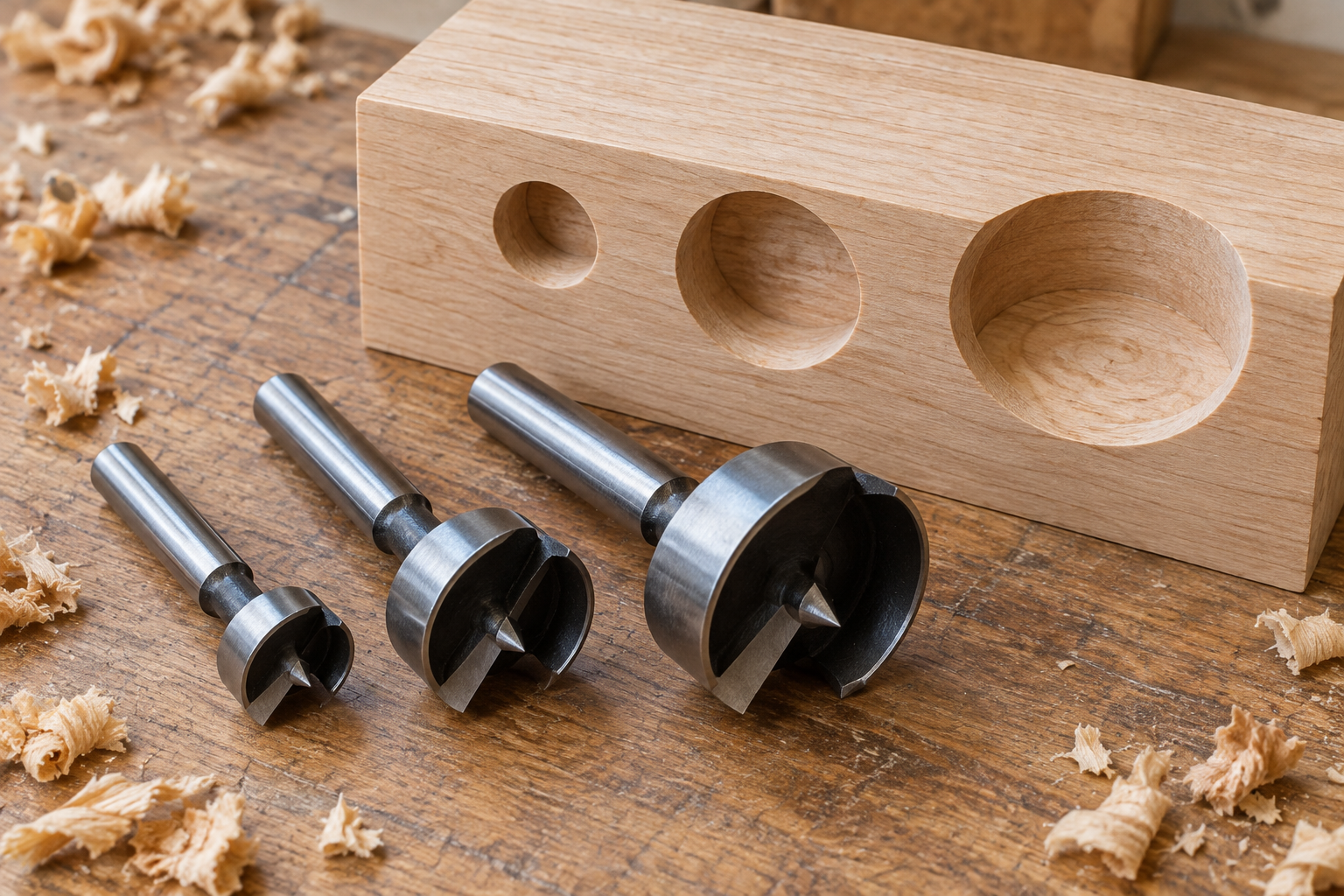
For most woodworking, the best solution is a purpose-made long-pattern Forstner bit. These have an extended shank or body while retaining the rim and center point that produce a flat-bottom hole. The right choice depends less on brand than on diameter, required depth, drilling machine, and how clean the bottom must be.
As an Amazon Associate we earn from qualifying purchases at no extra cost to you.


Our Top Picks


What “Long-Pattern” Means
A long-pattern Forstner bit is not simply a larger bit. It is a Forstner cutter made with extra reach, usually several inches longer than a conventional woodworking bit. The cutting diameter remains the same, while the extended shank lets you drill into thick posts, laminated workpieces, table legs, and recessed hardware locations.
Do not confuse total length with usable drilling depth. A bit advertised at 8 inches long may have only 5 or 6 inches of practical reach once the chuck, non-cutting shank, and required clearance are considered. Measure from the drill chuck or collet to the bottom of the hole, then add room for chip evacuation.
The center point also matters. A sharp point starts the hole accurately, but it can mark or penetrate the opposite face if the hole is blind and the stock is thin. For a 2-inch-deep hole in a 3-inch-thick leg, that is not normally an issue. For a 1-inch hole in 1-1/8-inch stock, it is a serious risk.
Head-to-Head Comparison
| Option | Best use | Advantages | Drawbacks |
|---|---|---|---|
| Long-pattern Forstner bit | Clean, deep blind holes | Flat bottom, controlled diameter, good wall quality | More expensive; needs careful chip clearing |
| Standard Forstner bit with extension | Occasional extra reach | Uses bits you already own; lower initial cost | More runout, poorer balance, connection can loosen |
| Long auger bit | Fast holes through deep timber | Excellent chip removal and low cost | Leaves a screw point and usually a rougher bottom |
| Spade bit with extension | Rough utility holes | Cheap and widely available | Wanders more easily; poor finish and less accurate diameter |
Best Choice for a Flat Bottom
For visible recesses, counterbores, concealed magnets, and furniture joints, a long-pattern Forstner bit is the clear choice. Its outer rim establishes the hole diameter, while the interior cutters remove material toward the center. That geometry leaves a reasonably flat bottom instead of the conical or torn surface produced by many twist, auger, and spade bits.
For occasional work, a single long Forstner bit in the exact diameter you need is often better value than a large set. A 1-inch or 1-1/4-inch bit used for cabinet hardware and furniture work gets expensive quickly if you buy a full range that stays in the drawer.
Choose a full set when you regularly drill different diameters or need matching sizes for a series of parts. Check the actual bit lengths before buying. Sets often include “long” bits that are only modestly longer than standard versions, and some include only the larger diameters in the extended format.
Diameter, Depth, and Shank Fit
For a deep hole, diameter affects cutting resistance. A 2-inch Forstner bit removes four times as much area as a 1-inch bit per revolution. It therefore needs a more rigid setup, slower speed, and a motor that will not stall. A hand drill can manage smaller long-pattern bits, but a drill press is strongly preferred above roughly 1-1/4 inches or when the hole must be square.
Confirm the shank diameter before ordering. Many long bits use a 3/8-inch or 1/2-inch shank even when the cutter is smaller. A compact drill may not accept a 1/2-inch shank, while a small three-jaw chuck may grip a long, heavy bit poorly. Avoid relying on a keyless chuck at its maximum capacity for a demanding deep cut.
For holes deeper than about 3 inches, plan to withdraw the bit every 1/2 to 1 inch to clear chips. Packed chips generate heat, increase torque, and can scorch the walls. In hardwood, pause more often. A short blast of compressed air or a narrow shop-vac nozzle helps, but keep loose clothing and fingers away from the rotating cutter.
Speed and Technique
Start slower than you would with a small standard bit. As a rough starting point, a 1-inch Forstner bit can run around 500 to 800 rpm in hardwood, while a 2-inch bit may need only 250 to 400 rpm. These are starting ranges, not fixed rules. If the rim squeals, smoke appears, or the bit needs excessive force, stop and reduce speed or clear the chips.
Clamp the work securely and support it directly below the hole. Long-pattern bits exaggerate any movement, and a handheld drill can twist sharply if the cutter catches. On a drill press, set the depth stop slightly short of the final dimension, then sneak up on the finished depth. Measure with a depth gauge rather than trusting the scale on the machine.
For the cleanest entry, place masking tape over the layout mark and make a shallow scoring pass first. A sacrificial backing board is useful when the center point or breakthrough could damage the rear face. If the hole must stop at a precise depth, mark the bit with tape, but treat the tape as a visual warning—not a substitute for a depth stop.
When the Cheaper Option Is Fine
A standard Forstner bit and extension is acceptable for a few holes in softwood where the bottom will be hidden. It is also reasonable when you already own the exact bit and only need an extra inch of reach. Keep the extension short, tighten both connections, and test for wobble before entering the workpiece.
If you are drilling through timber for wiring, bolts, or pipe, a long auger bit is usually the better buy. It evacuates chips far more effectively and drills faster. Its screw point and rougher bottom are irrelevant for a through-hole.
Buy the long-pattern Forstner bit when the bottom must be flat, the diameter must be controlled, and the hole is deep enough that an extension becomes unstable. For that job, paying for reach and rigidity is cheaper than repairing a wandering, overheated, or incorrectly sized hole.