What's inside
As an Amazon Associate I earn from qualifying purchases. This post may contain affiliate links at no extra cost to you.
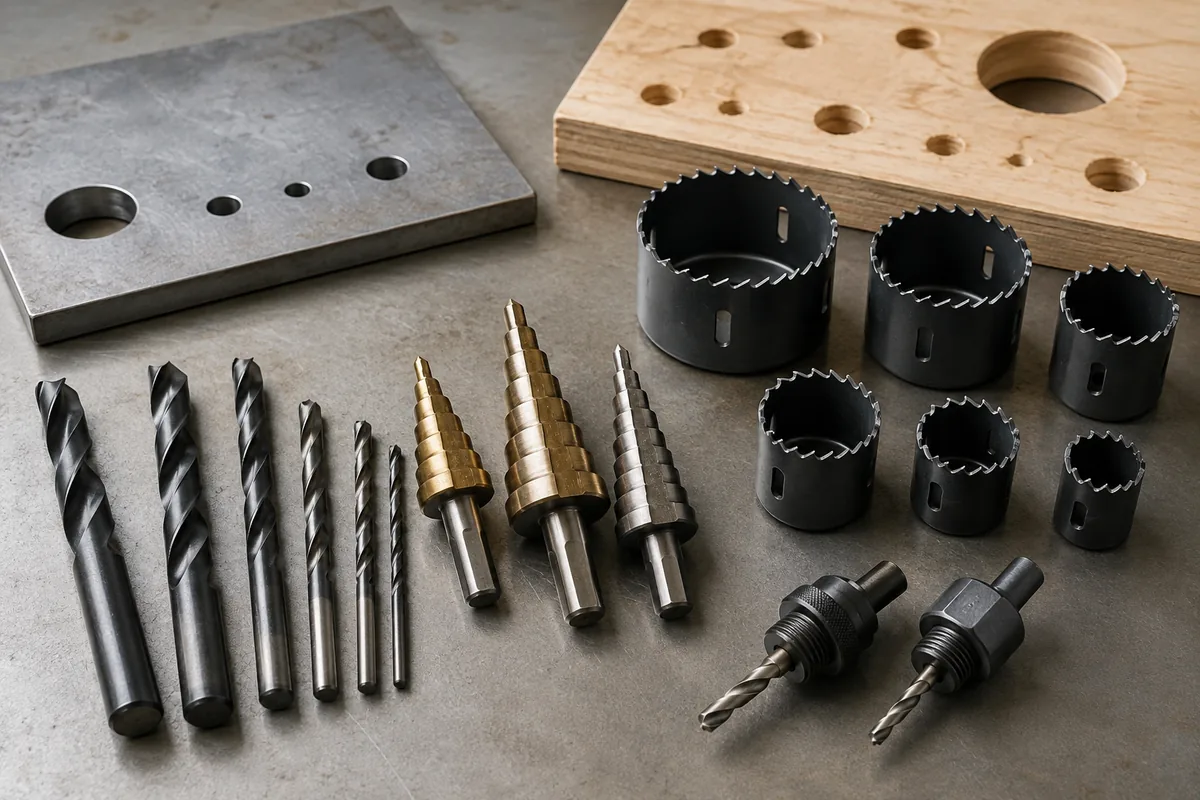
For large holes in steel, an annular cutter usually produces the cleaner, faster result. A hole saw can still be the better buy for occasional work, thin sheet, and jobs where you already own a handheld drill. The right choice depends on steel thickness, hole diameter, machine stability, and how much cleanup you can tolerate.
As an Amazon Associate we earn from qualifying purchases at no extra cost to you.


Our Top Picks


How annular cutters and hole saws cut
An annular cutter removes a ring of metal rather than grinding away the entire hole. Its teeth cut around the circumference, leaving a solid slug in the middle. A pilot pin centers the cutter and usually retracts when the slug breaks free. Because only a narrow ring enters the steel, an annular cutter removes far less material than a conventional twist drill of the same diameter.
A hole saw uses teeth around the edge of a cup. The steel inside the cup remains until you remove the round disc, and the saw must carry that disc through the cut. Most metal hole saws also use a pilot drill to keep the cup from wandering. That pilot drill makes starting easier, but it is also a common failure point.
Which makes the cleaner hole?
In properly supported steel, the annular cutter wins. Its teeth follow a fixed circular path, so the finished hole is normally round with relatively straight walls. A sharp cutter used with cutting fluid may leave only a light burr on the entry and exit sides. The cut also generates less heat than a hole saw of the same diameter because there is less metal to remove.
A hole saw can make a perfectly acceptable hole, especially in mild steel up to roughly 1/8 inch thick. However, it is more likely to leave tooth marks, a larger exit burr, and a slightly rougher edge. If the saw catches as the final section breaks through, it can distort thin sheet or pull the drill sideways.
Neither tool automatically produces a finished, deburred hole. Use a file, countersink, or deburring tool on edges that will carry wiring, hose, or a fastener. For visible fabrication work or accurately located holes, an annular cutter usually needs less finishing.
Annular cutter vs hole saw
| Factor | Annular cutter | Metal hole saw |
|---|---|---|
| Best machine | Magnetic drill or rigid drill press | Hand drill or drill press |
| Typical large-hole range | About 3/4 to 2 inches and larger | About 3/4 to 4 inches, depending on the set |
| Cut quality | Cleaner, rounder, lower burr | Usable, but more tooth marks and edge burr |
| Thin sheet performance | Can work, but needs enough material for the teeth to engage | Usually better for thin sheet |
| Material waste | Small ring plus one slug | Entire circular disc |
| Main failure mode | Tooth damage from sideways force or broken slug ejection | Binding, stripped teeth, overheated pilot drill |
| Cost | Higher cutter and machine cost | Lower entry cost |
When an annular cutter is the better choice
Choose an annular cutter when you need multiple holes, holes larger than about 1 inch, or a clean result in structural steel. A magnetic drill keeps the cutter square to the work and gives you the controlled feed it needs. A rigid drill press can do the same job for loose parts, provided the workpiece fits and is clamped securely.
Annular cutters are especially effective in 1/4-inch plate and thicker material. A 1-inch cutter may pass through that plate quickly, while a hole saw can require considerably more pressure and produce more heat. The slug also comes out as one piece, which makes cleanup easier than removing a hot circular disc from inside a hole saw.
Look for cutters made for steel, not only general-purpose cutters intended for wood or light sheet. High-speed steel cutters are suitable for mild steel and occasional use. Cobalt or carbide-tipped versions cost more but can last longer in harder steel or production work. You can compare annular cutter sets for steel if you already have a compatible mag drill or drill press.
When a hole saw is the smarter buy
A hole saw is the practical choice for one or two holes in thin mild-steel sheet, electrical boxes, brackets, and automotive panels. It works with a normal variable-speed drill and does not require a magnetic base. If the hole will be hidden under a grommet or flange, the extra burr may not matter.
It is also more versatile when you cut several materials. Bi-metal hole saws can handle steel, stainless steel, aluminum, brass, and some plastics, while many annular cutters are selected for a narrower range of materials and machines. A broad bi-metal hole saw set for metal can cover common sizes at much lower cost.
Do not use a large hole saw in a small, low-power drill without checking the arbor and speed requirements. The saw can grab hard enough to twist the drill or your wrist. For holes above roughly 2 inches, use the side handle on a suitable drill, clamp the work, and avoid standing in line with a possible kickback.
How to get the cleanest result
Clamp the steel firmly. Do not hold a plate by hand while cutting either tool. Mark the center with a punch, then use cutting fluid made for steel. Run a hole saw slowly enough to keep the teeth cutting rather than rubbing; excessive speed turns the teeth blue and dulls them. For a typical 1-inch hole saw in mild steel, a low drill setting is generally safer than the high setting used for wood.
With an annular cutter, align the pilot pin with the punched center and start with light pressure. Increase feed only enough to produce a continuous chip. Stop periodically if the chips pack in the gullets, and clear them with the machine off. Never force the cutter sideways to correct a misaligned hole; that is how teeth chip and cutters bind.
Breakthrough deserves special attention. Reduce pressure as the cutter or saw nears the far side, and support thin sheet with sacrificial material where possible. After the hole is complete, remove the slug or disc with pliers, shut off the tool, and deburr both sides.
The practical buying decision
Buy a magnetic drill and annular cutter kit if large steel holes are regular work and clean edges save time. The higher investment pays back through faster cutting, fewer damaged edges, and less cleanup.
If this is a single project involving thin sheet, buy a good bi-metal hole saw and use it carefully. The cheaper option is fine when the hole will be covered, the steel is thin, and perfect roundness is not critical. For thick plate, repeated holes, or a finished fabrication job, the annular cutter is the clear choice.