What's inside
As an Amazon Associate I earn from qualifying purchases. This post may contain affiliate links at no extra cost to you.
Our Top Picks


Short answer: Forstner bits make cleaner holes
For a large, flat-bottomed hole in plywood, a Forstner bit usually leaves a cleaner rim and a more controlled cut than a spade bit. Its outer rim scores the hole’s perimeter before the center removes material, which helps limit splintering on the face. A spade bit is faster and cheaper, but its cutting edges tend to tear fibers—especially on the exit side of a through-hole.
Neither bit guarantees a perfect cut in every plywood panel. Veneer quality, bit sharpness, backing, speed, and feed pressure all matter. Choose a Forstner bit for visible work and shallow pockets; choose a spade bit when speed and low cost matter more than finish.
As an Amazon Associate we earn from qualifying purchases at no extra cost to you.


Why their cuts look different
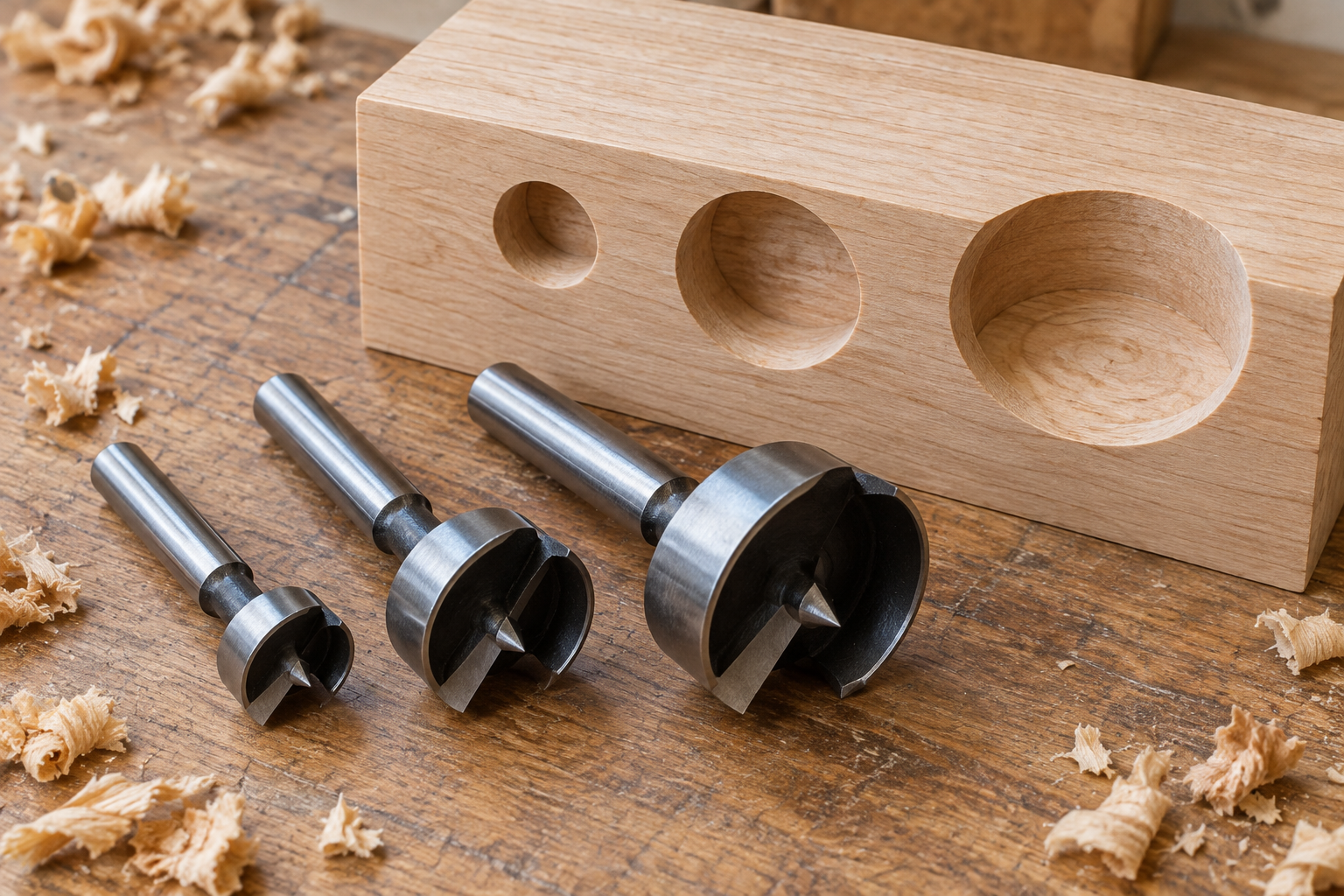
A Forstner bit has a circular rim that cuts around the hole, plus inner cutters that clear the waste. The rim guides the bit and severs surface fibers before they can peel away. This makes Forstners useful for clean, accurately placed holes, including holes that overlap an edge or another hole. Many also leave a flat bottom, though the center point may leave a small mark.
A spade bit uses a central point to locate the cut and two broad cutting wings to remove material. It is simple, inexpensive, and quick in a drill. But it lacks a continuous scoring rim. In plywood, the wings can lift thin face veneer, and the bit can wander or chatter if pushed hard, held at an angle, or used in a loose-fitting chuck.
Forstner bit vs. spade bit
| Factor | Forstner bit | Spade bit |
|---|---|---|
| Face-side finish | Usually cleaner, especially with a sharp rim | More prone to veneer tear-out |
| Exit-side finish | Can still splinter without backing | Often rough; backing is strongly recommended |
| Hole bottom | Flat-bottomed pocket; small center mark possible | Rough, tapered or irregular bottom |
| Speed in a handheld drill | Slower; large sizes demand steady control | Fast, but can grab or chatter |
| Typical large-hole range | Commonly available around 1/4 to 2 in. and larger | Commonly available around 1/4 to 1-1/2 in. |
| Best fit | Visible holes, shallow pockets, accurate placement | Rough openings, utility work, low-cost drilling |
When to buy a Forstner bit
Pick a Forstner bit when the rim will remain visible, the hole needs a flat bottom, or the hole must land precisely. A 1-1/2-inch hole for a recessed fitting or a shallow pocket for hardware is a good example. The cleaner perimeter is particularly valuable in plywood with a thin decorative face veneer, where a chip can expose the contrasting inner plies.
Forstners take more time and make more heat, especially in thick material or at large diameters. In a handheld drill, a wide bit can produce a strong twisting reaction as it engages. Use a drill with a side handle when appropriate, hold the work securely, and avoid forcing the bit. For regular large-hole work, a drill press gives better control. A suitable Forstner bit set is useful if you need several diameters; for one hole, buying a single sharp bit may be the better value.
When a spade bit is good enough
A spade bit is a sensible choice for hidden holes, rough construction, or jobs where you need to pass a cable or pipe and the edge will be covered. It costs less and can cut quickly in a cordless drill. For a hole behind a cabinet or inside a wall, a slightly ragged rim may not matter.
Its low price does not make it harmless: a large spade bit can catch suddenly, particularly as it breaks through. Keep both hands on the drill, clamp the panel, and reduce pressure as the point nears the back face. If you expect to make occasional rough openings, a spade bit set for wood is usually cheaper than a comparable spread of Forstner sizes.
How to reduce tear-out in plywood
For either bit, clamp a sacrificial piece of scrap wood tightly behind the plywood. The backing supports the veneer as the cutting edges exit and is often the most effective way to improve the back face. Clamp the work itself too; do not rely on one hand to keep a panel from spinning.
Mark the center clearly and drill square to the surface. Start at a controlled speed, then let the bit cut without leaning hard on the drill. With a spade bit, back off pressure near breakthrough. With a Forstner bit, clear chips periodically in a deep hole so they do not pack around the rim and overheat the cutter. A sharp bit matters: a dull edge rubs and tears rather than slicing cleanly.
For a cleaner through-hole when both faces matter, drill from one side until the center point just breaks through, then finish from the other side using that small opening to locate the bit. This avoids forcing either bit to tear through the far veneer. If the hole must be especially crisp, masking tape over the cut area can help keep surface fibers in place, but it is no substitute for a sharp bit and solid backing.
What to buy for your project
Choose the Forstner bit if the hole is visible, needs a flat bottom, or must be placed accurately in finished plywood. Choose the spade bit if the opening is hidden, speed matters, and minor splintering is acceptable. If you have only one hole to make, borrow or buy the bit that matches the finish requirement rather than building a set you may not use.
For very large openings—roughly 2 inches or more—or repeated cuts in thick plywood, consider a hole saw instead of either bit. It can be faster at those diameters, though it leaves a core to remove and may need careful setup to control tear-out. The right choice is the least expensive tool that meets the required finish, not automatically the one with the cleanest cut.