What's inside
As an Amazon Associate I earn from qualifying purchases. This post may contain affiliate links at no extra cost to you.
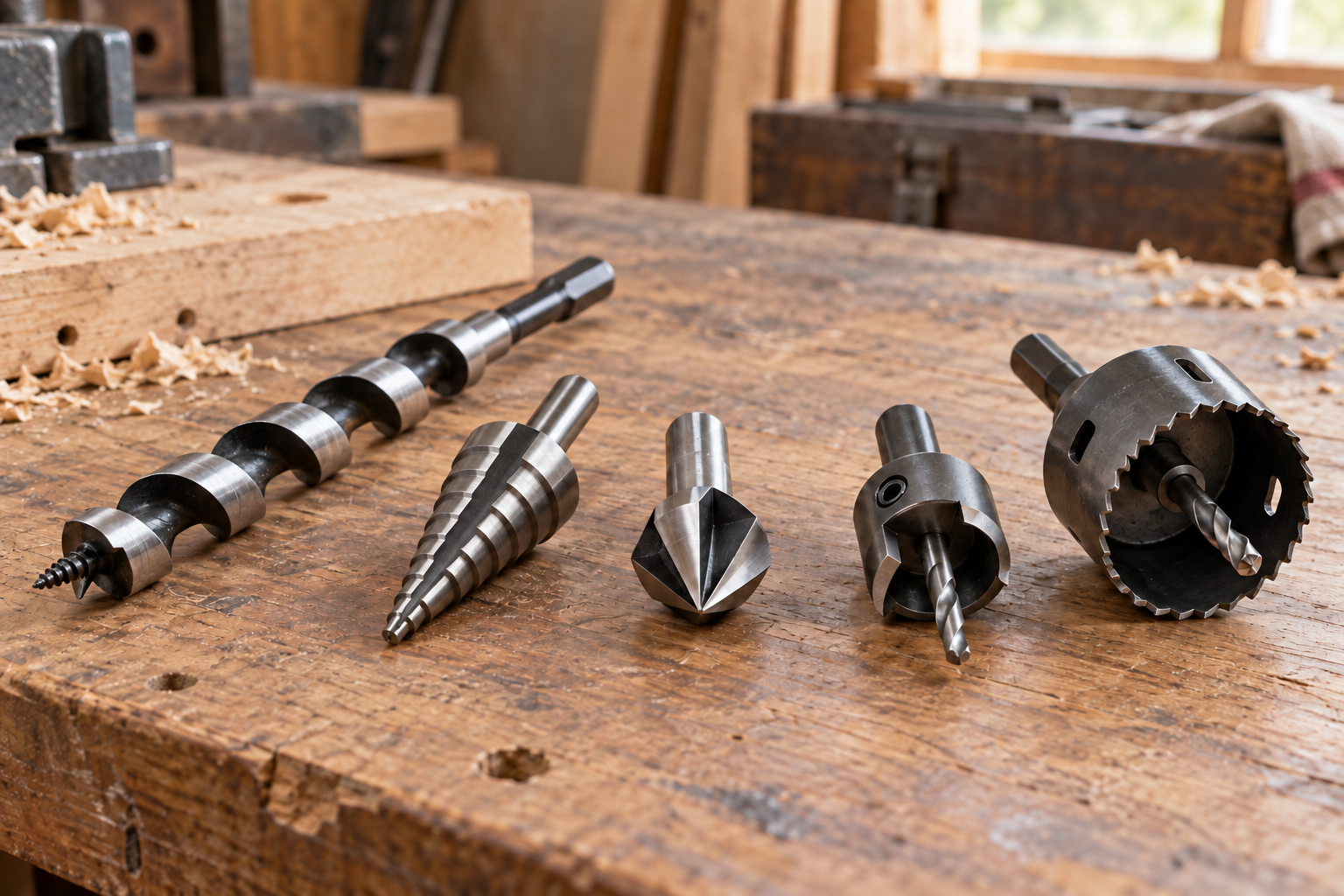
A countersink bit and a counterbore bit both change the shape of a drilled hole so a screw head fits better. They do different jobs, though: a countersink makes a cone-shaped recess for a flat-head screw, while a counterbore makes a flat-bottomed, wider recess for a cylindrical head or plug. Pick the wrong one and the screw may sit proud, wobble, split the workpiece, or fail to clamp it securely.
As an Amazon Associate we earn from qualifying purchases at no extra cost to you.


Our Top Picks
 DEWALT Countersink Drill Bit Set for Wood1/4, 3/8, 1/2, 5/8, 3/4 Inch5.2 x 4.6 x 1 inchesCheck on Amazon


The shape determines the job
A countersink cuts a tapered opening at the top of a pilot hole. Its angle should match the angle under the screw head; common screw angles include 82 degrees for many U.S. flat-head screws and 90 degrees for many metric fasteners. The head bears against the sloping sides of the recess. A correctly sized countersink lets the head sit flush or slightly below the surface.
A counterbore cuts a larger-diameter, flat-bottomed pocket around a smaller pilot hole. Its sides are usually straight, and the screw head sits on the pocket’s bottom. Use it for socket-head or other cylindrical-head screws, or when you want to hide a fastener under a wood plug. A counterbore is not a substitute for a countersink: a flat-head screw in a flat-bottomed pocket has little support beneath its angled head.
Quick comparison
| Feature | Countersink bit | Counterbore bit |
|---|---|---|
| Recess shape | Conical or tapered | Wider, straight-sided pocket with a flat bottom |
| Typical screw head | Flat-head | Socket-head or other cylindrical head |
| Best use | Seat a flat head flush or below the surface | Clear a larger head or make room for a plug |
| Depth control | Often judged by screw fit; some bits have stops | Important for head clearance or plug thickness |
| Common mistake | Making the cone too wide or too deep | Making the pocket too large, deep, or off-center |
Which bit should you buy?
Start with the screw, not the bit. Check the head shape and, when possible, the screw’s specified head angle and dimensions. For ordinary flat-head wood screws, a countersink bit set is the right category. Some sets combine a pilot drill with a countersink; others cut only the cone. A combined bit saves time on repeated holes, but the pilot size may not suit every screw or material. Check the drill diameter before relying on it.
For a socket-head screw that needs its head below the surface, choose a counterbore bit set sized to the screw head. If you want to cover the fastener, check that the pocket also leaves enough material for a plug. A depth stop or a brad-point-style guide can help keep pockets consistent, but careful marking and a test cut can be enough for a small one-off job.
There is no need to buy both for every project. If you use only flat-head screws, a basic countersink is often the cheaper, sensible choice. If you use cylindrical-head screws or regularly plug fasteners, a counterbore earns its place. Adjustable or specialty sets can be useful for production work, but are unnecessary for a few holes in a shelf or cabinet.
How to cut the recess without damaging the work
Drill the pilot hole first unless you are using a combination bit designed to drill and countersink in one pass. Clamp the workpiece, mark the hole center, and test the setup on scrap of the same material. In hardwood, start at a modest speed and use light pressure; forcing a wide cutter can burn the wood or make the bit chatter. Clear chips from a deep counterbore rather than letting them pack around the cutting edges.
For a countersink, deepen the cone gradually and test the actual screw. Stop when the head is flush, or at the depth the project requires. Cutting too far leaves a broad, weak opening and can reduce the material supporting the screw. A cone that is too narrow leaves the head standing proud. Do not assume a screw’s label tells you its exact head angle: check the fit, particularly with imported hardware or mixed fastener types.
For a counterbore, keep the cutter centered on the pilot hole and set a depth limit where repeatability matters. The pocket must be wide enough for the head without leaving an unnecessarily thin rim of material. In a thin board, a deep pocket can break through the back or weaken the joint. If the pocket is for a plug, allow enough depth for both the screw head and plug, then verify that the finished plug will not sit above the surface.
Common fit problems and fixes
If a flat-head screw rocks or bears only on one edge, the recess angle may not match the head, or the pilot hole may be off-center. Use a matching countersink and recut lightly; avoid enlarging the cone more than needed. If the head sits proud, deepen the countersink in small steps. If it sinks too far, the material cannot be restored—use a larger fastener only if the design allows it, or fill and relocate the hole.
If a cylindrical head bottoms out before clamping the parts, the counterbore may be too shallow. If the screw head disappears into an oversized pocket, the diameter may be excessive, or the bit may have wandered. Reduce that risk by clamping the work and making a test pocket. In metal, use a suitable cutting speed and cutting fluid where appropriate; wood-specific cutters are not automatically suitable for metal.
Choose by head shape, then test
Use a countersink for a tapered flat head and a counterbore for a cylindrical head or a fastener you plan to plug. Match the cutter to the screw, take shallow cuts, and check the fit before making a batch of holes. For occasional work, an inexpensive bit in the correct size is usually adequate; paying more makes sense when you need consistent depth, cleaner cuts, or frequent use—not because one recess shape is universally better.