What's inside
As an Amazon Associate I earn from qualifying purchases. This post may contain affiliate links at no extra cost to you.
Our Top Picks


The short answer for a small trim shop
The DeWalt DWS715 is the simpler, less expensive choice for a shop that needs a dependable 12-inch compound miter saw for everyday crosscuts. It has a sliding fence, bevels left to 48 degrees, and weighs about 42 pounds. The Bosch CM10GD is a 10-inch glide saw built around a forward-sliding arm rather than conventional sliding rails. It costs more, but its compact movement saves room behind the saw and its controls are designed to make adjustments easier.
For mostly baseboard, casing, and small trim, either can do the work. Choose the DeWalt if price and 12-inch blade capacity matter most. Choose the Bosch if the saw must sit close to a wall, or if you value its more refined adjustment system enough to pay extra. Neither is automatically the better choice just because it has a larger blade or a more unusual mechanism.
As an Amazon Associate we earn from qualifying purchases at no extra cost to you.


What separates them
| Feature | DeWalt DWS715 | Bosch CM10GD |
|---|---|---|
| Blade size | 12 inches | 10 inches |
| Saw type | Compound miter saw | Axial-Glide compound miter saw |
| Bevel range | 0–48° left | 0–47° left and right |
| Rear clearance | Needs room for sliding rails | Glide arm keeps the saw’s travel close to the wall |
| Weight | About 42 lb | About 64 lb |
| Best fit | Budget-conscious cutting and larger blade capacity | Space-constrained setup and frequent angle changes |
Specifications and included features can vary by package or revision, so check the listing before buying. In particular, confirm whether a stand, blade, or other accessory is included. Both are corded saws, and neither is a substitute for a track saw or a dedicated ripping setup.
Cut capacity and blade trade-offs
The DeWalt’s 12-inch blade gives it an advantage on taller or wider stock when the cut is within the saw’s capacity. That can be useful when a trim job includes chunky posts, wide boards, or occasional framing lumber. The larger blade is not a guarantee that every wide board can be cut in one pass: check the manufacturer’s capacity chart for the exact miter and bevel angle you plan to use. Angled cuts reduce usable capacity.
The Bosch’s 10-inch blade is ample for much standard casing and baseboard work, and 10-inch blades are widely available. Its smaller diameter can also mean less blade cost, though the price difference depends on tooth count and quality. For clean finish cuts, blade quality and tooth geometry matter more than diameter alone. A sharp, suitable crosscut blade and a steady workpiece are essential on either saw.
There is a practical failure mode with both: trying to finish an oversized cut by forcing the blade or shifting the workpiece partway through. That risks a poor joint, blade binding, or kickback. For stock beyond the published capacity, use a different cutting method or make a controlled two-pass cut only when the work can be secured safely and the cut remains aligned.
Space, setup, and adjustments
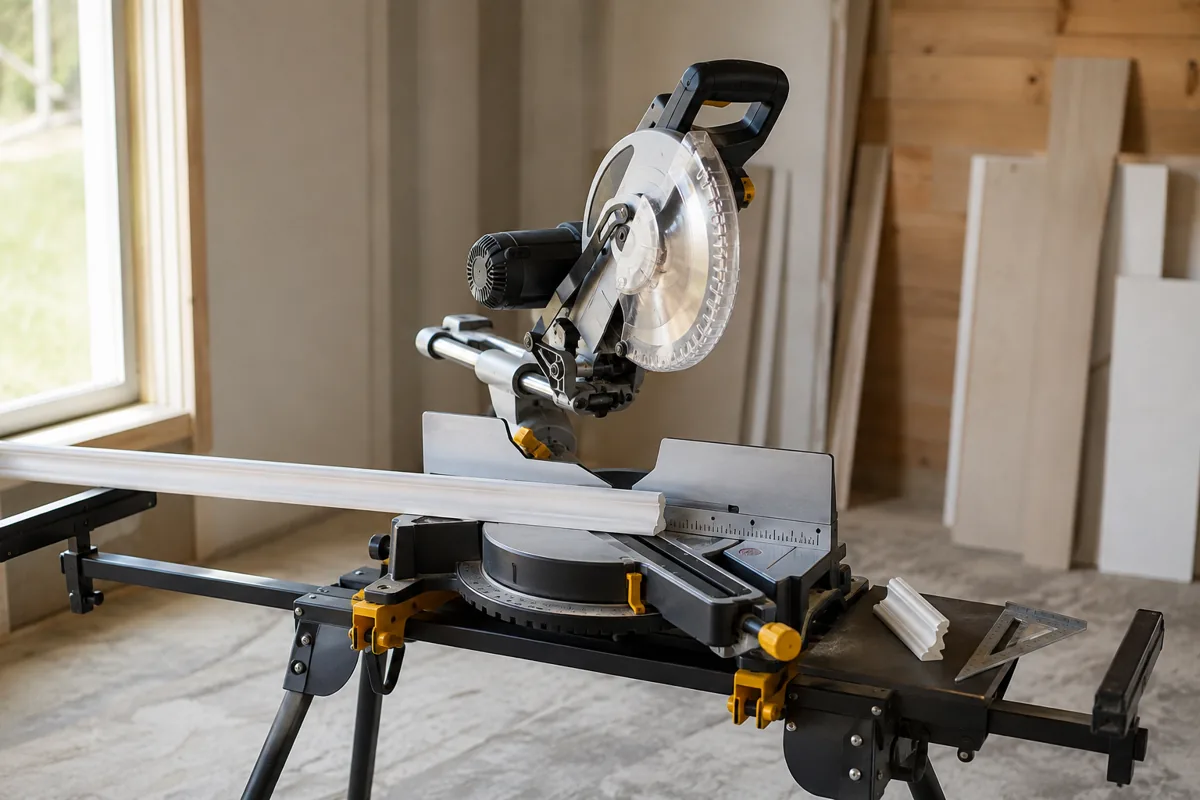
The CM10GD’s main shop advantage is its Axial-Glide mechanism. Conventional sliding saws need clearance behind them for their rails; the Bosch moves on linked arms, so it can sit nearer a wall. In a narrow trim shop, reclaiming that space can make a real difference. The trade-off is weight: at roughly 64 pounds, it is much less pleasant to carry between sites or lift onto a bench alone.
The DWS715 is lighter and straightforward, but its rails need room to travel. Measure the saw with its head fully extended, not just the footprint of the base. A common setup mistake is pushing a slider against a wall, then discovering that its cut capacity disappears when the head cannot retract or extend properly.
Bosch gives the CM10GD a more elaborate miter and bevel adjustment arrangement, including bevel stops and a miter detent override. That helps when switching among angles, but it adds controls to learn. The DeWalt is more basic: a good fit for a shop where the saw is set to common angles and left there, provided the fence and scale are checked and the saw is calibrated.
Accuracy and trim workflow
Neither model eliminates the need to verify calibration. Before cutting a run of expensive trim, check the blade against the table for square, confirm the fence alignment, and make test cuts in scrap. A small error can compound across a room, especially on inside corners. For a precise 90-degree joint, pair two offcuts and inspect the seam rather than trusting the scale by itself.
Support long stock at the same height as the saw table. Without support, a long molding can tip or lift as the cut finishes, leaving a rough edge or a joint that opens. Use clamps when appropriate, keep hands clear of the blade path, and let the blade reach speed before entering the work. A sliding saw can tempt users to pull the spinning blade through material; follow the saw’s manual for the correct cutting motion.
Which one should you buy?
Buy the DWS715 if you want a capable 12-inch saw at a lower price, mostly make standard crosscuts, and have room for rear rails. It is a sensible choice for a small shop that does not need dual-bevel convenience or frequent angle changes. The cheaper saw is fine when its capacity, accuracy, and available space fit the work; spending more does not improve a joint that was measured or supported poorly.
Pay for the CM10GD if wall clearance is tight, you regularly bevel in both directions, or a more flexible adjustment system will save time across repeated setups. Its compact travel is valuable, but its weight makes it a poor pick if portability is a priority. For either saw, budget for a quality finish blade and safe stock support rather than treating the bundled blade as the final word. Compare current DWS715 listings and CM10GD listings, then check the exact included accessories and return policy before ordering.