What's inside
As an Amazon Associate I earn from qualifying purchases. This post may contain affiliate links at no extra cost to you.
Our Top Picks


The short answer
The Bosch 4100XC-10 is generally easier to set up if you want a saw that opens and folds with a simple gravity-rise stand. The Metabo HPT C10RJ is a reasonable alternative, especially if its lower price matters more than a slightly fussier stand routine. Neither is a zero-adjustment saw: check the blade-to-miter-slot alignment and fence before trusting either for accurate cuts.
Setup here means more than getting the saw out of the box. It includes unfolding the stand, locking the saw in place, attaching or stowing accessories, and making the first checks that keep a board from binding or a cut from wandering.
As an Amazon Associate we earn from qualifying purchases at no extra cost to you.

Setup at a glance
| Setup factor | Bosch 4100XC-10 | Metabo HPT C10RJ |
|---|---|---|
| Stand design | Gravity-rise wheeled stand | Folding stand with wheels |
| Opening routine | Use the release and lift the handle to raise the saw | Unfold and secure the stand, then position the saw |
| Transport | Folds into a compact, wheeled unit | Wheels help move it, but the folded package is less convenient to handle |
| Before the first cut | Check fence, blade alignment, guard and riving knife | Check fence, blade alignment, guard and riving knife |
| Best fit | Frequent setup, breakdown and repositioning | Occasional jobsite use where price is a priority |
These are jobsite saws, not precision cabinet saws. Stand convenience affects how quickly you get working, but it does not replace setup checks or good support for long stock.
Opening and folding the stands
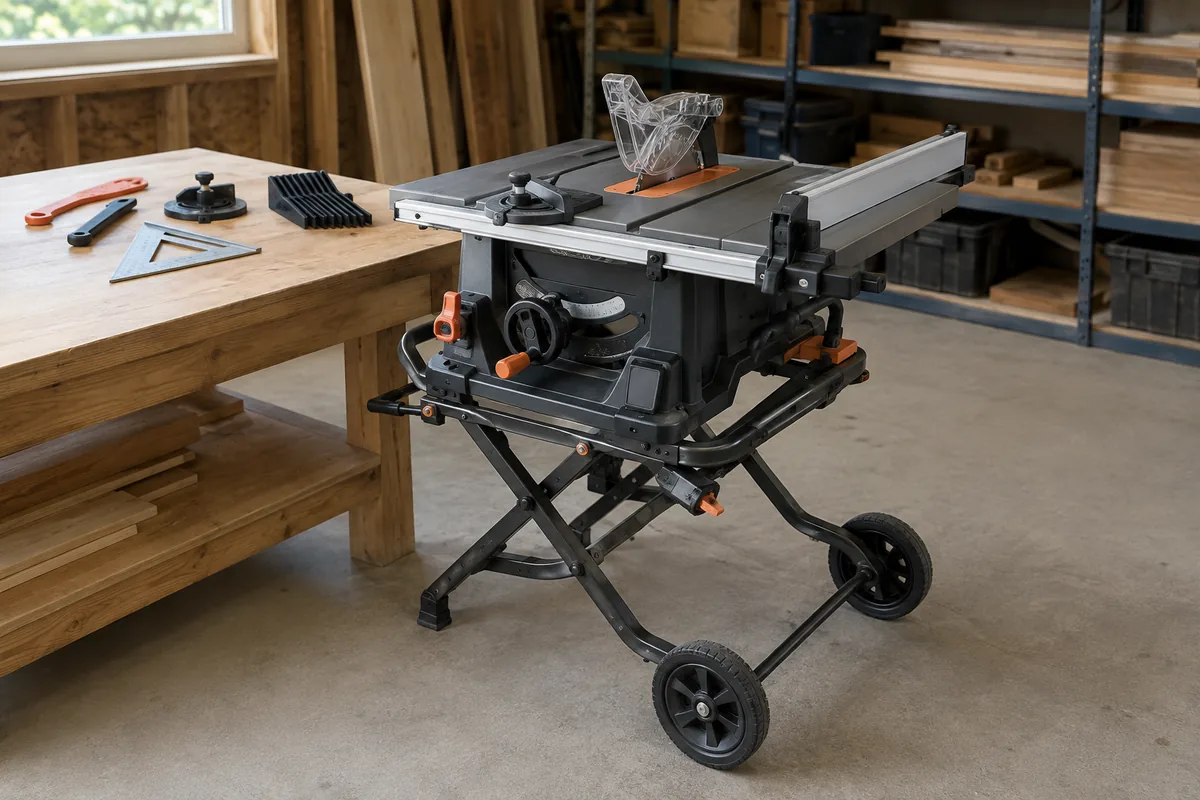
The Bosch’s gravity-rise stand is its clearest setup advantage. Release the folded frame, use the handle to raise it, and the saw moves into working position without requiring you to assemble a separate base. The wheels make it practical to roll the folded saw across a garage or finished jobsite floor. It is still a substantial unit; rolling is easier than lifting, but loading it into a vehicle is another matter.
The Metabo HPT’s stand does the job, but its folding and locking routine takes more attention. Keep fingers clear of the hinge points and confirm the stand is fully locked before putting a sheet or long board on the table. A stand that is only partly opened can shift under an awkward load. The C10RJ’s wheels help with repositioning, though they do not make the saw as effortless to deploy as the Bosch arrangement.
Try either saw in the space where you will use it. A stand that opens easily is no help if the saw cannot clear a wall or parked vehicle. Allow room behind the blade for the workpiece and for the operator to stand clear of the cut.
Assembly and first adjustments
Out of the box, expect some accessory fitting and inspection on both models. Follow the manual for installing the blade, blade guard, anti-kickback pawls and riving knife. Do not skip the riving knife or guard just because setup is taking longer than expected. A missing or mis-seated safety part is a real failure mode, not a cosmetic issue.
Before cutting, unplug the saw and check that the blade is parallel to the miter slot. Then check that the fence locks square to the table and stays put when pushed from the side. A fence that toes inward toward the rear of the blade can pinch the workpiece and increase kickback risk; a fence that is out of square can spoil repeatable cuts. Use the adjustment procedure in the manual rather than forcing the fence or relying on its scale alone.
Also check that the blade raises and tilts smoothly, the throat plate sits flush, and the bevel scale points to zero when the blade is square to the table. If the saw has shifted during transport, recheck these settings. A few minutes with a square and straightedge is cheaper than discovering the problem halfway through a stack of plywood.
Which one is easier in real use?
For a carpenter who loads a saw in the morning, rolls it to a cut station, then packs it away at the end of the day, the Bosch is the easier machine to live with. Its stand is designed around quick changes between folded and working positions. That matters on small sites where the saw is moved repeatedly to keep walkways open.
The Metabo HPT can make sense for a homeowner, remodeler or occasional user who sets up in one place and leaves the saw there for most of the job. Once it is open, the stand’s extra steps matter less. If the price difference buys useful blades, a sturdy outfeed support or a table saw outfeed support, the cheaper saw may be the better overall purchase.
Do not confuse a fast stand with safe solo handling. Both saws are bulky enough that stairs, gravel, and lifting into a truck can be awkward. Get help for loading, or choose a setup that does not require frequent lifting. On uneven ground, check that the stand is stable before cutting, and do not use a long board as a lever against an unsecured saw.
What to buy
Choose the Bosch 4100XC-10 if you value repeatable, quick setup and breakdown, especially when the saw needs to be moved around a jobsite. Its stand is the stronger reason to buy it than any claim that it eliminates calibration. You will still need to verify alignment and keep the fence and safety equipment in good order.
Choose the Metabo HPT C10RJ if it is meaningfully cheaper and you will set it up less often. It is not a bad choice simply because its stand takes more steps. Put the savings toward a suitable 10-inch table-saw blade for the material you cut, or better stock support. For either saw, a dull or inappropriate blade can cause rough cuts, burning and extra feed pressure.
If possible, test the stand before buying: open and fold it, engage every lock, and see whether you can move the folded saw through the doors and storage area you actually use. That hands-on check will tell you more about setup convenience than a feature list.