What's inside
- Best Torx socket sets by job
- What makes one set better than another?
- Bit construction: chrome, S2, and impact steel
- Fit on stubborn or partly damaged fasteners
- Decision matrix: which set suits your situation?
- Size markings and case design matter more than expected
- Ownership realities: what wears first?
- How to use a Torx socket without damaging the fastener
- Bottom line
- Related Guides
As an Amazon Associate I earn from qualifying purchases. This post may contain affiliate links at no extra cost to you.
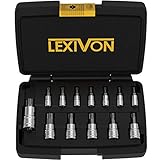
The best Torx socket set for most home mechanics is a mixed 1/4-inch and 3/8-inch drive set with standard T10–T60 coverage, external E4–E24 sockets, S2 or chrome-moly bit construction, laser-etched size markings, and a snug fit on partially rounded fasteners.
As an Amazon Associate we earn from qualifying purchases at no extra cost to you.


Our Top Picks



Best Torx socket sets by job
| Best for | Recommended set type | Useful coverage | Drive sizes | Typical market range |
|---|---|---|---|---|
| General automotive and home repair | Mixed standard and external Torx set | T10–T60; E4–E24 | 1/4 and 3/8 inch | $35–$90 |
| Frequent automotive work | Impact-rated master set | T20–T70; E5–E24 | 3/8 and 1/2 inch | $80–$180 |
| Electronics, appliances, and bicycles | Compact chrome bit-socket set | T5–T40 | 1/4 inch | $20–$55 |
| Heavy equipment and seized fasteners | Long-impact Torx bit socket set | T25–T70; E8–E24 | 3/8 and 1/2 inch | $100–$250 |
| Occasional use and limited storage | Small standard Torx set with adapters | T15–T55 | 1/4 inch, sometimes 3/8 inch | $15–$40 |
What makes one set better than another?
Torx sets are often listed by the number of pieces, but piece count can be misleading. A 42-piece kit may include duplicate extensions, adapters, and ratchets while omitting the E-sizes needed for external Torx bolts. For a useful comparison, check five details: standard Torx coverage, external Torx coverage, drive size, bit construction, and the quality of the fit.
Standard versus external Torx coverage
Standard Torx fasteners have a six-point recess in the head, so they require a Torx bit socket such as T25 or T50. External Torx fasteners have a six-lobed shape on the outside of the bolt head and require an E-socket, such as E10 or E14. The two systems are not interchangeable.
A general-purpose set should reach at least T10 through T60. T10–T30 covers smaller brackets, interior fittings, electronics, and bicycles; T40–T60 is more common on automotive suspension, seat hardware, brake components, and engine accessories. For external Torx, E4–E8 handles small mechanical assemblies, while E10–E24 is the more important range for cars and trucks.
Pay attention to skipped sizes. Some inexpensive sets include T10, T15, T20, T25, T30, T40, T45, T50, and T55 but omit T27, T35, and T47. Those omissions are inconvenient because manufacturers sometimes use the intermediate sizes specifically to discourage ill-fitting tools.
Choosing the drive size
A 1/4-inch drive is compact and gives better access around trim, brackets, dashboards, and small engine components. It is the right foundation for T5 through T40, but its small square drive and ratchet should not be used for high-torque fasteners.
A 3/8-inch drive is the most versatile choice for automotive work. It suits T25 through T60 and medium external Torx sockets while accepting a breaker bar or torque wrench. If buying only one set, choose 3/8-inch drive for repair work and add a 1/4-inch set later for small fasteners.
A 1/2-inch drive is useful for large E-sockets and impact work, but it is unnecessary for most household repairs. A set with 1/2-inch T55–T70 sockets is worth considering for heavy equipment, commercial vehicles, and stubborn suspension hardware.
Bit construction: chrome, S2, and impact steel
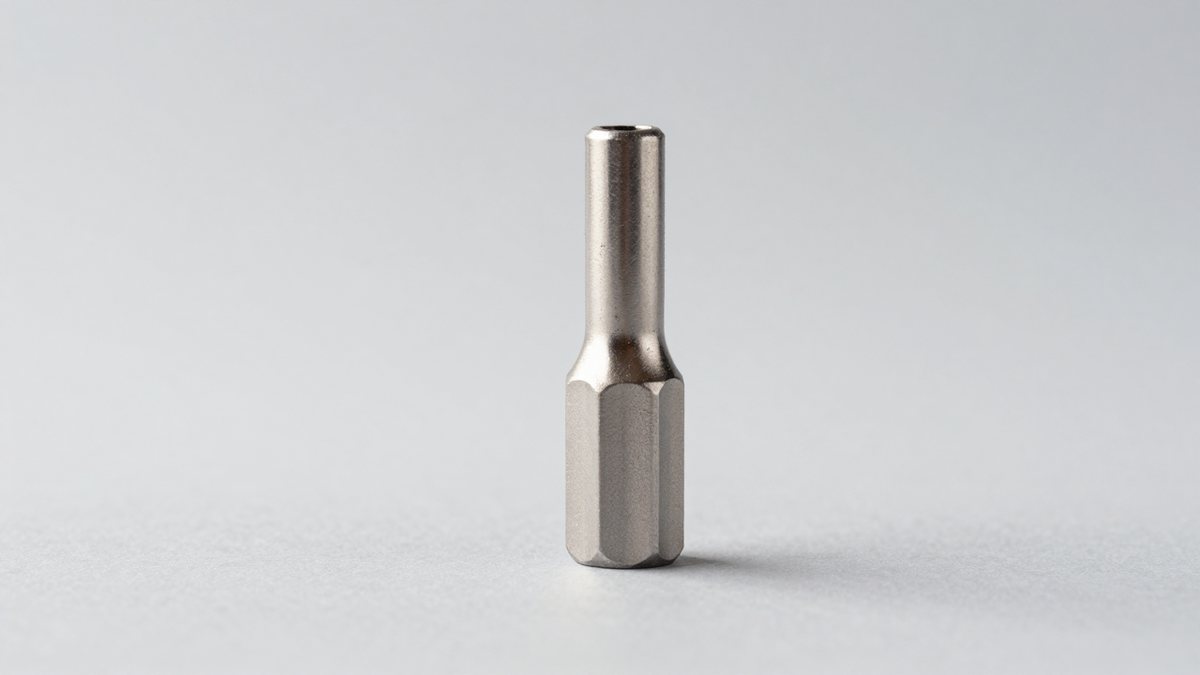
The bit is the part that contacts the fastener, and it usually wears before the socket body does. Chrome-vanadium socket bodies with a hardened S2 steel bit are a sensible combination for hand-tool use. S2 bits resist twisting well, while chrome-vanadium provides a durable, corrosion-resistant socket shell.
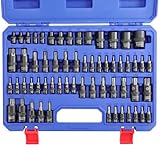
Impact-rated sockets generally use chrome-molybdenum steel and have a black oxide finish. They are thicker and less decorative than polished chrome sockets, but they are designed for impact drivers and impact wrenches. Do not use a polished chrome hand-tool socket on an impact wrench merely because the square drive fits; cracking or socket failure can result.
Long bits are helpful when a fastener sits inside a deep recess, but extra length also increases leverage and can make a bit more vulnerable to bending. For stubborn fasteners, prioritize impact construction and a compatible 3/8-inch or 1/2-inch breaker bar over maximum bit length.
Fit on stubborn or partly damaged fasteners
A good Torx socket should seat fully, with the bit reaching the bottom of the recess rather than resting on dirt or corrosion. The six lobes should contact evenly. If the socket rocks, stops before bottoming, or enters only partway, it may be the wrong size, damaged, or obstructed by debris.
For a seized fastener, clean the recess with a pick or stiff brush, tap the socket into place with a light hammer, and apply force in line with the fastener. A six-point Torx profile has more contact area than a conventional multi-point socket, but it can still round a fastener if the tool is undersized or tilted.
A useful fit check is simple: compare the next size up and down before applying force. The correct socket should enter without hammering, sit squarely, and have almost no visible side-to-side movement. Never substitute a metric hex socket, SAE hex socket, or smaller Torx size because it appears to fit.
Decision matrix: which set suits your situation?
| Your situation | Prioritize | Avoid | Best choice |
|---|---|---|---|
| First set for occasional repairs | 1/4 and 3/8 inch drives; T10–T60; clear markings | A large set with mostly duplicates | Mixed hand-tool set |
| Limited drawer or toolbox space | Compact rail or molded case; common sizes only | Separate long and standard versions of every size | 1/4-inch T15–T40 set plus a few 3/8-inch larger sizes |
| Weekly automotive use | E4–E24 coverage, T27–T70, impact compatibility | Chrome-only sockets used with power tools | Mixed-drive impact master set |
| Restoring older machinery | Large sizes, long reach, breaker-bar compatibility | Thin-wall sockets and short bits | 3/8 and 1/2-inch long impact set |
| Small electronics or bicycle work | T5–T40, fine size intervals, low-profile 1/4-inch ratchet | Heavy 1/2-inch sets | Compact 1/4-inch bit socket set |
Size markings and case design matter more than expected
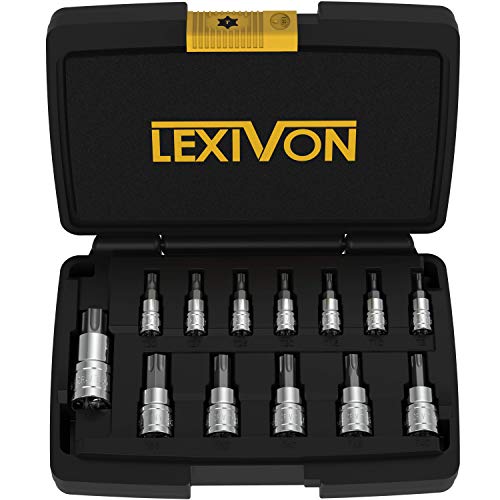
Laser-etched markings are easier to read after years of use than shallow stamped labels, particularly on black impact sockets. Markings should appear on the socket body and on the storage rail or case. A colored ring can speed identification, but it should supplement—not replace—the actual size marking.
For a toolbox, loose sockets on a rail are convenient to rearrange but can fall off during transport. A molded case takes more space but makes missing sizes obvious. Check that the case labels distinguish T sockets from E sockets; confusing T30 with E30 is impossible to correct by appearance alone, and E30 is much larger than the standard Torx range found in many general-purpose kits.
Ownership realities: what wears first?
- Bit corners: Repeated use on dirty or partly rounded fasteners can polish or deform the lobes. Replace a bit when its tips look rounded or it no longer seats firmly.
- Retaining balls and clips: The square-drive retention mechanism can collect grit or lose tension. Clean it rather than forcing a socket onto a rusty ratchet.
- Finish and markings: Black oxide wears at contact points; this is cosmetic unless corrosion begins. Wipe sockets dry after use and apply a light rust-preventive film in damp storage.
- Extensions: An extension can introduce flex and make a bit appear to fit at an angle. Use the shortest extension that reaches the fastener.
- Case organization: Missing T27 and E12 sockets are common problems in mixed sets. Count the actual sizes before starting a repair.
How to use a Torx socket without damaging the fastener
- Identify whether the fastener is standard Torx or external Torx.
- Brush dirt and corrosion out of the recess or off the external lobes.
- Select the exact size and confirm that it seats completely and squarely.
- Break the fastener loose with a hand ratchet or breaker bar before using an impact tool whenever access allows.
- For reassembly, use a torque wrench where the manufacturer specifies a torque value. Over-tightening can stretch the bolt or damage the Torx recess.
Bottom line
For most buyers, the best Torx bit socket set is a mixed 1/4-inch and 3/8-inch hand-tool set with T10–T60 and E4–E24 coverage, S2 bits, readable markings, and a well-fitted case. Choose an impact-rated 3/8-inch and 1/2-inch set if seized automotive or equipment fasteners are routine. Choose a compact 1/4-inch set if your work is mainly bicycles, appliances, electronics, or interior trim. Coverage and accurate fit are more valuable than an impressive piece count.