What's inside
- Best impact socket sets by situation
- Why a 1/2-inch drive is the best general-purpose choice
- Head-to-head: what separates a good set from a frustrating one
- Recommended set types and real-world examples
- Coverage calculation: how much set do you actually need?
- Ownership details that affect durability
- Bottom line
- Related Guides
As an Amazon Associate I earn from qualifying purchases. This post may contain affiliate links at no extra cost to you.
The best impact socket set for most home mechanics is a 1/2-inch-drive, 6-point set with chrome-moly construction, metric sizes from 10 to 24 mm, SAE sizes from 3/8 to 1 inch, and deeply stamped or laser-etched markings that remain readable after repeated use.
That recommendation changes if you mainly work on interior fasteners, motorcycles, bicycles, or commercial vehicles. The right set is determined less by the number of pieces than by drive size, size coverage, wall thickness, and how easily you can identify a worn or incorrect socket.
As an Amazon Associate we earn from qualifying purchases at no extra cost to you.



Our Top Picks
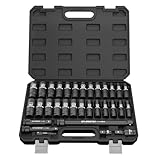
 VEVOR 1/2" Drive Impact Socket Set 65 Piece1/2" 65 PCS21.06 x 16.85 x 2.68 inches31.99 PoundsCheck on Amazon


Best impact socket sets by situation
| Situation | Best choice | Useful coverage | Why |
|---|---|---|---|
| Occasional car and household repairs | 1/2-inch-drive metric and SAE set | 10–24 mm; 3/8–1 inch | Handles lug nuts, suspension work, and most general repairs |
| Compact work, motorcycles, and smaller fasteners | 3/8-inch-drive impact set | 8–19 mm; 1/4–3/4 inch | Smaller head and lighter weight improve access |
| Heavy equipment or high-torque work | 3/4-inch-drive deep impact set | 19–50 mm or larger | Provides greater torque capacity and larger fastener coverage |
| Wheel service | 1/2-inch-drive thin-wall lug nut set | 17, 19, 21, and 22 mm are common | Reaches recessed wheel nuts while protecting the wheel better than a standard thick socket |
| One set for mixed imperial and metric equipment | Master 1/2-inch-drive set | 8–32 mm and 1/4–1-1/4 inch | Minimizes gaps, though the case is larger and more expensive |
Why a 1/2-inch drive is the best general-purpose choice
A 1/2-inch drive provides the broadest useful range for automotive work. It is compact enough for most wheel and suspension jobs but strong enough for high-torque fasteners when paired with a suitable impact wrench. A typical 1/2-inch impact socket has a drive opening rated for substantially more abuse than a 3/8-inch set, while remaining much easier to carry than a 3/4-inch set.
Choose 3/8 inch when access and control matter more than maximum torque. A 3/8-inch set is often the best 3/8 impact socket set for motorcycles, engine-bay brackets, brake components, and smaller machinery. It is not the ideal replacement for a 1/2-inch set if you regularly remove seized lug nuts or large suspension bolts.
A 3/4-inch set is appropriate for trucks, agricultural machinery, industrial maintenance, and fasteners above about 32 mm. For ordinary passenger vehicles, it adds cost and bulk without improving everyday coverage.
Head-to-head: what separates a good set from a frustrating one
Metric and SAE coverage
Metric sockets should be the priority for most modern vehicles, but SAE sizes still matter on older American vehicles, trailers, imported machinery, and workshop equipment. A basic set with 10–24 mm and 3/8–1 inch covers the sizes used most often. A complete impact socket set should extend farther, ideally to at least 32 mm metric and 1-1/4 inch SAE, and include both shallow and deep sockets.
Do not count every size in the package as useful coverage. Some large sets include duplicate sizes in different lengths, universal sockets, adapters, or extensions. Those can be valuable, but they do not replace missing intermediate sizes. Check the actual size list before paying for a high piece count.
Chrome-moly versus chrome-vanadium
Impact sockets should normally be made from chrome-molybdenum steel, often marked Cr-Mo. This material is designed to tolerate the repeated shock loads produced by pneumatic and cordless impact tools. Chrome-vanadium sockets are common in hand-tool sets, but a polished chrome hand socket is not an appropriate substitute for an impact socket.
Look for a dark phosphate, black oxide, or other non-chrome finish rather than a shiny chrome finish. The finish is not proof of quality by itself, but impact sockets are commonly left unpolished because they are engineered for toughness rather than appearance.
Wall thickness and access
Thicker walls generally improve strength, but they can prevent a socket from fitting over a recessed lug nut or between a fastener and a wheel opening. Standard impact sockets are the safer choice for high-torque work. Thin-wall sockets are better for wheel service when clearance is limited, but their reduced material leaves less margin for misuse, corrosion, or an incorrectly sized fastener.
A practical garage may need both: a standard 1/2-inch set for suspension and general repairs, plus a small thin-wall lug nut set for wheels. Do not use a thin-wall lug socket as your only high-torque socket for heavily seized fasteners.
Size markings and wear visibility
Readable markings save time and reduce the risk of using a loose-fitting socket. Deeply stamped markings are the most durable because the size remains identifiable even after the finish is scratched. Laser-etched markings are often easier to read when new, especially in poor light, but shallow etching can fade or become obscured by grease and rust.
The most useful layout combines a large size marking on the side with a smaller marking near the drive end. Color bands can speed up identification, but they should be treated as a convenience rather than a permanent marking system. Inspect frequently used sockets for flattened markings, damaged drive openings, and rounded internal corners.
Recommended set types and real-world examples
Best general-purpose set: 1/2-inch metric and SAE impact set
Look for a set from an established tool maker such as Sunex, Tekton, GearWrench, Milwaukee, or DeWalt with 6-point sockets, Cr-Mo construction, and both shallow and deep sizes. A sensible mid-range set typically costs about $80–$180, depending on size range and whether extensions or adapters are included.
For a first purchase, prioritize 10–24 mm metric coverage, 3/8–1 inch SAE coverage, and at least four deep metric sockets. A carrying case with individual labeled positions is preferable to a loose blow-molded tray because missing sockets are immediately apparent.
Best lug nut impact socket set
A dedicated lug nut set should include thin-wall sockets in common sizes such as 17, 19, 21, and 22 mm, preferably with protective sleeves or non-marring outer coatings. Some sets also include 19.5, 21.5, or 22.5 mm sizes for vehicles with unusual wheel hardware.
Use the exact-size socket, not the next metric or SAE approximation. A socket that seems to fit can damage a decorative or swollen lug nut. If the socket requires hammering onto the nut, stop and investigate the size, corrosion, or nut condition before applying impact force.
Best complete impact socket set
A master set is worthwhile for a professional, fleet owner, or serious enthusiast who works on both cars and machinery. Choose one containing 1/4-, 3/8-, and 1/2-inch drive sizes, shallow and deep sockets, metric and SAE ranges, extensions, universal joints, and impact-rated adapters.
Expect a broad master set to cost roughly $200–$500. The extra pieces are useful only if they fill real gaps. For occasional repairs, buying a quality 1/2-inch set first and adding a 3/8-inch or lug-nut set later usually provides better value.
Coverage calculation: how much set do you actually need?
Suppose your work consists of two vehicle services per month, and each service commonly uses 10, 12, 14, 17, 19, 21, and 22 mm. A 10–24 mm metric set gives you all seven working sizes with room for less frequent 11, 13, 15, 16, 18, 20, and 23 mm fasteners. If a $120 set lasts five years, its purchase cost is about $2 per month before adding replacement costs.
By contrast, a $300 master set may provide little additional value if you never work on SAE or large machinery. The lower piece count is not a disadvantage when it contains the sizes you actually use and has stronger markings, a better case, and suitable deep sockets.
Ownership details that affect durability
- Inspect the drive opening: stop using a socket if the square opening is visibly stretched, cracked, or burred.
- Clean after exposure to salt or mud: wipe sockets dry and apply a light rust-preventive film to the exterior.
- Do not use adapters casually: an impact-rated adapter is essential; ordinary chrome adapters can fracture under shock loading.
- Keep sockets seated: hold the socket squarely against the fastener. Side loading increases wear on both the socket and the fastener.
- Replace damaged sockets: rounded internal corners and enlarged drive openings are warnings, not cosmetic defects.
- Use a torque wrench for final tightening: an impact wrench is for removal and fast installation, not accurate final torque unless a controlled torque system is used.
Bottom line
For most buyers, the best impact socket set is a 1/2-inch-drive 6-point Cr-Mo set with metric and SAE coverage, a useful selection of deep sockets, standard wall thickness, and markings that are stamped or otherwise durable. Add a 3/8-inch set for compact fasteners, a thin-wall lug set for wheel clearance, or a 3/4-inch set for heavy equipment. Choose coverage and identification quality over an impressive piece count, because the socket you can identify, fit correctly, and still trust after years of impact use is the one that provides the most value.