What's inside
As an Amazon Associate I earn from qualifying purchases. This post may contain affiliate links at no extra cost to you.
Our Top Picks
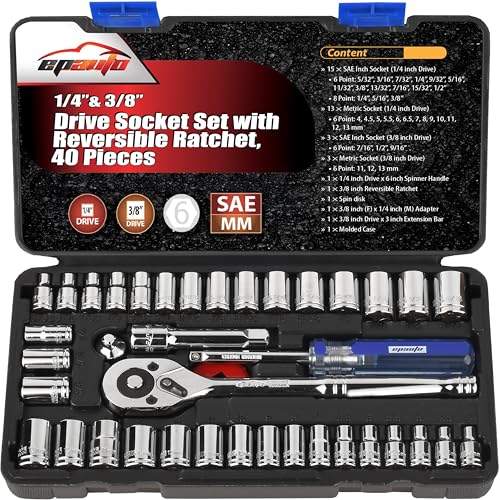 EPAuto 40 Pieces 1/4-Inch & 3/8-Inch Drive SocketOnesize10 x 5.8 x 1.8 inches2.95 poundsCheck on Amazon


Best Drive Socket Sets: Choose 1/4, 3/8, or 1/2 Inch?
The best drive socket set for most home mechanics is a 3/8-inch set with both metric and SAE sockets, a 72-tooth ratchet, and useful extensions; choose 1/4 inch for small fasteners and tight access, or 1/2 inch for larger hardware and higher-torque work. The right choice depends less on the number of pieces than on whether the drive, size range, socket type, and case suit the jobs you actually do.
Quick comparison by drive size
| Drive | Typical socket range | Ratchet size | Best for | Main trade-off |
|---|---|---|---|---|
| 1/4 inch | About 4–14 mm; 3/16–9/16 in. | 4–6 in. | Small fasteners, appliances, bicycles, interior trim | Limited leverage and capacity |
| 3/8 inch | About 6–22 mm; 1/4–7/8 in. | 7–10 in. | General automotive, household repairs, machinery | Not as compact as 1/4 or as powerful as 1/2 |
| 1/2 inch | About 10–32 mm; 3/8–1-1/4 in. | 10–16 in. | Larger fasteners, suspension work, heavy equipment | Bulky for confined spaces and small bolts |
These are common ranges, not a guarantee of what any particular kit includes. A set may cover only metric or SAE sizes, skip intermediate sizes, or include deep sockets instead of standard ones. Check the size list before buying.
As an Amazon Associate we earn from qualifying purchases at no extra cost to you.


Which drive is right for your work?
Choose 1/4 inch for small, precise jobs
The best 1/4 drive socket set is compact, has a useful spread of small sockets, and includes a short extension and a fine-tooth ratchet. It suits light assembly, small engine accessories, cabinet hardware, and fasteners in cramped spaces. Its small head can reach places a larger ratchet cannot.
Don’t use the short handle as an excuse to force a stuck bolt. Excessive torque can damage the fastener, ratchet, or socket. For tight fasteners, use the correct larger drive or a suitable breaker bar rather than adding a pipe to a small ratchet.
Choose 3/8 inch as the general-purpose set
The best 3/8 drive socket set offers the most useful balance for a home garage: a manageable ratchet, broad everyday size coverage, and enough strength for many vehicle and workshop tasks. For a first set, look for metric sockets at minimum; add SAE if you maintain older American equipment or work on mixed-standard machinery.
A practical kit includes standard and deep sockets, a 72-tooth or finer ratchet, a 3-inch and 6-inch extension, and a universal joint or wobble extension. A reversible ratchet with a low-profile head helps in crowded spaces, while a quick-release button makes socket changes easier.
Choose 1/2 inch for larger fasteners
A 1/2-inch set is the better choice for larger automotive fasteners, wheel-related work, and heavy equipment. Its larger sockets and longer ratchet provide more leverage, but that leverage can also make it easier to overtighten or break a fastener. Use a torque wrench when a job calls for a specified tightening value; a standard ratchet is not a substitute.
If you plan to use an impact wrench, buy sockets specifically marked for impact use. They are typically made from tougher, less brittle material and have thicker walls than chrome hand sockets. Do not assume a chrome socket is safe on a powered impact tool just because it fits.
How to compare sets beyond the piece count
- Size coverage: Check the actual size list and gaps. A large piece count can include many bits or accessories while omitting the sockets you need.
- Standard and deep sockets: Standard sockets fit more easily in tight spaces; deep sockets reach nuts on long studs. A mixed set is more versatile than either type alone.
- Six-point or twelve-point: Six-point sockets grip the flats of a fastener and are a sensible default for stubborn or worn hardware. Twelve-point sockets can engage a fastener at more angles, which can help where movement is limited, but require a good fit to avoid rounding.
- Ratchet teeth and access: More teeth mean a smaller swing arc between clicks, useful in tight quarters. Tooth count alone does not establish strength or smoothness, so also consider head size, handle comfort, and the ratchet’s serviceability.
- Extensions and adapters: Two useful extension lengths usually beat a handful of redundant adapters. A universal joint or wobble extension helps with angled access, but avoid using it to compensate for a socket that does not seat squarely.
- Case layout: Molded size labels and secure clips save time and make missing sockets obvious. A case that closes reliably matters more than a high piece count if the set travels between shop and job site.
Match the set to your situation
| Your situation | Best starting choice | What to prioritize |
|---|---|---|
| Occasional household repairs, limited storage | Compact 3/8-inch metric set | Common sizes, short and medium extensions, tidy case |
| Bicycles, small engines, or delicate assemblies | 1/4-inch set | Small size coverage, fine-tooth ratchet, shallow head |
| One set for home and basic automotive maintenance | 3/8-inch metric and SAE combination | Standard and deep sockets, clear markings, solid ratchet |
| Frequent large-fastener or heavy vehicle work | 1/2-inch set, plus 3/8 for smaller jobs | Impact-rated sockets if using an impact wrench; longer handle for hand work |
| Already own one drive and need to fill a gap | Add the next drive size, not another duplicate kit | Buy only the sizes and accessories your current set lacks |
Buying strategy: coverage before extras
For a first purchase, a complete 3/8-inch set is usually more useful than a mixed-drive mega-kit with thin coverage in every size. If your work is mostly small or confined, start with 1/4 inch. If you routinely deal with large fasteners, get 1/2 inch as well rather than asking a smaller drive to do that work.
General market pricing varies by brand, material, and included pieces: basic sets often fall in the tens of dollars, while larger or professional-grade kits can reach several hundred dollars. Spend for dependable ratchets, clear markings, and the right sockets before paying extra for a very high piece count. Buying a second drive later can be more economical than replacing an oversized set that does not fit your needs.
Care and ownership: what wears first
Ratchet pawls and gears are often the first parts to show wear, especially after exposure to grit or repeated overload. Clean the mechanism according to the manufacturer’s instructions and use the specified lubricant if the ratchet is designed to be serviced. A gritty ratchet may feel rough or skip under load; stop using it until it has been cleaned or repaired.
Keep sockets dry, wipe off oil and dirt, and return them to labeled slots. Corrosion and lost sizes are more likely when a set is stored loose than when it is kept in a closed case. Inspect sockets for cracks, rounded corners, or a loose fit, and replace damaged ones rather than risking a slipping tool. Finally, pull steadily on the ratchet and keep the socket fully seated; side-loading or using an extension as a lever can damage both tool and fastener.