What's inside
As an Amazon Associate I earn from qualifying purchases. This post may contain affiliate links at no extra cost to you.
Our Top Picks
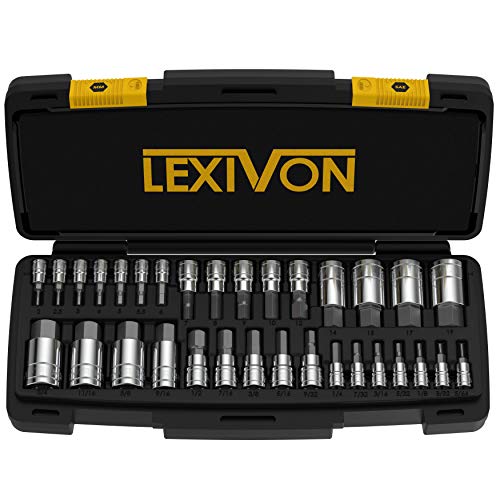


Best Hex Socket Sets: The Right Pick Depends on Your Fasteners
The best hex socket set for woodworking and shop repairs is a well-fitting, hardened bit-socket set with the sizes and drive format your fasteners actually use: choose metric for most newer equipment, SAE for inch-based hardware, and a mixed set if you regularly work on both. For repeated use, prioritize accurate bit geometry and a secure fit over the biggest piece count.
Hex bit sockets versus regular sockets
A hex bit socket has a hexagonal bit fixed into a socket body, so it fits internal-hex fasteners such as Allen bolts. It is different from a conventional socket, which fits the outside of a hex-head bolt. The two tool types are often sold together, but neither replaces the other.
As an Amazon Associate we earn from qualifying purchases at no extra cost to you.


For cabinetry, machinery, jigs, and shop fixtures, a 1/4-inch-drive hex bit socket set is often the most useful compact option. It reaches confined areas and pairs with a small ratchet or extension. A 3/8-inch-drive set is a better choice for larger fasteners or frequent work, while 1/2-inch drive is usually excessive for ordinary internal-hex screws and can make it easier to apply more force than a small fastener can tolerate.
Compare the coverage before buying
Size lists vary by manufacturer, so check the actual sizes rather than relying on “complete” or “master” in a product name. The table below shows practical coverage targets, not a claim that every set contains precisely these sizes.
| Set type | Useful coverage to look for | Drive | Best suited to |
|---|---|---|---|
| Metric compact | 2, 2.5, 3, 4, 5, 6, 8, 10 mm | 1/4 inch | Furniture hardware, shop equipment, and compact repairs |
| SAE compact | 3/32, 7/64, 1/8, 9/64, 5/32, 3/16, 7/32, 1/4 inch | 1/4 inch | Older or inch-spec machinery and fixtures |
| Mixed metric and SAE | Common small sizes from both systems; verify each size list | 1/4 or 3/8 inch | Shared shops and varied repair work |
| Extended-range metric | Typically 2–12 mm, with fewer gaps at the larger end | 3/8 inch | Frequent maintenance and larger internal-hex fasteners |
Metric and SAE sizes are close enough in a few places to tempt substitution, but “almost fits” is a common cause of rounded sockets. For instance, 5/32 inch is about 3.97 mm, close to 4 mm. That small difference can matter under load. Use the system specified for the fastener, and do not force a near-match.
Our picks by shop situation
- For a first or general-purpose set: Choose a mixed metric-and-SAE hex bit socket set if you do not yet know which standards your projects use. Favor a clearly labeled case and common sizes in both systems over a large assortment of rarely needed bits.
- For a small toolbox or occasional repairs: A compact 1/4-inch-drive metric set is often the best small socket set and best compact socket set for modern shop hardware. It takes little space and works with a small ratchet, hand driver, or bit adapter.
- For mostly inch-based equipment: Buy a dedicated SAE set with the small fractional sizes you encounter. Extra metric pieces do not compensate for a missing size you need regularly.
- For frequent work or stubborn fasteners: Step up to a reputable 3/8-inch-drive set with clearly marked sizes and hardened steel bits. The larger ratchet gives more leverage, so use it with care—small fasteners can still shear or strip.
- For a broader repair kit: The best socket tool set may combine hex bit sockets with ordinary metric or SAE sockets, extensions, and a ratchet. Check that the hex sizes are real socket bits, not just short insert bits requiring a separate holder.
What matters for fit and durability
Bit material and construction
Look for a stated alloy steel such as S2 tool steel or chrome-vanadium steel, along with a clear heat-treatment specification when available. Material names alone do not guarantee performance: heat treatment, bit geometry, and manufacturing accuracy also affect how well the tool holds up. A securely retained bit and a robust socket body are preferable to a loose bit that can wobble or pull free.
Long bits provide reach, but can flex more under heavy force. Short bits are compact and generally better supported, though they may not reach recessed hardware. If you often work inside deep holes, prioritize a set with the needed reach rather than assuming the longest option is always stronger.
Fit is the main defense against rounding
A correctly sized bit should enter the socket fully and sit snugly, with little visible rocking. Clean dirt and finish debris out of the fastener first. Press the bit straight into the socket, keep the driver aligned with the fastener, and apply steady hand force. Tilting the tool or using the wrong size concentrates force on the hex corners—the first places to deform.
For a fastener that is tight, begin with a hand ratchet rather than an impact driver. Power tools can deliver sudden torque before you notice a poor fit. If the hex recess is already rounded, a new standard bit may not solve the problem; stop before making the damage worse and use an appropriate extraction method.
A quick coverage check before you buy
Take a sample of the fasteners you use most, or check their drawings, and list the required sizes by system. Then compare that list with the set’s published contents. For example, if your regular work uses 3, 4, 5, and 6 mm screws plus 1/8, 3/16, and 1/4-inch hardware, a mixed set only makes sense if it includes all seven sizes. A set with 30 pieces can still leave a costly gap if its extra pieces are duplicates or unrelated accessories.
If the listed sizes are only in a photo or described as a range, confirm that the intermediate sizes are included. Also check whether the set uses standard-length or long-reach bits, whether it includes a ratchet, and whether its drive matches tools you already own.
Ownership: what wears first
With regular use, the bit’s working edges and the fastener recess usually show wear before the socket body does. Mis-sized bits, repeated high-torque use, and side-loading accelerate that wear. Keep bits clean and dry, wipe off oil after use, and return each piece to its labeled slot so the wrong size is less likely to get grabbed in a hurry.
Replace a bit if its corners are visibly rounded, it rocks in a clean fastener, or it no longer seats fully. Continuing with a worn bit can damage the fastener and turn a simple repair into an extraction job. For most woodworking shops, a compact 1/4-inch metric set is the sensible starting point; choose SAE or mixed coverage when your actual hardware calls for it, and move to 3/8-inch drive when larger sizes or frequent use justify the added bulk.