What's inside
As an Amazon Associate I earn from qualifying purchases. This post may contain affiliate links at no extra cost to you.
Our Top Picks

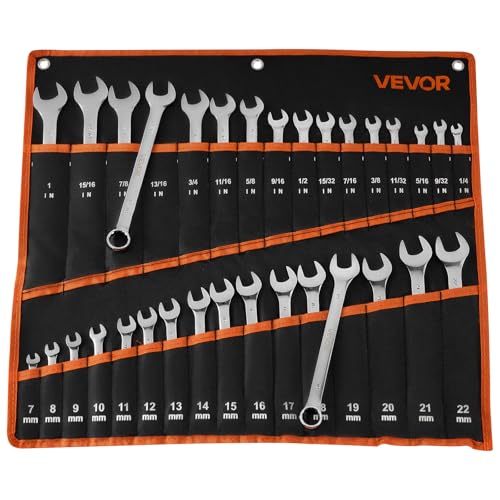


Best Combination Wrench Sets for Everyday Repairs
The best combination wrench set for most everyday repairs is a 15-piece metric set covering 8–22 mm; choose a 15-piece SAE set covering 1/4–1 in. if you mainly work on older American equipment, or a combined metric-and-SAE set if you want one purchase for a mixed garage.
A combination wrench has an open end on one side and a closed box end on the other. The box end grips more of a fastener’s corners and is less likely to slip; the open end is useful when you can’t slide a ring over the fastener or need to reposition quickly. Before buying, match the set to the hardware you actually service. More pieces don’t help if they duplicate sizes you rarely use or leave out the one your job needs.
As an Amazon Associate we earn from qualifying purchases at no extra cost to you.



Compare coverage before piece count
Metric and SAE sizes are not interchangeable, even when two sizes seem close. A 13 mm wrench, for example, is near 1/2 in. but not identical. Using the almost-right size can round a fastener, especially if it is rusty or tight. If you work on both modern vehicles and older machinery, a dual-system set avoids that guesswork.
| Set type | Typical coverage | Best fit | Trade-off |
|---|---|---|---|
| Metric, 15-piece | 8–22 mm, generally in 1 mm steps | Home repairs, appliances, many modern vehicles | Doesn’t cover SAE fasteners |
| SAE, 15-piece | 1/4–1 in., generally in 1/16 in. steps | Older American vehicles, equipment and plumbing hardware | Doesn’t cover metric fasteners |
| Metric, 22-piece | 6–27 mm, often with selected larger sizes | Frequent automotive or shop work | Costs and storage needs more; check for gaps in the size sequence |
| Dual-system, 22–30-piece | Commonly about 8–19 mm and 1/4–3/4 in. | Mixed household and garage jobs | May omit larger sizes included in dedicated sets |
These are common coverage patterns, not a promise that every set has those exact sizes. Check the size list before ordering: some sets skip less-common sizes or include duplicates in a different wrench style. A useful approach is to inspect the fasteners on your own car, bike, mower, or household equipment, then prioritize the range you use most.
Choose by where and how often you work
- Occasional home repairs: A modest metric or SAE set with a clear size range and a compact roll is usually enough. If you don’t know which system you need, a dual-system set is a practical starting point.
- Automotive work: Favor a metric set with a broad, continuous range and a slim profile for access around brackets and hoses. Add SAE separately if your vehicle or accessories use inch-size hardware.
- Frequent shop use: Look for a complete, clearly marked set in a durable rack or roll. A professional combination wrench set should also offer consistent sizing, a comfortable finish, and box ends suited to the fasteners you encounter—not just a high piece count.
- Limited storage or a mobile kit: A compact roll takes little room and travels well, though it can be slower to inventory than a rack. Avoid buying a large combined set if most of its sizes will stay unused.
Box-end design: standard, offset or ratcheting
A standard closed box end is the sensible default for general repairs. A 12-point box end engages a fastener in more positions than a 6-point end, which can help in tight spaces. However, a 6-point end makes broader contact with a compatible hex fastener and is a good choice when the fastener is tight, damaged, or prone to rounding. Some sets have different designs at each end, so read the product specifications rather than assuming every wrench is 12-point.
Offset box ends lift your hand away from a flat surface and can clear nearby obstructions. That clearance is useful, but a deep offset may make access worse in a cramped engine bay. Ratcheting box ends save time when a fastener can turn only through a small arc, but they add a moving mechanism and generally cost more. For stuck or corroded fasteners, use a properly fitting non-ratcheting wrench rather than treating a ratchet mechanism as a breaker bar.
Steel, finish and storage affect ownership
Chrome vanadium steel is common in combination wrenches and offers a practical balance for general use. Chrome-molybdenum steel appears in some heavy-duty tools. The alloy name alone doesn’t tell you how well a wrench is made: fit, heat treatment, dimensional consistency, and the manufacturer’s warranty all matter. Smooth, legible size markings are especially useful when a wrench is oily or stored in low light.
Polished chrome is easy to wipe clean and resists corrosion when maintained, but can feel slippery with oily hands. Satin or matte finishes may provide a steadier grip and hide scuffs better, though grease can be harder to remove from some surface textures. Whichever finish you choose, wipe wrenches dry before storage. Do not leave them wet with salt, coolant, or cleaning chemicals.
A molded rack keeps sizes visible and accessible on a bench; a roll is more compact and convenient for a vehicle or toolbox drawer. Check that the storage markings match the included sizes and that the largest wrenches won’t fall out when the rack is moved. A loose pile in a drawer saves the price of a holder, but makes missing tools and size mix-ups more likely.
What wears first—and how to avoid it
With ordinary use, a fixed wrench has few moving parts. The common problems are rounded fastener corners from a poor fit, a spread or damaged open jaw from misuse, and corrosion from damp storage. Ratcheting mechanisms add another wear point: dirt and lack of care can affect their smooth operation. Keep them clean and follow the maker’s maintenance guidance; don’t soak a ratcheting wrench in solvent unless its instructions permit it.
Use the exact size that fits snugly, and seat the box end fully before applying force. Pull with controlled pressure when possible, keeping your hand clear if the wrench slips. Don’t extend a wrench with a pipe or strike it with a hammer unless the manufacturer explicitly rates it for that use. For a stubborn fastener, penetrating oil, a correctly sized six-point tool, or a purpose-made breaker tool is a safer next step than overloading a small wrench.
Bottom line
For most households, a well-marked metric set covering roughly 8–22 mm is the best starting choice. Choose SAE for equipment with inch-size fasteners, or a dual-system set if your jobs genuinely mix both. For regular automotive and shop work, prioritize complete coverage, a useful box-end design, and storage that keeps the tools organized. Spend extra on ratcheting or specialty offsets only when restricted access makes those features valuable.