What's inside
As an Amazon Associate I earn from qualifying purchases. This post may contain affiliate links at no extra cost to you.
Our Top Picks
 SKIL 10" Dual Bevel Sliding Compound Miter Saw-MS6305-0010''35.43 x 22.44 x 14.17 inches39.4 poundsCheck on Amazon


The short answer
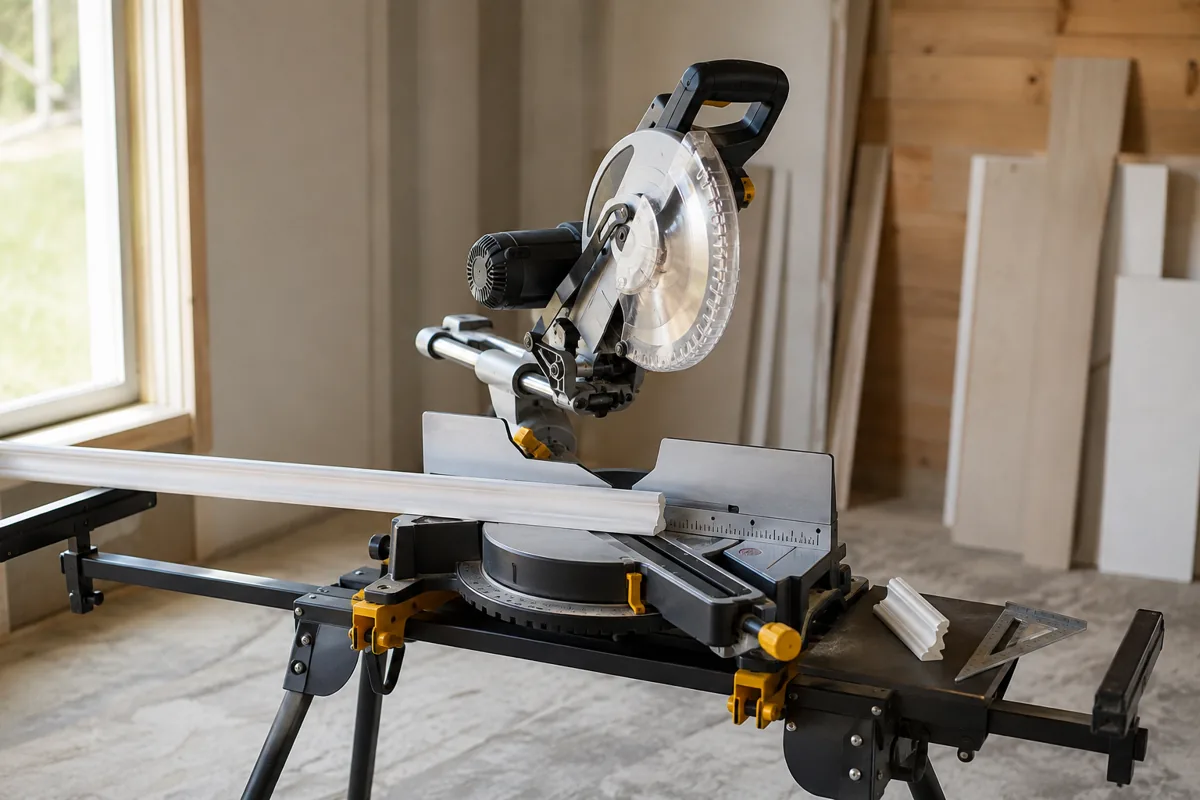
For wide baseboard, a sliding compound miter saw gives you more cutting capacity, but it is not automatically the better trim saw. A non-sliding compound saw is usually more rigid, simpler to use, and easier to keep accurate. If your baseboard is 5-1/4 inches wide or less, a quality 10-inch non-slider can be enough for most rooms. For 6-inch, 7-1/4-inch, or wider stock, a slider is the safer choice unless you plan to cut the molding flat or use a coping saw.
The important measurement is not the saw’s advertised crosscut capacity alone. You need to know how much material it can cut while the baseboard is standing against the fence, at the spring angle you intend to use. A saw may claim a 12-inch crosscut but handle significantly less molding vertically because the motor housing, fence, or bevel mechanism gets in the way.
As an Amazon Associate we earn from qualifying purchases at no extra cost to you.


How wide baseboard changes the job
Baseboard is normally installed flat against the wall, but it is often cut standing upright against the miter-saw fence. That method is fast and works well for standard profiles. Wide baseboard creates three problems:
- The board may be taller than the saw can cut vertically.
- The top edge may hit the motor or upper fence during a bevel cut.
- The molding can rock unless it is firmly supported and held at the correct spring angle.
A 5-1/4-inch baseboard is near the practical limit of many 10-inch non-sliding saws when cut vertically. A 6-inch profile may fit on some saws but not others. Once you reach 7-1/4 inches, cutting flat is often more reliable than trying to stand the board upright.
Sliding saws move the blade through the work, increasing front-to-back capacity. That helps with wide boards and lets you make some cuts flat on the table. However, sliding rails add moving parts and can introduce a slightly wider kerf path, more dust, and more opportunities for alignment problems.
Sliding compound saw vs. non-sliding saw
| Feature | Sliding compound miter saw | Non-sliding compound miter saw |
|---|---|---|
| Wide-board capacity | Higher; commonly useful for 6- to 12-inch crosscuts depending on blade size | Lower; often around 5-1/2 to 8 inches at 90 degrees, depending on model |
| Vertical baseboard cuts | Can be good, but rails and motor clearance still limit molding height | Simple and predictable when the molding fits against the fence |
| Accuracy | Good when rails are adjusted and the head is pulled straight | Usually more rigid with less movement |
| Size and weight | Heavier and deeper; needs more bench space | Smaller and easier to carry |
| Price and maintenance | Costs more; rails need cleaning and checking | Usually cheaper and simpler to maintain |
| Best use | Wide trim, shelving, flooring, framing, and general remodeling | Finish trim and normal baseboard within its vertical capacity |
When a non-slider is enough
Choose a non-sliding saw if most of your baseboard is 3-1/4 to 5-1/4 inches tall and you value clean, repeatable miters over maximum versatility. With a sharp 80-tooth or similar fine-finish blade, a non-slider can produce excellent trim cuts. Its fixed head is also less likely to deflect when you make a delicate cut at 45 degrees.
The cheaper option is fine for a one-room project, rental-property repairs, or a homeowner who only cuts standard pine, MDF, or PVC baseboard. A 10-inch non-sliding compound miter saw is often the better value when its published vertical capacity exceeds your molding height by at least 1/2 inch.
Do not rely on the saw’s scale alone. Test a scrap piece first. Set the board against the fence exactly as it will sit during installation, mark the waste side, and check that the blade clears the entire profile without forcing the head down.
When a slider is worth paying for
A slider earns its cost when you regularly cut wide baseboard, casing, shelving, stair parts, or dimensional lumber. A 10-inch slider may crosscut roughly 10 to 12 inches at 90 degrees, while a 12-inch slider may reach 12 to 14 inches or more. Actual capacity varies, so check the manual rather than trusting the blade diameter.
Use a 10-inch sliding compound miter saw when you want one saw for trim and general remodeling. It can cut wide baseboard flat, especially when the profile is too tall to stand safely against the fence. A slider is also useful for long crosscuts in shelving and 2x lumber, jobs a non-slider handles poorly.
Pay attention to rail direction. A front-rail design can sit closer to a wall, while rear rails require more clearance behind the saw. For a small shop or a workbench against a wall, that difference can matter more than an extra inch of cutting capacity.
The best way to cut wide baseboard
First, measure the actual molding height and spring angle. Mark the wall-side and floor-side edges before cutting. Support long pieces at the same height as the saw table; an unsupported 8-foot board can lift or rotate and ruin an otherwise accurate cut.
If the board fits vertically, clamp it against the fence and use a stop block for repeated pieces. Keep your hands at least 6 inches from the blade and let the blade reach full speed before entering the wood.
If it does not fit vertically, lay it flat and use the saw’s bevel and miter settings. This requires calculating the compound angle, so make a test cut on scrap. An alternative is to cut slightly proud and cope the inside corners with a coping saw for wood trim. Coping hides out-of-square inside corners better than trying to make two perfect miters.
Which saw should you buy?
Buy the non-slider if your molding fits vertically, your projects are mostly finish trim, and you want the lowest cost and simplest setup. Buy the slider if you need to cut 6-inch-plus baseboard flat, want one saw for multiple remodeling tasks, or regularly work with wide boards.
Before purchasing, compare vertical nested capacity, bevel range, fence height, front-to-back depth, and the availability of a fine-finish blade. Those specifications matter more for baseboard than the biggest headline crosscut number.