What's inside
As an Amazon Associate I earn from qualifying purchases. This post may contain affiliate links at no extra cost to you.
Our Top Picks


What matters when cutting long baseboards
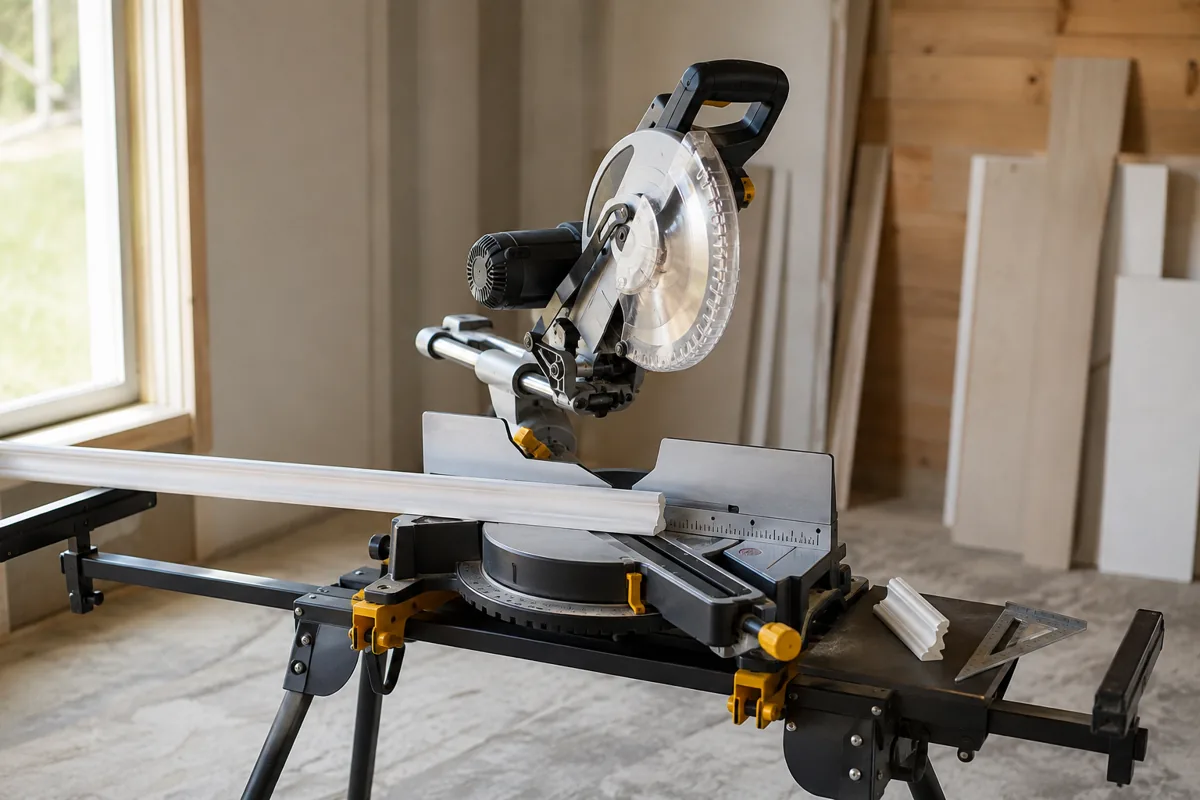
A miter saw stand for baseboards has two jobs: hold the saw securely and keep the board supported at the same height as the saw table. On uneven ground, the second job is easy to get wrong. A board that sags or twists can change the cut angle, pinch the blade, or lift off a support roller. A stand’s advertised weight capacity does not tell you whether it will support a 12-foot molding cleanly across a lumpy driveway.
For most trim work, look for adjustable support arms with broad rollers or material supports, a rigid center section, and feet that can be leveled independently. Extension length matters too: a stand that reaches 8 feet in total may still leave a 12-foot board poorly supported unless you add a separate stand or have a helper hold the far end.
As an Amazon Associate we earn from qualifying purchases at no extra cost to you.


Stand types and trade-offs
Folding rail stands are light and quick to move, but their long support rails can flex under a heavy board if extended far from the center. Scissor-style stands usually fold compactly and can be stable on flat concrete; uneven ground can make their fixed-width feet rock. Gravity-rise stands are convenient for frequent setup and teardown, though they are heavier and can be awkward to position on sloped or irregular surfaces. Dedicated saw horses with a straight support plank are the simplest low-cost approach, but take more setup to get level with the saw.
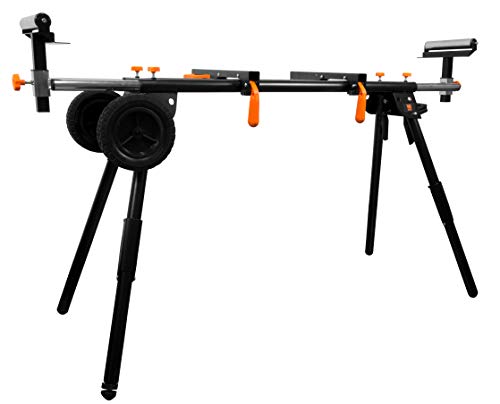
A miter saw stand with adjustable roller supports is a practical starting point for long molding. Rollers help feed stock, but they must be aligned with the saw table and should not be the only support under a flexible board. Flat support wings or a sacrificial plank are often better for narrow, profiled trim that can tip on a roller.
Quick comparison
| Support option | Best for | Uneven-ground performance | Main drawback |
|---|---|---|---|
| Folding rail stand | Portable jobsite use | Good if feet adjust and the frame is braced | Long extensions can flex |
| Gravity-rise stand | Frequent setup with a heavier saw | Fair; level each foot and check for rocking | Heavy and bulky |
| Roller stand | Feeding long, straight stock | Fair; a small height error can steer the board | Can let narrow trim roll or twist |
| Saw horses and a plank | Occasional cuts on a tight budget | Good when individually shimmed | Slower to set up and less compact |
Setting up on uneven ground
First place the stand on the firmest patch available, with the saw close to the center of the frame. Check for rocking before mounting the saw; a loose shim under one foot can shift during a cut. Use stable, non-slip shims or adjustable feet rather than stacking scraps loosely. On a noticeable slope, rotate the stand so its wider, more stable direction faces the slope where practical.
Next, set each support to the exact height of the saw table. A support that is even 1/8 inch too high can push a long baseboard upward; one that is too low lets the board sag. Lay a straight board across the table and the support, then adjust until it sits without rocking or bending. Repeat on both sides if the stand has supports at each end.
For a 12-foot board, support it near the saw and again toward the far end rather than relying on one extended arm. A second stand, a stable workbench, or a helper can carry that end. Keep supports close enough that the board cannot droop substantially between them. Do not use a roller as a stop: it is meant to let material move, not hold a repeatable cut length.
What to buy for your situation
If you move between rooms or jobsites, choose a folding stand with independent height adjustment and support arms that lock firmly. Check the maximum supported length and the actual support surface, not just the headline load rating. A stand rated for several hundred pounds may still be unsuitable if its arms twist when extended or its rollers are too narrow for your molding.
For regular finish work, broad, flat supports are usually more controlled than rollers. A stand with flat material supports helps keep narrow baseboard from turning on edge. If the stand you own has rollers, a straight, flat sacrificial board across the supports can create a wider bearing surface. Secure it so it cannot slide, and make sure it does not interfere with the saw or blade.
The inexpensive option is fine for occasional work: two sturdy saw horses and a straight plank can support long trim well, provided you level the plank to the saw and prevent it from shifting. This takes more measuring and is less convenient to carry. Avoid lightweight, unbraced stands on soft soil, and do not compensate for a wobbly setup by pressing harder on the board.
Avoiding bad cuts and unsafe support
Before cutting, check that the baseboard lies flat against the fence and table, with the waste piece supported too. Long molding can bow naturally; forcing it straight against the fence may release that bend after the cut and leave a gap at the joint. Mark the cut, dry-fit the piece, and use a stop only when the stock is straight and the stop cannot trap it.
Watch for three warning signs: the board rocks on the saw table, an extension arm moves under hand pressure, or the workpiece lifts as the blade enters. Stop and reset the supports. Keep hands away from the blade path, wait for the blade to stop before lifting the saw head, and never reach across a spinning blade to catch an offcut. A stable setup is more valuable than a stand with the longest advertised extension: for long baseboards on rough ground, independent leveling and a second support point are what prevent sag, twist, and spoiled cuts.