What's inside
As an Amazon Associate I earn from qualifying purchases. This post may contain affiliate links at no extra cost to you.
For a large, clean hole in a cabinet side panel, a hole saw is usually the safer choice. A self-feed bit is faster in thick solid wood, but its aggressive screw tip can grab thin sheet goods, chip the face, or pull the drill off line. The right tool depends on the panel material, hole diameter, and whether the cut will show.
As an Amazon Associate we earn from qualifying purchases at no extra cost to you.



Start with the panel material
Cabinet sides are commonly 5/8- or 3/4-inch plywood, particleboard, or MDF, often with a veneer or laminate face. These materials are not the same as a thick framing stud. A self-feed bit is built to bite hard and clear chips quickly in wood; in a thin cabinet panel, that bite can become a liability. The screw tip may pull the bit through before you can control the feed, especially with a high-torque drill.
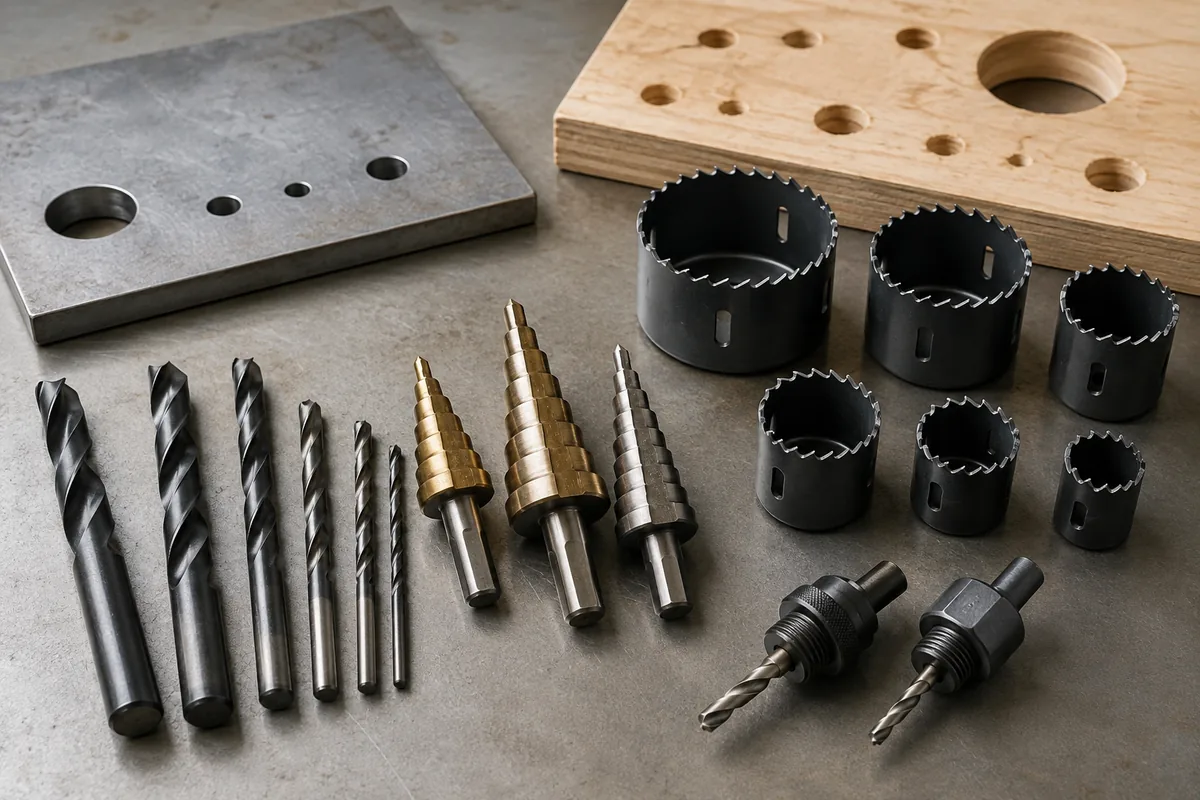
A hole saw cuts around the perimeter rather than removing the whole disk as chips. It is slower, but typically gives you more control in sheet goods. With a pilot bit and a backing board, it can make a tidy opening for pipe, wiring, or a vent. For a visible hole in veneered or laminated stock, use a sharp saw and test on scrap from the same material if possible.
Self-feed bit vs. hole saw
| Factor | Self-feed bit | Hole saw |
|---|---|---|
| Best use | Fast holes in thick, solid wood | Large openings in plywood, MDF, particleboard, and thin panels |
| Typical control | Aggressive; screw tip pulls into the work | More gradual, though teeth can still catch |
| Cutting action | Removes most of the material inside the diameter | Cuts a narrow ring and leaves a center plug |
| Finish on panel faces | More risk of breakout and tear-out | Better with a backing board and cutting from both sides |
| Chip and plug handling | Produces substantial chips | Plug can bind inside the cup and needs clearing |
| Cost and flexibility | Often economical for repeated wood holes in one size | Arbor and interchangeable cups cover multiple diameters |
When a self-feed bit makes sense
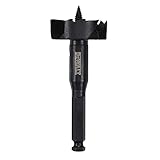
Choose a self-feed bit when the panel is actually thick solid wood, the hole is large enough to justify its speed, and the back face is hidden or can be backed up. It is useful for repeated rough openings through framing lumber or solid-wood components. A common range for these bits is roughly 1 to 4 inches, but check the drill’s capacity and the bit manufacturer’s limits before buying.
The main failure mode is a sudden grab. The center screw can pull the bit into the panel, twisting a small drill or your wrist. Use a side handle, keep both hands on the drill, clamp the work, and select low speed. If the drill stalls or the bit binds, release the trigger rather than forcing it. For cabinet sheet goods, the risk of a ragged exit face usually outweighs the speed advantage. A self-feed wood drill bit is worth considering for solid stock, not as a default cabinet-panel cutter.
When a hole saw is the better buy
For most large holes in cabinet sides, start with a hole saw sized to the fitting or clearance needed. Cup diameters commonly run from about 1 to 6 inches, depending on the system. A standard bi-metal saw is adequate for many wood and wood-composite panels; carbide-tipped versions can last longer in abrasive materials, but cost more. Avoid buying a large kit if you need one opening: a single cup and compatible arbor may be cheaper.
Hole saws are not foolproof. Teeth can catch on a knot, laminate edge, or uneven feed, and a jam can twist the drill. At larger diameters, use a drill with a side handle and low speed. Clear packed dust and the center plug before they overheat the cup. If you need a particular diameter, check the saw’s actual cutting size rather than assuming a nominal size matches the opening exactly. A bi-metal hole saw with arbor is a practical starting point for occasional cabinet work.
How to avoid tear-out
Mark the center carefully, then clamp a sacrificial board tightly against the exit face. The backing board supports the fibers as the teeth break through. On a finished cabinet side where both faces matter, drill partway from one side until the pilot bit just emerges, then finish from the other side using that pilot hole to align the saw. This reduces breakout, though it requires access to both sides.
Keep the drill square to the panel. A tilted cup makes an uneven opening and can bind as more teeth engage. Let the teeth cut without leaning heavily on the drill. If the panel is already installed, confirm what is behind it before drilling: a wire, pipe, shelf pin, or cabinet contents can turn a simple hole into a repair. Masking tape over the cut line may help limit surface scuffing, but it does not replace a backing board or careful cutting.
What to buy for your job
For one hole in 5/8- or 3/4-inch MDF, particleboard, or plywood, buy or borrow a hole saw in the required diameter. If the edge will be visible, prioritize a sharp cutter and backing support; for laminate, test the setup on scrap first. If the opening is hidden behind a pipe escutcheon or inside a cabinet, a basic hole saw is often enough. The cheaper option is fine when the hole is concealed and you do not expect to reuse the cutter often.
Buy a self-feed bit only when you regularly cut large holes in thick solid wood and have a drill suited to the torque. For a cabinet-panel cut, its faster feed rarely compensates for the increased chance of grabbing or damaging the exit face. If the hole is larger than your available saw, or needs a particularly clean edge in finished material, consider a router template or jigsaw instead of pushing an unsuitable bit past its limits.