What's inside
As an Amazon Associate I earn from qualifying purchases. This post may contain affiliate links at no extra cost to you.
Our Top Picks
 Klein Tools 935DAG Digital Electronic Level and AngleLevel2.36 x 2.2 x 1.2 inches0.2 PoundsCheck on Amazon
 Klein Tools 935DAGL Digital Level Angle Finder withOne Size4.57 x 2.48 x 1.36 inches0.37 poundsCheck on Amazon


What you need to measure
Roof pitch is the roof’s rise over a 12-inch horizontal run. A roof that rises 6 inches for every 12 inches of run is called a 6-in-12 pitch. In a tight attic, the challenge is getting a reliable angle reading without holding a long level against a rafter or contorting yourself around insulation, wiring, and framing.
A digital angle finder can help, but it measures an angle—not pitch directly. Most read degrees, so you need to translate the result if you want a rise-in-12 figure. For example, a rafter angle of about 26.6 degrees corresponds to a 6-in-12 pitch. A tool that displays both degrees and pitch can save a calculation, but it is not essential.
As an Amazon Associate we earn from qualifying purchases at no extra cost to you.


Best choice for a tight attic
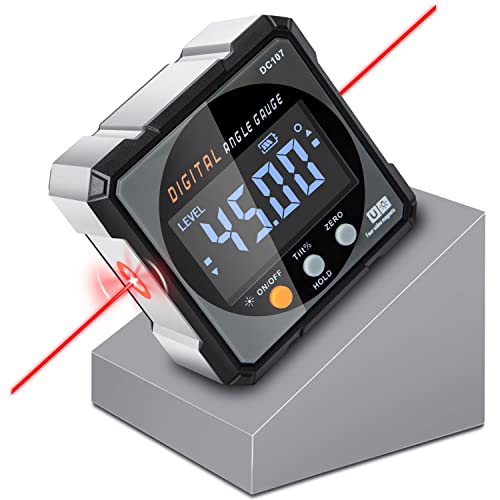
For most attic measurements, look for a compact digital angle finder with a magnetic base, a clear display, and a way to zero the reading. A magnetic tool can stay on an exposed steel surface, but most roof rafters are wood; the magnet will not hold there. On wood, you still need to seat the tool firmly against a clean, straight rafter face and keep it from shifting while you read it.
A compact angle cube is easier to maneuver in a cramped space than a long digital level. Its trade-off is a shorter measuring surface: a small tool is more sensitive to rough lumber, knots, and your hand position. If the rafter face is uneven, take several readings along a straight section and compare them rather than trusting one number.
Browse digital angle finders with magnetic bases if you want a small tool for this kind of work. Check the listed measuring range, display orientation, and whether the unit can be zeroed; features vary, and a magnetic base alone does not make it suitable for a wood rafter.
Angle finder options compared
| Tool type | Best for | Limit in a tight attic | Typical trade-off |
|---|---|---|---|
| Compact digital angle finder | Quick readings on a rafter or other accessible surface | Short base can rock on rough or warped lumber | Easy to fit into small spaces; readings depend on careful placement |
| Digital level | Checking a longer stretch of framing | May be awkward to position between rafters and roof sheathing | Longer contact surface can average small bumps, but takes more room |
| Phone inclinometer app | Occasional checks when you already own a suitable phone | Phone may not sit flat; case and camera bump can interfere | Cheapest option, but calibration and contact can be less dependable |
| Speed square | Estimating pitch or marking framing angles | Needs a usable edge and a clear way to register against the rafter | Durable and inexpensive, but not a digital readout |
A digital level or inclinometer is a better fit if you also want to check longer framing runs or do layout work outside the attic. If roof pitch is a one-time measurement and you have a straight speed square, buying a digital tool may not be worth it.
How to measure pitch in the attic
First, find an exposed rafter with a reasonably straight face. Avoid measuring on roof sheathing, a ceiling joist, or a framing member whose orientation is not parallel to the roof slope. Clear loose insulation from the contact area without disturbing electrical wiring or blocking ventilation.
Turn on the finder and check its instructions for calibration. If it has a zero function, place it on a known level reference and zero it before measuring. Then hold the base flat against the rafter face, with the tool’s measuring axis running along the slope. Keep your hand pressure steady and wait for the display to settle. Take a second reading nearby. A difference of a degree or two can come from rough wood or placement, not a sudden change in the roof.
For a degree reading, convert it to rise per 12 inches with this calculation: 12 × tan(angle). At 26.6 degrees, that is approximately 6 inches of rise per 12 inches of run. A phone calculator with a tangent function can do the conversion, but check that it is set to degrees, not radians. If you only need to identify a common pitch, a printed conversion chart is less error-prone than doing the math in a cramped attic.
What can throw off the reading
Dirty contact surfaces, bowed rafters, and a tool that rocks on a knot can all produce misleading numbers. So can reading a rafter that is twisted or not aligned with the roof plane. If the attic is too cramped to place the tool flat, do not force a reading from a corner or an unstable grip; move to a more accessible section or use a longer tool only if it can sit securely.
Digital angle finders also have resolution and accuracy limits. A display that changes in 0.1-degree steps does not guarantee 0.1-degree accuracy. For estimating roof pitch, a repeatable reading within about a degree is often adequate; for cutting or fitting work, verify against the actual framing and take more than one measurement.
Keep the tool away from wet insulation and loose debris, and do not lean on rafters or ceiling joists while reaching. In a low attic, a second person can help pass tools and record readings, but should not stand on unsupported ceiling material.
What to buy—and when to skip it
Choose a compact finder when access is the main problem and you expect to measure several rafters or use the tool for other layout tasks. Prioritize a readable screen from awkward angles, a solid flat base, simple zeroing, and a stated accuracy specification. A backlit display is useful in a dark attic; a magnetic base is a bonus for metal, not a substitute for stable contact on wood.
A basic speed square is fine for rough pitch identification if you can seat it consistently and only need a common framing estimate. A phone app can also work for a casual check, provided you remove a bulky case, calibrate the phone, and compare repeated readings. Neither is a good excuse to trust a single measurement when the result affects material ordering or a close-fitting repair.
If you want a non-digital backup for framing layout, compare framing speed squares. For a tight attic and repeated measurements, a compact digital angle finder is usually the more convenient buy; for one rough estimate, the cheaper tool you already own may be enough.