What's inside
As an Amazon Associate I earn from qualifying purchases. This post may contain affiliate links at no extra cost to you.
Our Top Picks
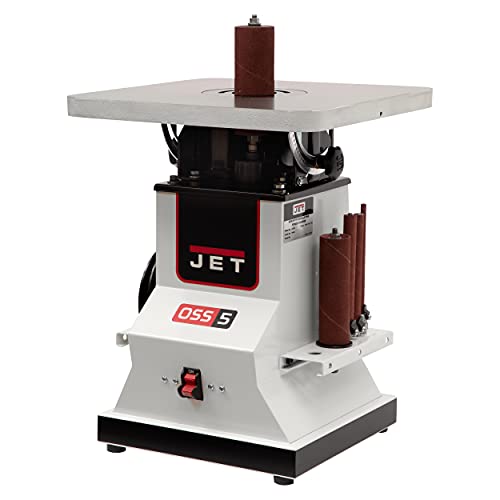
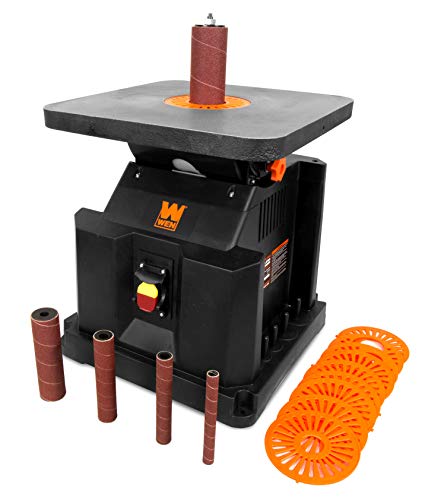 WEN AT6535 3.5-Amp Oscillating Spindle Sander with Extra14.75 x 14.75 x 16.75 inches33.2 poundsCheck on Amazon
Which Sander Fits the Job?
For curved cabinet parts, an oscillating spindle sander is usually the better first purchase. It is designed to smooth concave edges, cutouts, arches, and irregular profiles while keeping the sanding sleeve moving up and down. That movement reduces burning and extends sleeve life.
A drum sander is a different tool. It sands broad, mostly flat surfaces with a rotating abrasive drum. It is excellent for bringing cabinet doors, panels, and glued-up parts to a consistent thickness, but it does not naturally follow a curved edge. A drum sander can help with curved work when the part is supported by a carefully made carrier or fixture, but that is a specialized setup rather than its normal use.
As an Amazon Associate we earn from qualifying purchases at no extra cost to you.

If your project involves occasional rounded corners or small inside curves, the cheaper option may be enough: a drill-mounted sanding drum or a set of abrasive rolls can handle a few parts. For repeated curved cabinet work, however, a dedicated oscillating spindle sander saves time and produces more consistent results.
How the Tools Work
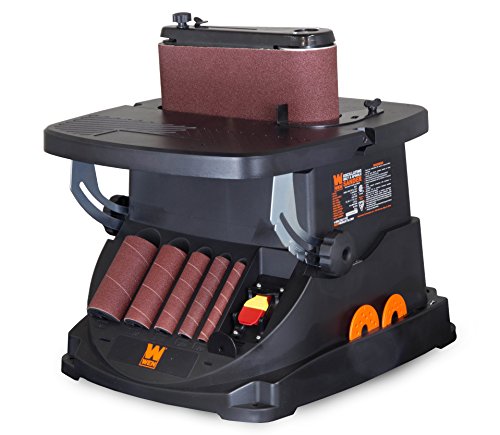
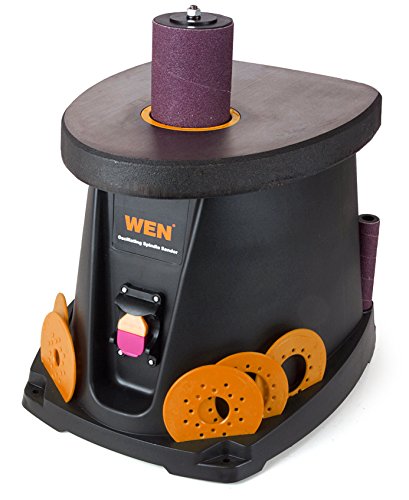
An oscillating spindle sander uses cylindrical sleeves, commonly 1/2, 3/4, 1, 1-1/2, and 2 inches in diameter. The spindle rotates and usually oscillates through roughly 5/8 to 1-1/2 inches of vertical travel, depending on the machine. You guide the workpiece against a flat table and around the sleeve.
The spindle diameter sets the tightest practical inside radius. A 1/2-inch sleeve can reach a tighter concave curve than a 2-inch sleeve, though the smallest sleeves remove material more slowly. The sanding action works well on plywood, solid wood, and MDF, provided you feed the part steadily and keep it flat on the table.
A drum sander pulls material beneath a wide abrasive drum. The drum may be 18 to 37 inches wide on shop machines, while benchtop models are often around 16 to 22 inches. You set a shallow cut, feed the board through, and make repeated passes until the surface is even. It removes thickness accurately, but the workpiece must have a stable, reasonably flat reference surface.
Head-to-Head Comparison
| Factor | Oscillating spindle sander | Drum sander |
|---|---|---|
| Best curved feature | Concave edges, arches, and cutouts | Broad surfaces with shallow curves or controlled fixtures |
| Typical workpiece position | Standing or moving on a flat table around the spindle | Fed horizontally under a rotating drum |
| Material removal | Moderate; excellent for edge shaping | Fast and even across flat panels |
| Accuracy | Depends on hand control and a reference template | Good thickness consistency on flat stock |
| Common failure | Tilting the part, creating a bevel or uneven radius | Sniping, gouging, or feeding an unstable curved part |
| Dust collection | Useful but often imperfect around open edges | Essential; produces a large volume of fine dust |
| Typical cost | Lower, especially for benchtop models | Higher, with more space and electrical demands |
How Each Tool Handles Cabinet Curves
For an inside corner on a curved cabinet side, the spindle sander is straightforward. Cut close to the line with a jigsaw or bandsaw, leaving about 1/16 inch of waste, then sand down to the layout line. Keep the piece moving. Holding it in one spot can create a hollow or enlarge one section of the curve.
Use the largest sleeve that fits the radius. It removes material faster and is less likely to dig into the edge. Change to a smaller sleeve only where the curve tightens. A template bearing bit in a router can produce a more exact profile before sanding, but the spindle sander is safer for refining a rough cut and cleaning saw marks.
A drum sander is useful when the curved cabinet part is a laminated blank that must be made uniform in thickness before shaping. For example, a glued-up curved door blank can be sanded on its flat faces before the final edge profile is cut. It is also useful for sanding thin veneer or solid-wood strips flat, assuming they are supported properly.
Do not simply feed a narrow, bowed, or rocking curved part through a drum sander. The drum can grab the high point, stall the machine, or press the workpiece into the abrasive unevenly. The result may be a deep gouge or a part that is thinner at one end. A carrier board can solve some of these problems, but it must be rigid, flat, and wide enough to remain stable through the machine.
Finish Quality and Speed
Spindle sanding is slower for large surfaces but fast for edge cleanup. On a 3/4-inch plywood cabinet side with a 12-inch inside radius, removing the final 1/16 inch typically takes only a few controlled passes. The final finish depends heavily on the abrasive. Start around 80 grit for saw marks, then use 120 or 150 grit. Going straight to fine paper often polishes the high spots while leaving low spots untouched.
Drum sanding is much faster for flattening panels, but it is not a replacement for a thickness planer. A drum sander usually removes only about 1/64 inch or less per pass on hardwood, and heavy cuts can overload a benchtop machine. Several light passes give better results. Finish with a final pass at the same setting from the opposite direction if the machine and workpiece allow it.
On both machines, abrasive loading is a practical concern with resinous wood, paint, and some MDF. A loaded sleeve or drum runs hotter and cuts poorly. Clean or replace abrasive when it begins burnishing instead of producing fresh dust.
What to Buy for a Small Shop
Choose an oscillating spindle sander if your cabinet work includes face-frame arches, sink cutouts, curved shelves, radius corners, or irregular plywood profiles. Look for a table that stays flat, several spindle sizes, an easy-to-use dust port, and a motor around 1/2 to 1 horsepower. A tilting table is helpful but not essential for ordinary cabinet curves.
Choose a drum sander if your priority is flattening wide glue-ups, calibrating door blanks, or sanding many flat parts to the same thickness. A benchtop benchtop drum sander is adequate for cabinet components up to its stated width, but check the minimum and maximum thickness before buying. Machines that accept open-ended passes are more flexible for wide panels.
If you need both capabilities but only build a few cabinets each year, buy the spindle sander first and use a router, sanding block, or local shop service for flat-panel thickness work. A drum sander earns its floor space when you routinely process multiple panels or need controlled thickness on veneer and solid wood.
Avoiding Damage and Injury
Wear eye protection and connect dust collection whenever possible. Keep fingers away from the sleeve, especially when sanding small parts. Use a push block or hold-down for narrow pieces, and never sand a part that cannot sit securely on the table.
Mark the waste side of every curved cut. The most common spindle-sander mistake is removing too much material at one end while chasing a pencil line. Stop frequently, compare the part with the template, and leave the final 1/32 inch for careful blending. With a drum sander, measure the part at several points after each pass; a seemingly flat carrier or panel can still hide a taper.